

Sunday, July 26, 2026
Science
No Result
View All Result
  • Login
  • HOME
  • SCIENCE NEWS
  • CONTACT US
  • HOME
  • SCIENCE NEWS
  • CONTACT US
No Result
View All Result
Scienmag
No Result
View All Result
Home Science News Medicine

Recycling US food waste cuts climate and nutrient pollution, but risks soil plastic buildup

July 26, 2026
in Medicine
Reading Time: 2 mins read
0
Recycling US food waste cuts climate and nutrient pollution, but risks soil plastic buildup

Recycling US food waste cuts climate and nutrient pollution, but risks soil plastic buildup

65
SHARES
587
VIEWS
Share on FacebookShare on Twitter
ADVERTISEMENT

Diverting household and commercial food scraps from landfills toward composting and anaerobic digestion can cut greenhouse-gas emissions and support a circular bioeconomy. But the transition isn’t automatically clean: recycling can shift pollution pathways by altering nutrient runoff into waterways and by carrying contamination—especially plastic packaging—into soil. Now, a new US-wide analysis uses integrated mass-balance modelling alongside life cycle assessment (LCA) to quantify both the gains and the risks of “organics recycling” at national scale.

The study compares today’s landfill-dominant food-waste system with hypothetical future scenarios that expand composting and anaerobic digestion. Researchers track where key outputs go—methane emissions avoided when waste is prevented from decomposing anaerobically in landfills, and where nitrogen (N) and phosphorus (P) ultimately end up once digestate and compost are land-applied. They also model plastic movement through recycling streams, focusing on whether packaging plastics could accumulate in agricultural soils over time.

Results indicate a dramatic climate advantage. Nationwide implementation of organics recycling could reduce the climate impact of US food-waste management by an estimated 89–99% compared with current landfill-dominant practices. The magnitude reflects both reduced landfill methane and the altered energy and materials balance captured by LCA.

The nutrient picture is more nuanced but still strongly improved overall. Relative to current practice, organics recycling could lower associated nitrogen loading to downstream waterways by roughly 49–54%. Phosphorus loading would fall even more sharply, by about 78–98%, suggesting that shifting treatment away from landfilling changes nutrient transport and bioavailability along the food-waste-to-water chain.

Yet environmental caution remains. The modelling suggests that land application of food-waste-derived composts and digestates would offset less than 2% of annual US mineral nitrogen and phosphorus fertilizer consumption. In other words, the agronomic substitution benefit is limited, even though recycled products could meaningfully change runoff patterns.

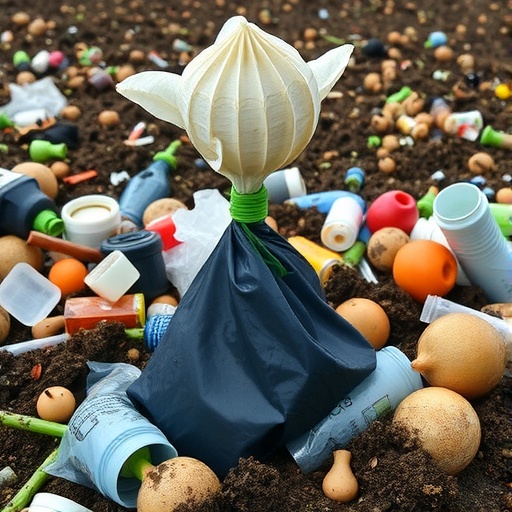
The most viral warning concerns plastics. Without innovations that redesign food packaging to reduce plastic leakage and contamination in recycling inputs, the analysis estimates plastic releases of around 20,000 tonnes per year into US agricultural soils. That quantity could represent a long-term accumulation risk, especially for persistent polymers that escape pre-treatment sorting.

Together, the findings frame organics recycling as a climate and nutrient pollution winner with a contingency plan: nutrient impacts improve, but soil plastic burdens may rise unless contamination is engineered out of the system. The study underscores that “circular” only holds when waste management, product design, and agricultural pathways are aligned.

Subject of Research: Food waste recycling in the USA; climate, nutrient pollution, and plastic contamination risks
Article Title: Food waste recycling in the USA can reduce climate and nutrient pollution impacts yet risks plastic accumulation in soils.
Article References: Porterfield, K.K., Schambura, M.N. & Roy, E.D. Food waste recycling in the USA can reduce climate and nutrient pollution impacts yet risks plastic accumulation in soils. Nat Food (2026). https://doi.org/10.1038/s43016-026-01396-z
Image Credits: AI Generated
DOI: https://doi.org/10.1038/s43016-026-01396-z
Keywords:

Tags: circular bioeconomyclimate benefits of organics recyclingcomposting and anaerobic digestionFood waste recyclingimpact of food waste diversionlandfill methane emissions reductionlife cycle assessment of food waste managementnutrient cycling and pollution pathwaysnutrient runoff from compostingplastic contamination in soilssoil plastic accumulation risksUS food waste management scenarios
Share26Tweet16
Previous Post

Pathology-CoT Trains Visual Chain-of-Thought Agents Using Expert Whole-Slide Diagnoses

Next Post

Tutorial Explains How to Use Large Language Models in Medical Research

Related Posts

Genome-wide screen finds host-targeted drugs and SARS-CoV-2 pro-viral pathways
Medicine

Genome-wide screen finds host-targeted drugs and SARS-CoV-2 pro-viral pathways

July 26, 2026
Randomized Trial Tests Advance Care Planning and Coordination for Parkinsonism Patients
Medicine

Randomized Trial Tests Advance Care Planning and Coordination for Parkinsonism Patients

July 26, 2026
Cannabidiol–Albumin Nanoparticles Boost Brain Delivery and Protect Neurons in Alzheimer’s
Medicine

Cannabidiol–Albumin Nanoparticles Boost Brain Delivery and Protect Neurons in Alzheimer’s

July 26, 2026
Recurrent Pleural Effusion Case Highlights Diagnostic Challenge Between TB and Other Causes
Medicine

Recurrent Pleural Effusion Case Highlights Diagnostic Challenge Between TB and Other Causes

July 26, 2026
Titanium Dioxide Disrupts Intestinal Metabolism, Revealed by Metabolomics and Transcriptomics
Medicine

Titanium Dioxide Disrupts Intestinal Metabolism, Revealed by Metabolomics and Transcriptomics

July 26, 2026
4D Cardiac Nucleome Maps Nuclear and Chromatin Dynamics in Health and Aging
Medicine

4D Cardiac Nucleome Maps Nuclear and Chromatin Dynamics in Health and Aging

July 26, 2026
Next Post
Tutorial Explains How to Use Large Language Models in Medical Research

Tutorial Explains How to Use Large Language Models in Medical Research

  • Mothers who receive childcare support from maternal grandparents show more

    Mothers who receive childcare support from maternal grandparents show more parental warmth, finds NTU Singapore study

    27656 shares
    Share 11059 Tweet 6912
  • University of Seville Breaks 120-Year-Old Mystery, Revises a Key Einstein Concept

    1061 shares
    Share 424 Tweet 265
  • Bee body mass, pathogens and local climate influence heat tolerance

    682 shares
    Share 273 Tweet 171
  • Researchers record first-ever images and data of a shark experiencing a boat strike

    546 shares
    Share 218 Tweet 137
  • Groundbreaking Clinical Trial Reveals Lubiprostone Enhances Kidney Function

    531 shares
    Share 212 Tweet 133
Science

Embark on a thrilling journey of discovery with Scienmag.com—your ultimate source for cutting-edge breakthroughs. Immerse yourself in a world where curiosity knows no limits and tomorrow’s possibilities become today’s reality!

RECENT NEWS

  • Advances Toward Liquid Biopsy Profiling of Antitumor Immune Responses
  • Civil Additive Manufacturing: Foundations and Frontiers Shaping Modern Construction
  • Spatial planning boosts sustainability by restructuring land use, new study finds
  • Adaptive Grid-Scale Irrigation System Enhances Rice Yields Amid Climate Swings

Categories

  • Agriculture
  • Anthropology
  • Archaeology
  • Athmospheric
  • Biology
  • Biotechnology
  • Blog
  • Bussines
  • Cancer
  • Chemistry
  • Climate
  • Earth Science
  • Editorial Policy
  • Marine
  • Mathematics
  • Medicine
  • Pediatry
  • Policy
  • Psychology & Psychiatry
  • Science Education
  • Social Science
  • Space
  • Technology and Engineering

Subscribe to Blog via Email

Enter your email address to subscribe to this blog and receive notifications of new posts by email.

Join 5,146 other subscribers

© 2025 Scienmag - Science Magazine

Welcome Back!

Login to your account below

Forgotten Password?

Retrieve your password

Please enter your username or email address to reset your password.

Log In
No Result
View All Result
  • HOME
  • SCIENCE NEWS
  • CONTACT US

© 2025 Scienmag - Science Magazine

Discover more from Science

Subscribe now to keep reading and get access to the full archive.

Continue reading
