

Saturday, July 18, 2026
Science
No Result
View All Result
  • Login
  • HOME
  • SCIENCE NEWS
  • CONTACT US
  • HOME
  • SCIENCE NEWS
  • CONTACT US
No Result
View All Result
Scienmag
No Result
View All Result
Home Science News Technology and Engineering

Noninvasive Acoustic Assessment of Feeding Skills in Preterm Infants With BPD

July 18, 2026
in Technology and Engineering
Reading Time: 2 mins read
0
Noninvasive Acoustic Assessment of Feeding Skills in Preterm Infants With BPD

Noninvasive Acoustic Assessment of Feeding Skills in Preterm Infants With BPD

65
SHARES
587
VIEWS
Share on FacebookShare on Twitter
ADVERTISEMENT

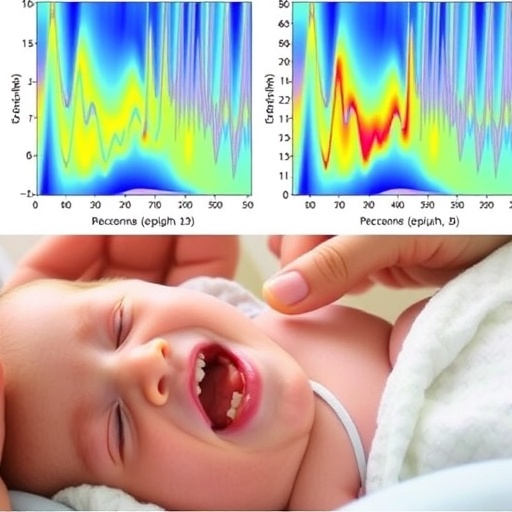
Oral feeding problems are a frequent, often hidden challenge in infants born preterm who develop bronchopulmonary dysplasia (BPD). These difficulties can prolong hospital stays by delaying safe, efficient feeding and complicating swallowing–breathing coordination. Now, a new study reports a bedside approach that aims to measure oral feeding skills without touch or invasive sensors, using acoustic signals collected in real time.

Researchers Bozkurt, Ecevit, and Gunlemez focused on oral feeding skills (OFS) and the timing relationship between swallowing and respiration. In BPD, respiratory vulnerability makes coordination especially critical: aspiration risk rises when airflow and swallowing rhythms become poorly synchronized.

The team employed a noninvasive, signal-based device designed for bedside monitoring. Rather than relying on labor-intensive assessments or imaging, the system captures sound patterns associated with feeding-related events. From these acoustic traces, the researchers derived quantitative features intended to reflect how effectively infants transition between sucking, swallowing, and breathing.

A key technical goal was to evaluate swallow–respiration coordination. The device identifies temporal relationships between feeding-generated acoustics and respiratory cues, then summarizes these relationships into metrics linked to coordination quality. The study therefore goes beyond “can the infant feed?” to ask “how well are feeding and breathing coupled?”

To support clinical relevance, the measurements were conducted in an infant-friendly setting. This matters because conventional evaluations can be disruptive, require specialized equipment, or involve additional procedures that are difficult to repeat frequently in preterm populations.

The results indicate that acoustic monitoring can detect differences in OFS and coordination among infants with BPD. Such signal-derived markers could help clinicians adjust feeding strategies earlier, potentially reducing delays in achieving oral feeding readiness and improving discharge timelines.

Importantly, the method offers a scalable workflow: a noncontact sensor setup, rapid analysis, and outputs intended to be interpretable at the bedside. If validated in larger cohorts, the approach could become a practical screening tool in neonatal intensive care units.

Overall, the work highlights how computational acoustic analysis can translate physiologic complexity into measurable signals, enabling earlier identification of infants at risk for poor feeding coordination. For parents and clinicians alike, that could mean fewer setbacks between feeding trials and safer, faster progression to discharge.

Researchers Bozkurt, Ecevit, and Gunlemez report their findings in Pediatric Research (2026). The study is accessible through DOI: 10.1038/s41390-026-05297-6.

Subject of Research: Oral feeding skills and swallow–respiration coordination in preterm infants with bronchopulmonary dysplasia (BPD)

Article Title: Noninvasive acoustic evaluation of oral feeding skills in preterm infants with bronchopulmonary dysplasia.

Article References: Bozkurt, O., Ecevit, A. & Gunlemez, A. Noninvasive acoustic evaluation of oral feeding skills in preterm infants with bronchopulmonary dysplasia. Pediatr Res (2026). https://doi.org/10.1038/s41390-026-05297-6

Image Credits: AI Generated

DOI: 10.1038/s41390-026-05297-6

Keywords:

Tags: acoustic signal analysis in neonatologybedside infant diagnosticsbronchopulmonary dysplasiafeeding skill assessmentinfant feeding challengesneonatal respiratory managementnoninvasive acoustic monitoringnoninvasive feeding evaluationpreterm infantsreal-time acoustic data collectionrespiratory-swallow synchronizationswallow-respiration coordination
Share26Tweet16
Previous Post

Journal Cyborg and Bionic Systems Impact Factor Hits 20.9, Ranks Top Four

Next Post

Toddler Diet Quality Linked to Childhood Growth Outcomes

Related Posts

Neonatal Monocyte Iron Handling Drives Immunometabolic Responses in Sepsis
Technology and Engineering

Neonatal Monocyte Iron Handling Drives Immunometabolic Responses in Sepsis

July 18, 2026
Carbonation-Empowered Offshore Deep Cement Mixing Enables Undredged Land Reclamation
Technology and Engineering

Carbonation-Empowered Offshore Deep Cement Mixing Enables Undredged Land Reclamation

July 18, 2026
Journal Cyborg and Bionic Systems Impact Factor Hits 20.9, Ranks Top Four
Technology and Engineering

Journal Cyborg and Bionic Systems Impact Factor Hits 20.9, Ranks Top Four

July 18, 2026
Delayed vs Early Cord Clamping in Preterm Twins: Echocardiography Study
Technology and Engineering

Delayed vs Early Cord Clamping in Preterm Twins: Echocardiography Study

July 18, 2026
Omics and AI in Pediatric Environmental Health: Tools, Challenges, Cohort Insights
Technology and Engineering

Omics and AI in Pediatric Environmental Health: Tools, Challenges, Cohort Insights

July 18, 2026
Necrotizing Enterocolitis: A Paradigm Shift in Understanding
Technology and Engineering

Necrotizing Enterocolitis: A Paradigm Shift in Understanding

July 18, 2026
Next Post
Toddler Diet Quality Linked to Childhood Growth Outcomes

Toddler Diet Quality Linked to Childhood Growth Outcomes

  • Mothers who receive childcare support from maternal grandparents show more

    Mothers who receive childcare support from maternal grandparents show more parental warmth, finds NTU Singapore study

    27656 shares
    Share 11059 Tweet 6912
  • University of Seville Breaks 120-Year-Old Mystery, Revises a Key Einstein Concept

    1061 shares
    Share 424 Tweet 265
  • Bee body mass, pathogens and local climate influence heat tolerance

    682 shares
    Share 273 Tweet 171
  • Researchers record first-ever images and data of a shark experiencing a boat strike

    546 shares
    Share 218 Tweet 137
  • Groundbreaking Clinical Trial Reveals Lubiprostone Enhances Kidney Function

    531 shares
    Share 212 Tweet 133
Science

Embark on a thrilling journey of discovery with Scienmag.com—your ultimate source for cutting-edge breakthroughs. Immerse yourself in a world where curiosity knows no limits and tomorrow’s possibilities become today’s reality!

RECENT NEWS

  • Frequency-Dependent Deep Brain Stimulation in Motor Thalamus Alters Speech and Swallowing
  • Neonatal Monocyte Iron Handling Drives Immunometabolic Responses in Sepsis
  • Factors Affecting Fall Prevention for Older Adults With Dementia, Systematic Review
  • Gene therapy reverses complete congenital night blindness in mice, improving vision

Categories

  • Agriculture
  • Anthropology
  • Archaeology
  • Athmospheric
  • Biology
  • Biotechnology
  • Blog
  • Bussines
  • Cancer
  • Chemistry
  • Climate
  • Earth Science
  • Editorial Policy
  • Marine
  • Mathematics
  • Medicine
  • Pediatry
  • Policy
  • Psychology & Psychiatry
  • Science Education
  • Social Science
  • Space
  • Technology and Engineering

Subscribe to Blog via Email

Enter your email address to subscribe to this blog and receive notifications of new posts by email.

Join 5,146 other subscribers

© 2025 Scienmag - Science Magazine

Welcome Back!

Login to your account below

Forgotten Password?

Retrieve your password

Please enter your username or email address to reset your password.

Log In
No Result
View All Result
  • HOME
  • SCIENCE NEWS
  • CONTACT US

© 2025 Scienmag - Science Magazine

Discover more from Science

Subscribe now to keep reading and get access to the full archive.

Continue reading
