

Friday, July 17, 2026
Science
No Result
View All Result
  • Login
  • HOME
  • SCIENCE NEWS
  • CONTACT US
  • HOME
  • SCIENCE NEWS
  • CONTACT US
No Result
View All Result
Scienmag
No Result
View All Result
Home Science News Social Science

Republican push fuels rapid rise of antivaccine laws in US states

July 17, 2026
in Social Science
Reading Time: 2 mins read
0
Republican push fuels rapid rise of antivaccine laws in US states

Republican push fuels rapid rise of antivaccine laws in US states

65
SHARES
587
VIEWS
Share on FacebookShare on Twitter
ADVERTISEMENT

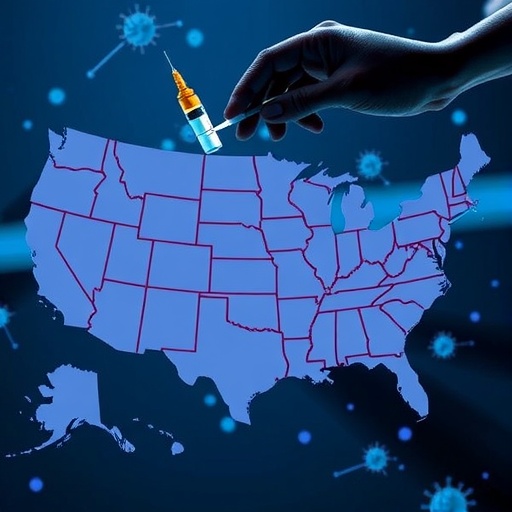
A new analysis led by Boston University School of Public Health researchers finds that anti-vaccine attitudes, once largely expressed as individual beliefs and public debate, have increasingly materialized as state-level legislation in the United States. The study focuses on how proposed bills changed after the COVID-19 pandemic, when vaccine hesitancy spread alongside misinformation and growing distrust in scientific institutions.

Using data from the State Vaccine Policy Project (SVPP), the team systematically categorized 1,513 vaccine-related bills introduced in state legislatures between 2019 and 2023. The investigation is observational in design and examines legislative intent by classifying proposals as antivaccine, provaccine, or mixed, allowing researchers to compare the partisan distribution of policy signals across time.

The results show a substantial legislative shift beginning in the early pandemic period. Proposed antivaccine measures—such as bills aiming to reduce vaccine access, weaken vaccination requirements, and expand exemptions—rose sharply during 2021–2023. In several legislative cycles, the number of antivaccine proposals exceeded the number of bills intended to strengthen vaccination policies.

The study also reports that antivaccine proposals accounted for at least 40% of bills introduced in each full legislative cycle after the pandemic began. Partisan polarization was central: Republican lawmakers sponsored 86% of antivaccine bills, while Democrats introduced 54% of provaccine bills supporting greater access, funding, and promotion of immunization.

Importantly, the work distinguishes between proposals and enacted policy. Even though many antivaccine bills do not pass, 24% of antivaccine legislation during the period was advanced enough to become law. Enacted measures included expanded religious or personal belief exemptions for childcare and school immunizations, and restrictions on employer vaccination mandates in certain settings.

The authors argue that weakening vaccine protections can have population-level consequences that extend beyond state borders. Low coverage in one region can accelerate outbreaks elsewhere, an effect consistent with historical patterns of infectious disease spread and reinforced by current examples such as measles resurgence.

The study further contextualizes the findings within electoral dynamics. As the U.S. approaches the November midterm elections, the authors note that who voters elect could shape vaccine policy trajectories for years, potentially entrenching legislative environments hostile to immunization.

Finally, the researchers emphasize that vaccine communication strategies must account for the multifaceted drivers of trust and hesitancy. They call for investments in evidence-based message targeting and messenger selection, suggesting that public health officials may not always be the most effective conveyors of vaccine information.

Subject of Research: People
Article Title: Quantifying the Polarization of Vaccine Policymaking Across State Legislatures
News Publication Date: 16-Jul-2026
Web References: https://ajph.aphapublications.org/doi/10.2105/AJPH.2026.308535
References: 10.2105/AJPH.2026.308535
Image Credits: Not provided

Keywords: vaccine policy, antivaccine legislation, polarization, state legislatures, public health, exemptions, measles, COVID-19, misinformation

Tags: anti-vaccine legislation in US statesCOVID-19 pandemic vaccine policygrowth of antivaccine movement in US politicsimpact of misinformation on vaccine lawsinfluence of distrust in scientific institutionslegislative response to vaccine hesitancypartisan influence on vaccine legislationpublic health policy and vaccine accessrise of vaccine exemption lawsrole of political parties in vaccine policystate-level vaccine mandates and exemptionstrends in vaccine-related bills post-pandemic
Share26Tweet16
Previous Post

ESA 2026 Annual Meeting to Spotlight Wildlife Ecology in Media Tip Sheet

Next Post

Study Finds Women’s Neighborhoods Can Influence Heart Health for Decades

Related Posts

Work-Family Conflicts: Flexible Jobs Determine Who Adjusts
Social Science

Work-Family Conflicts: Flexible Jobs Determine Who Adjusts

July 17, 2026
Social Media Use Linked to ADHD Symptoms in Adolescents, Study Finds
Social Science

Social Media Use Linked to ADHD Symptoms in Adolescents, Study Finds

July 17, 2026
Invisible Gaps in Urban AI Security Threaten City Systems
Social Science

Invisible Gaps in Urban AI Security Threaten City Systems

July 17, 2026
Herbularyo Card Game Marries Filipino Folklore With Organic Chemistry
Social Science

Herbularyo Card Game Marries Filipino Folklore With Organic Chemistry

July 17, 2026
Heat’s Nationwide Toll: Suicide and Homicide Patterns in Mexico and Brazil
Social Science

Heat’s Nationwide Toll: Suicide and Homicide Patterns in Mexico and Brazil

July 17, 2026
Discrete Choice Study Maps Apartment Residents’ Park Preferences Across Australian Cities
Social Science

Discrete Choice Study Maps Apartment Residents’ Park Preferences Across Australian Cities

July 17, 2026
Next Post
Study Finds Women’s Neighborhoods Can Influence Heart Health for Decades

Study Finds Women’s Neighborhoods Can Influence Heart Health for Decades

  • Mothers who receive childcare support from maternal grandparents show more

    Mothers who receive childcare support from maternal grandparents show more parental warmth, finds NTU Singapore study

    27656 shares
    Share 11059 Tweet 6912
  • University of Seville Breaks 120-Year-Old Mystery, Revises a Key Einstein Concept

    1061 shares
    Share 424 Tweet 265
  • Bee body mass, pathogens and local climate influence heat tolerance

    682 shares
    Share 273 Tweet 171
  • Researchers record first-ever images and data of a shark experiencing a boat strike

    546 shares
    Share 218 Tweet 137
  • Groundbreaking Clinical Trial Reveals Lubiprostone Enhances Kidney Function

    531 shares
    Share 212 Tweet 133
Science

Embark on a thrilling journey of discovery with Scienmag.com—your ultimate source for cutting-edge breakthroughs. Immerse yourself in a world where curiosity knows no limits and tomorrow’s possibilities become today’s reality!

RECENT NEWS

  • Agri-environmental Policies Boost Cropland Quality Globally
  • Work-Family Conflicts: Flexible Jobs Determine Who Adjusts
  • Methane-Consuming River Bacteria Cannot Stop Human-Caused Climate Change
  • Fish Oil Supplements in Pregnancy Shape Brain Metabolism by Mid-Childhood

Categories

  • Agriculture
  • Anthropology
  • Archaeology
  • Athmospheric
  • Biology
  • Biotechnology
  • Blog
  • Bussines
  • Cancer
  • Chemistry
  • Climate
  • Earth Science
  • Editorial Policy
  • Marine
  • Mathematics
  • Medicine
  • Pediatry
  • Policy
  • Psychology & Psychiatry
  • Science Education
  • Social Science
  • Space
  • Technology and Engineering

Subscribe to Blog via Email

Enter your email address to subscribe to this blog and receive notifications of new posts by email.

Join 5,146 other subscribers

© 2025 Scienmag - Science Magazine

Welcome Back!

Login to your account below

Forgotten Password?

Retrieve your password

Please enter your username or email address to reset your password.

Log In
No Result
View All Result
  • HOME
  • SCIENCE NEWS
  • CONTACT US

© 2025 Scienmag - Science Magazine

Discover more from Science

Subscribe now to keep reading and get access to the full archive.

Continue reading
