


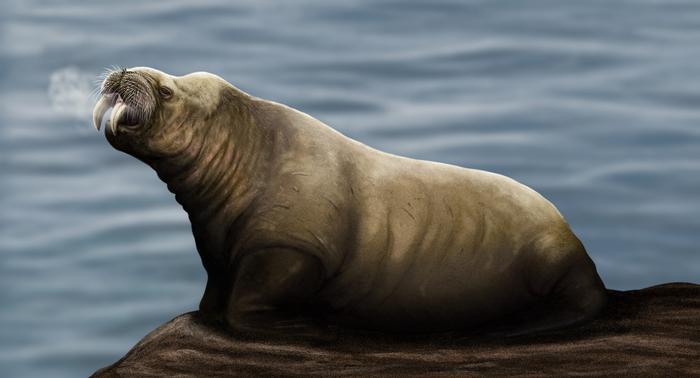
A new discovery by a team of paleontologists, led by Dr. Mathieu Boisville (University of Tsukuba, Japan), has uncovered a new species of the extinct genus Ontocetus from the Lower Pleistocene deposits in the North Atlantic. This species, named Ontocetus posti, displays surprising similarities in feeding adaptations to the modern walrus (Odobenus rosmarus), highlighting an intriguing case of convergent evolution. The research is published in the open access journal PeerJ Life & Environment.

Credit: Credit: Jaime Bran
A new discovery by a team of paleontologists, led by Dr. Mathieu Boisville (University of Tsukuba, Japan), has uncovered a new species of the extinct genus Ontocetus from the Lower Pleistocene deposits in the North Atlantic. This species, named Ontocetus posti, displays surprising similarities in feeding adaptations to the modern walrus (Odobenus rosmarus), highlighting an intriguing case of convergent evolution. The research is published in the open access journal PeerJ Life & Environment.
The fossils of Ontocetus posti were discovered in Norwich, United Kingdom, and Antwerp, Belgium. These remains were initially thought to belong to another species, Ontocetus emmonsi; however, detailed analysis of the mandibles revealed a unique combination of features that distinguish it as a new species. These features include the presence of four post-canine teeth, a larger lower canine, and a fused and short mandibular symphysis. Such anatomical characteristics suggest that Ontocetus posti was quite well adapted to suction-feeding, somewhat similar to its modern relative, the walrus.
Originating from the North Pacific Ocean, the Ontocetus genus spread to the Atlantic during the Mio-Pliocene transition. This migration was probably facilitated by the Central American Seaway, a crucial oceanic passage before the closure of the Isthmus of Panama. The resulting global cooling starting during the Late Pliocene significantly impacted marine life, contributing to the extinction of Ontocetus posti during the Early Pleistocene and allowing the cold-adapted Odobenus rosmarus to emerge and eventually dominate.
The discovery sheds light on the evolutionary history of walruses, emphasizing how environmental changes have shaped the adaptations and survival of marine mammals. The convergence of feeding adaptations between Ontocetus posti and the modern walrus illustrates the dynamic evolutionary processes that occur across different eras and environments.
For more information or to schedule an interview with Dr. Mathieu Boisville, please contact mathieu.boisville1@gmail.com
Journal
PeerJ
Method of Research
Observational study
Subject of Research
Animals
Article Publication Date
13-Aug-2024
Cite Scienmag News
Drew Townsend. (August 13, 2024). New species of extinct walrus-like mammal discovered in the North Atlantic. Scienmag. https://scienmag.com/new-species-of-extinct-walrus-like-mammal-discovered-in-the-north-atlantic/
Drew Townsend. "New species of extinct walrus-like mammal discovered in the North Atlantic." Scienmag, 13 August 2024, https://scienmag.com/new-species-of-extinct-walrus-like-mammal-discovered-in-the-north-atlantic/. Accessed 4 September 2026.
Drew Townsend. "New species of extinct walrus-like mammal discovered in the North Atlantic." Scienmag. August 13, 2024. https://scienmag.com/new-species-of-extinct-walrus-like-mammal-discovered-in-the-north-atlantic/

