

Thursday, July 16, 2026
Science
No Result
View All Result
  • Login
  • HOME
  • SCIENCE NEWS
  • CONTACT US
  • HOME
  • SCIENCE NEWS
  • CONTACT US
No Result
View All Result
Scienmag
No Result
View All Result
Home Science News Medicine

AI Disagreements Could Undermine Patient Trust in Doctors

July 16, 2026
in Medicine
Reading Time: 2 mins read
0
AI Disagreements Could Undermine Patient Trust in Doctors

AI Disagreements Could Undermine Patient Trust in Doctors

65
SHARES
587
VIEWS
Share on FacebookShare on Twitter
ADVERTISEMENT

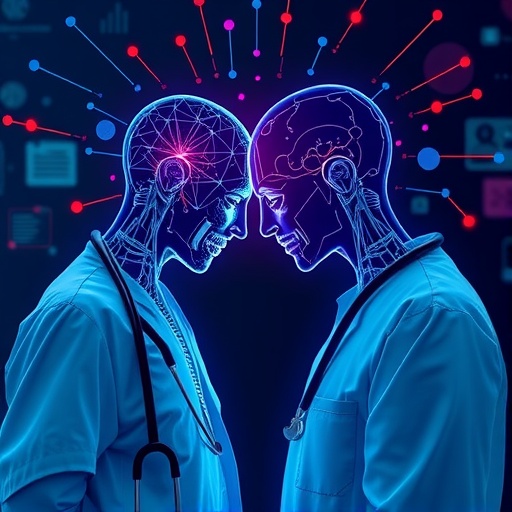
UNIVERSITY PARK, Pa. — Patients’ trust in physicians may rise or fall depending on what artificial intelligence (AI) says during a mental health visit, according to new research from Penn State and collaborators. The study shows that when an AI “second opinion” agrees with a human doctor’s recommendation, patients judge the doctor as more credible. But when the AI contradicts the doctor, patients report greater perceived uncertainty and even interpret the physician’s behavior as less diligent.

The team focused on a realistic scenario: during an online consultation, a doctor consults an AI system and shares the result with the patient. Historically, asking for a second opinion meant seeing another clinician. Now, some telehealth workflows can embed AI as an additional “expert” in the same session. The researchers asked how this changes perceptions of medical authority and doctor professionalism.

To test this, the researchers built an AI-powered chatbot that roleplayed as a human doctor named Dr. Alex. Participants first received a brief cognitive behavioral therapy (CBT)-style consultation about everyday stressors. Dr. Alex concluded that CBT was appropriate, and then patients were offered an optional AI second opinion.

For the second opinion, the researchers used a chatbot called CareBot. In different conditions, CareBot either agreed or disagreed with Dr. Alex’s recommendation. The assistant delivered the exchange in a way designed to mirror conversational clinical guidance, enabling consistent presentation of the same medical context across participants.

The experiment recruited 135 adults in the United States and then measured post-session evaluations of doctor credibility and perceived medical certainty. The results revealed an asymmetry: agreement between Dr. Alex and the AI increased patients’ confidence. Disagreement amplified judgments of uncertainty and “doctor laziness.”

Importantly, these effects depended on anthropomorphism—how human-like the doctor appeared through the interface. The study found that positive and negative consequences of AI agreement or disagreement emerged only when participants perceived the doctor as sufficiently human. In other words, the same technical contradiction can be socially interpreted very differently depending on perceived identity cues.

The findings carry direct implications for telehealth platforms and app-based medicine, where clinicians’ real identities may be obscured and AI co-present. More than half of participants in the study treated the AI-simulated doctor as human-like, suggesting that conversational behavior alone can create strong authority.

The negative impact of AI disagreement was strongest among individuals who believe machines are more objective and precise than humans. For those patients, AI contradictions can plant doubts rapidly, shifting trust away from the physician.

Finally, the research proposes communication strategies for clinical settings: doctors can acknowledge AI differences implicitly, invite joint exploration of the conflicting points, and explain plausible reasons for disagreement, such as data limitations affecting whether results generalize to different patient groups.

Subject of Research: Patient trust and credibility in doctor–AI “second opinion” workflows during mental health consultations
Article Title: When AI Disagrees: The Effect of Second Opinion on Patients’ Trust in Doctors
News Publication Date: 1-Jun-2026
Web References: https://doi.org/10.1016/j.ijhcs.2026.103824
References: 10.1016/j.ijhcs.2026.103824
Image Credits: Not provided
Keywords: Artificial intelligence, generative AI, mental health, telehealth, doctor–patient relationship, trust, cognitive behavioral therapy (CBT)

Tags: AI and medical authorityAI and patient perceptionAI disagreement impact on healthcareAI in telehealthAI second opinions in mental healthdoctor credibility and AIeffects of AI consensus and disagreementpatient interpretation of AI advicepatient trust in medical AIrole of chatbots in therapytelehealth AI integrationtrust dynamics in AI-assisted consultations
Share26Tweet16
Previous Post

Cost to Illinois Farmers If Glyphosate Were Banned

Next Post

New experiment maps multiple isotopes showing pygmy excitations

Related Posts

Crown Bioscience Joins C-Path Coalition for New Approach Methodologies
Medicine

Crown Bioscience Joins C-Path Coalition for New Approach Methodologies

July 16, 2026
Fractional High-Chern Insulator Realized in Twisted Rhombohedral Graphene
Medicine

Fractional High-Chern Insulator Realized in Twisted Rhombohedral Graphene

July 16, 2026
Plasma Ceramide Ratios Link Metabolic and Inflammation Markers to Parkinson’s Cognitive Decline
Medicine

Plasma Ceramide Ratios Link Metabolic and Inflammation Markers to Parkinson’s Cognitive Decline

July 16, 2026
Selectivity Achieved Despite Indiscriminate Photoreduction in New Study
Medicine

Selectivity Achieved Despite Indiscriminate Photoreduction in New Study

July 16, 2026
Medication Complexity and Risk of Rehospitalization in Older Chronic Kidney Disease Patients
Medicine

Medication Complexity and Risk of Rehospitalization in Older Chronic Kidney Disease Patients

July 16, 2026
AI-Guided CRISPR and quantum nanobiology reverse cancer cell behavior
Medicine

AI-Guided CRISPR and quantum nanobiology reverse cancer cell behavior

July 16, 2026
Next Post
New experiment maps multiple isotopes showing pygmy excitations

New experiment maps multiple isotopes showing pygmy excitations

  • Mothers who receive childcare support from maternal grandparents show more

    Mothers who receive childcare support from maternal grandparents show more parental warmth, finds NTU Singapore study

    27656 shares
    Share 11059 Tweet 6912
  • University of Seville Breaks 120-Year-Old Mystery, Revises a Key Einstein Concept

    1061 shares
    Share 424 Tweet 265
  • Bee body mass, pathogens and local climate influence heat tolerance

    682 shares
    Share 273 Tweet 171
  • Researchers record first-ever images and data of a shark experiencing a boat strike

    546 shares
    Share 218 Tweet 137
  • Groundbreaking Clinical Trial Reveals Lubiprostone Enhances Kidney Function

    531 shares
    Share 212 Tweet 133
Science

Embark on a thrilling journey of discovery with Scienmag.com—your ultimate source for cutting-edge breakthroughs. Immerse yourself in a world where curiosity knows no limits and tomorrow’s possibilities become today’s reality!

RECENT NEWS

  • Bioengineered Bacterial Spores Found for Broader New Applications
  • Crown Bioscience Joins C-Path Coalition for New Approach Methodologies
  • First Atmosphere Detected on Rocky Exoplanet in Habitable Zone
  • Brexit nurse departures tied to 3,700 additional hospital deaths, researchers warn

Categories

  • Agriculture
  • Anthropology
  • Archaeology
  • Athmospheric
  • Biology
  • Biotechnology
  • Blog
  • Bussines
  • Cancer
  • Chemistry
  • Climate
  • Earth Science
  • Editorial Policy
  • Marine
  • Mathematics
  • Medicine
  • Pediatry
  • Policy
  • Psychology & Psychiatry
  • Science Education
  • Social Science
  • Space
  • Technology and Engineering

Subscribe to Blog via Email

Enter your email address to subscribe to this blog and receive notifications of new posts by email.

Join 5,146 other subscribers

© 2025 Scienmag - Science Magazine

Welcome Back!

Login to your account below

Forgotten Password?

Retrieve your password

Please enter your username or email address to reset your password.

Log In
No Result
View All Result
  • HOME
  • SCIENCE NEWS
  • CONTACT US

© 2025 Scienmag - Science Magazine

Discover more from Science

Subscribe now to keep reading and get access to the full archive.

Continue reading
