

Thursday, July 16, 2026
Science
No Result
View All Result
  • Login
  • HOME
  • SCIENCE NEWS
  • CONTACT US
  • HOME
  • SCIENCE NEWS
  • CONTACT US
No Result
View All Result
Scienmag
No Result
View All Result
Home Science News Technology and Engineering

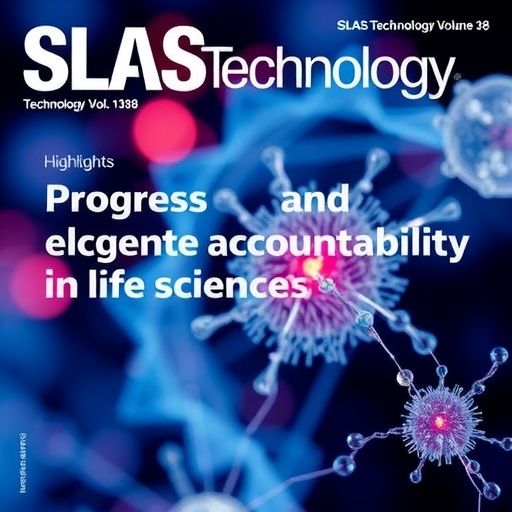
SLAS Technology Vol. 38 Highlights Progress and Accountability in Life Sciences

July 16, 2026
in Technology and Engineering
Reading Time: 2 mins read
0
SLAS Technology Vol. 38 Highlights Progress and Accountability in Life Sciences

SLAS Technology Vol. 38 Highlights Progress and Accountability in Life Sciences

65
SHARES
587
VIEWS
Share on FacebookShare on Twitter
ADVERTISEMENT

SLAS Technology’s new volume spotlights how today’s life-science research is tightening the feedback loop between experimentation, automation, and evidence. Published on May 29, 2026, the issue reflects a field moving rapidly from proof-of-concept toward repeatable, measurable workflows—whether in genomics, imaging, assay development, or high-throughput screening.

At the core is a review on viral vector gene therapy, laying out fundamental principles and comparing alternative evaluation models. It emphasizes how vector performance is not only determined by efficacy, but also by stability and safety—two practical constraints that shape how therapies translate into clinical settings.

Technical briefs extend this theme into tools and infrastructure. OT2Eye, for example, introduces image-based detection of labware conditions for the Opentrons OT-2 platform, turning visual states into machine-readable status that can be integrated into AI-driven automation. Other briefs tackle bottlenecks such as solvent evaporation efficiency and quantification consistency in colorimetric assays, highlighting how engineered peripherals can accelerate routine lab steps while preserving data quality.

Original research spans diagnostic imaging and translational workflows. Diffusion tensor imaging paired with tractography in children with autism reveals microstructural differences in major white-matter pathways compared with controls, illustrating how advanced imaging analytics can sharpen biological interpretation. In lab automation, a proposed evaluation method for automated solid dosing targets mid-scale tasks, addressing risk reduction and operational efficiency in daily biotech pipelines.

Robotics and computation also make a strong appearance. A GPT-enhanced automation platform uses natural-language instructions to coordinate multi-brand robots, aiming to reduce programming barriers while enabling complex experimental sequences. In parallel, a humanoid robotic system for iPSC culture and organoid generation (“Maholo LabDroid”) targets long-term reliability by coupling real-time imaging with flexible liquid handling to improve predictive power.

The issue further underscores the importance of experimental rigor. A SARS-CoV-2 nsp3 protease HTS campaign identifies metal contamination as a driver of false positives, illustrating why counter-screens can prevent wasted resources during drug discovery. Elsewhere, a microfluidic fluid-removal system (“Stacks Insert System”) improves throughput and uniformity in low-volume exchanges—an engineering advance designed for reproducibility.

Overall, Volume 38 pairs biological discovery with practical, scalable technologies, reinforcing SLAS Technology’s focus on translating innovation into dependable laboratory practice. For readers and practitioners, the collection signals where the next gains in speed, accuracy, and accountability are likely to emerge.

Subject of Research: Life sciences and laboratory automation (viral gene therapy, imaging analytics, liquid-handling automation, microfluidics, high-throughput screening, machine learning)

Article Title: SLAS Technology, Vol. 38 (Volume 38 of SLAS Technology)

News Publication Date: 29-May-2026

Web References: (Not provided in the provided content)

References: (Not provided in the provided content)

Image Credits: SLAS Publishing

Keywords

Life sciences; biotechnology; high throughput screening; drug discovery; machine learning; artificial intelligence; laboratory automation; robotics; microfluidics; viral vectors

Tags: AI integration in laboratory automationcolorimetric assay quantificationdiffusion tensor imaging in autism researchhigh-throughput screening advancementsimage-based labware detection automationlife sciences automationoptical detection of labware conditionsreproducible workflows in genomicssolvent evaporation optimization in assaysstability and safety in gene therapytranslational workflows in diagnosticsviral vector gene therapy evaluation
Share26Tweet16
Previous Post

$2.5M DoD grant supports targeted therapy development for triple-negative breast cancer

Next Post

Repurposed Antiplatelet Prasugrel Shows Neuroprotective Effects in Parkinson’s, Proteomics Reveal

Related Posts

Maternal and Cord Mitochondrial DNA Heteroplasmy, Copy Number Linked to Preterm Birth
Technology and Engineering

Maternal and Cord Mitochondrial DNA Heteroplasmy, Copy Number Linked to Preterm Birth

July 16, 2026
Driving Speed Limits Saves Millions in Fuel Costs with Seconds of Change
Technology and Engineering

Driving Speed Limits Saves Millions in Fuel Costs with Seconds of Change

July 16, 2026
Modular In Vivo Antibody–ADC Click Reaction Reverses Tumor Drug Resistance
Medicine

Modular In Vivo Antibody–ADC Click Reaction Reverses Tumor Drug Resistance

July 16, 2026
Bayesian framework integrates longitudinal EHR data with genetic discovery
Medicine

Bayesian framework integrates longitudinal EHR data with genetic discovery

July 16, 2026
Climate Change Alters Resource Adequacy Risks and Optimal Wind, Solar Siting
Technology and Engineering

Climate Change Alters Resource Adequacy Risks and Optimal Wind, Solar Siting

July 16, 2026
Queen Odor Mediates Reproductive Suppression in Eusocial Mammals
Medicine

Queen Odor Mediates Reproductive Suppression in Eusocial Mammals

July 16, 2026
Next Post
Repurposed Antiplatelet Prasugrel Shows Neuroprotective Effects in Parkinson’s, Proteomics Reveal

Repurposed Antiplatelet Prasugrel Shows Neuroprotective Effects in Parkinson’s, Proteomics Reveal

  • Mothers who receive childcare support from maternal grandparents show more

    Mothers who receive childcare support from maternal grandparents show more parental warmth, finds NTU Singapore study

    27656 shares
    Share 11059 Tweet 6912
  • University of Seville Breaks 120-Year-Old Mystery, Revises a Key Einstein Concept

    1061 shares
    Share 424 Tweet 265
  • Bee body mass, pathogens and local climate influence heat tolerance

    682 shares
    Share 273 Tweet 171
  • Researchers record first-ever images and data of a shark experiencing a boat strike

    546 shares
    Share 218 Tweet 137
  • Groundbreaking Clinical Trial Reveals Lubiprostone Enhances Kidney Function

    531 shares
    Share 212 Tweet 133
Science

Embark on a thrilling journey of discovery with Scienmag.com—your ultimate source for cutting-edge breakthroughs. Immerse yourself in a world where curiosity knows no limits and tomorrow’s possibilities become today’s reality!

RECENT NEWS

  • Maternal and Cord Mitochondrial DNA Heteroplasmy, Copy Number Linked to Preterm Birth
  • Driving Speed Limits Saves Millions in Fuel Costs with Seconds of Change
  • Association for Molecular Pathology Honors Dartmouth Health Director for Long Leadership
  • Air-Stable Ru/BaSiN2O: Floating Electrons Power New Catalyst

Categories

  • Agriculture
  • Anthropology
  • Archaeology
  • Athmospheric
  • Biology
  • Biotechnology
  • Blog
  • Bussines
  • Cancer
  • Chemistry
  • Climate
  • Earth Science
  • Editorial Policy
  • Marine
  • Mathematics
  • Medicine
  • Pediatry
  • Policy
  • Psychology & Psychiatry
  • Science Education
  • Social Science
  • Space
  • Technology and Engineering

Subscribe to Blog via Email

Enter your email address to subscribe to this blog and receive notifications of new posts by email.

Join 5,146 other subscribers

© 2025 Scienmag - Science Magazine

Welcome Back!

Login to your account below

Forgotten Password?

Retrieve your password

Please enter your username or email address to reset your password.

Log In
No Result
View All Result
  • HOME
  • SCIENCE NEWS
  • CONTACT US

© 2025 Scienmag - Science Magazine

Discover more from Science

Subscribe now to keep reading and get access to the full archive.

Continue reading
