

Thursday, July 16, 2026
Science
No Result
View All Result
  • Login
  • HOME
  • SCIENCE NEWS
  • CONTACT US
  • HOME
  • SCIENCE NEWS
  • CONTACT US
No Result
View All Result
Scienmag
No Result
View All Result
Home Science News Chemistry

Frog Protein Shows Promise as First Antidote to Fatal Red Tide Toxin

July 16, 2026
in Chemistry
Reading Time: 2 mins read
0
Frog Protein Shows Promise as First Antidote to Fatal Red Tide Toxin

Frog Protein Shows Promise as First Antidote to Fatal Red Tide Toxin

65
SHARES
587
VIEWS
Share on FacebookShare on Twitter
ADVERTISEMENT

A fast-growing “red tide” problem on the Pacific coast is bringing with it an escalating threat: saxitoxin (STX), a potent neurotoxin that accumulates in shellfish and triggers paralytic shellfish poisoning (PSP). Unlike many poisons, STX acts with ruthless speed by disrupting the electrical signaling of nerve and muscle systems—so fast that existing mitigation strategies have struggled to keep pace with outbreaks.

The challenge has long been clinical and strategic at once. There is no widely available antidote for STX, even though the compound was stockpiled as a chemical weapon during the Cold War. That absence has left public health agencies to rely heavily on monitoring and prevention rather than treatment.

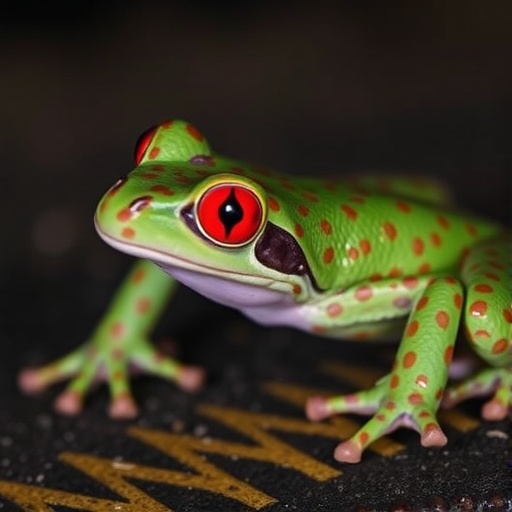
In a new UC San Francisco study published July 16 in Nature Communications, researchers report an unexpected solution: saxiphilin, a naturally occurring protein found in bullfrogs and other frog species worldwide. The protein functions as a molecular “sponge,” binding STX tightly enough in the bloodstream to prevent the toxin from reaching its cellular targets.

This mechanism matters because STX exists as a family of closely related variants rather than a single chemical entity. Saxiphilin’s ability to recognize multiple STX forms improves the odds that a single countermeasure could work across real-world exposures, where toxin mixtures vary by bloom and location.

To test whether the sponge idea survives contact with living biology, the team administered saxiphilin to mice challenged with lethal doses of STX. When given before or alongside toxin exposure, the protein prevented poisoning. Strikingly, treatment after exposure also rescued nearly all animals—closely resembling the scenario in which someone unknowingly eats contaminated shellfish.

Beyond survival, saxiphilin reduced the severity of PSP-like symptoms, while producing no detectable harmful side effects in the study. Using additional analyses, the researchers found that the protein distributes throughout the body, reaching organs including the brain, heart, and muscles—enabling toxin interception along its route.

The study builds on earlier UCSF work showing strong saxiphilin–STX binding in biochemical experiments, but it extends that result into whole-organism efficacy. The authors emphasize that the size of the antidote—large relative to a small toxin—raised doubts about whether it could “catch up” fast enough to block damage.

Finally, the research reconnects to a scientific lineage reaching back to the late 1920s and 1930s, when UCSF physician-scientist Hermann Sommer investigated shellfish poison outbreaks and noted frog resistance. Today’s findings close that loop and provide a blueprint for countering other naturally produced toxins. With harmful algal blooms increasing globally, saxiphilin could also inspire faster shellfish detection approaches and, more broadly, new antidote strategies derived from nature itself.

Subject of Research: Saxiphilin-based neutralization of saxitoxin (PSP prevention and reversal)
Article Title: Not provided in the supplied text
News Publication Date: July 16 (year not specified in the supplied text)
Web References: https://doi.org/10.1038/s41467-026-75136-z
References: (1) https://www.ucsf.edu/news/2021/08/421166/poison-frogs-birds-hold-clues-antidotes-deadly-toxins (2) https://www.nature.com/articles/s41467-025-58903-2 (3) https://www.cell.com/structure/fulltext/S0969-2126(26)00154-1
Image Credits: Sandra Zakrzewska, Minor Lab

Keywords

saxiphilin; saxitoxin; paralytic shellfish poisoning; PSP; molecular binding; neurotoxin; harmful algal blooms; red tide; antidote; public health

Tags: Frog protein as antidote for red tide toxinfrog-derived biotherapeuticsinnovative approaches to red tide health risksmarine toxin prevention strategiesnatural toxin-binding proteinsneurotoxin disruption in nerve signalingparalytic shellfish poisoning treatmentpotential antidote for saxitoxin poisoningred tide outbreak managementsaxiphilin toxin neutralizationsaxitoxin neurotoxin mitigationshellfish poisoning countermeasures
Share26Tweet16
Previous Post

Frog Protein Antidote Could Neutralize Lethal Red Tide Toxin First

Next Post

Listening to Black Hole Ringing Reveals Path to Future Gravitational-Wave Astronomy

Related Posts

Scientists Identify Invisible Early Indicators of Skin Aging
Chemistry

Scientists Identify Invisible Early Indicators of Skin Aging

July 16, 2026
Roadmap Outlines Self-Powered Tactile Sensors for Robots and Wearable Devices
Chemistry

Roadmap Outlines Self-Powered Tactile Sensors for Robots and Wearable Devices

July 16, 2026
AI and Quantum Chemistry Reveal Dual-Modulated Catalysts for Next-Gen Fuel Cells
Chemistry

AI and Quantum Chemistry Reveal Dual-Modulated Catalysts for Next-Gen Fuel Cells

July 16, 2026
Bioinspired Hierarchical Hydrogel Electrolyte Enables Ultralong-Life Flexible Zinc Batteries
Chemistry

Bioinspired Hierarchical Hydrogel Electrolyte Enables Ultralong-Life Flexible Zinc Batteries

July 16, 2026
Terminal Groups Enable Tunable, Versatile MXene Materials
Chemistry

Terminal Groups Enable Tunable, Versatile MXene Materials

July 16, 2026
Ions Move Through Solid Crystals Like Liquid Flow
Chemistry

Ions Move Through Solid Crystals Like Liquid Flow

July 16, 2026
Next Post
Listening to Black Hole Ringing Reveals Path to Future Gravitational-Wave Astronomy

Listening to Black Hole Ringing Reveals Path to Future Gravitational-Wave Astronomy

  • Mothers who receive childcare support from maternal grandparents show more

    Mothers who receive childcare support from maternal grandparents show more parental warmth, finds NTU Singapore study

    27656 shares
    Share 11059 Tweet 6912
  • University of Seville Breaks 120-Year-Old Mystery, Revises a Key Einstein Concept

    1061 shares
    Share 424 Tweet 265
  • Bee body mass, pathogens and local climate influence heat tolerance

    682 shares
    Share 273 Tweet 171
  • Researchers record first-ever images and data of a shark experiencing a boat strike

    546 shares
    Share 218 Tweet 137
  • Groundbreaking Clinical Trial Reveals Lubiprostone Enhances Kidney Function

    531 shares
    Share 212 Tweet 133
Science

Embark on a thrilling journey of discovery with Scienmag.com—your ultimate source for cutting-edge breakthroughs. Immerse yourself in a world where curiosity knows no limits and tomorrow’s possibilities become today’s reality!

RECENT NEWS

  • RModBlock antisense oligonucleotides enable universal, efficient inhibition of RNA modifications
  • Alzheimer’s Disease Cell Signatures Found Shared Across Diverse Population Groups
  • Volcanic eruptions leave imprint on coupled reanalysis global overturning circulation
  • Residential Water Sources Predict Serum PFAS Levels in Contaminated Communities

Categories

  • Agriculture
  • Anthropology
  • Archaeology
  • Athmospheric
  • Biology
  • Biotechnology
  • Blog
  • Bussines
  • Cancer
  • Chemistry
  • Climate
  • Earth Science
  • Editorial Policy
  • Marine
  • Mathematics
  • Medicine
  • Pediatry
  • Policy
  • Psychology & Psychiatry
  • Science Education
  • Social Science
  • Space
  • Technology and Engineering

Subscribe to Blog via Email

Enter your email address to subscribe to this blog and receive notifications of new posts by email.

Join 5,146 other subscribers

© 2025 Scienmag - Science Magazine

Welcome Back!

Login to your account below

Forgotten Password?

Retrieve your password

Please enter your username or email address to reset your password.

Log In
No Result
View All Result
  • HOME
  • SCIENCE NEWS
  • CONTACT US

© 2025 Scienmag - Science Magazine

Discover more from Science

Subscribe now to keep reading and get access to the full archive.

Continue reading
