


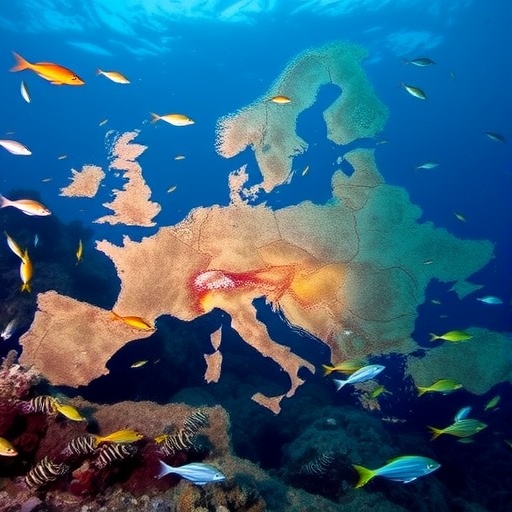
A new analysis of Europe’s marine fish communities suggests that many species are not only moving north and south, but also sinking to greater depths. The study, published in Nature Communications, combines large-scale biodiversity records with environmental data to map how species’ depth limits are changing across the European continental shelf.
Researchers report that fish ranges are expanding vertically as well as geographically. In multiple regions, populations increasingly occupy habitats that were previously too deep—or too cold—for them to persist. This “depth shifting” pattern indicates that thermal conditions on the shelf are being reconfigured faster than fish can track using traditional migration alone.
To reach this conclusion, the team applied statistical models to reconstruct historical and present-day distributions. They then evaluated how key drivers—especially seawater temperature, oxygen availability, and habitat suitability—align with observed changes in where fish are found. The results show that warming does not simply push species poleward; it also relaxes depth-related constraints that historically limited survival.
The findings add an important layer to marine climate risk. Deeper waters are often associated with higher pressure, altered light environments, and different food-web structures. While some species may gain new habitat, others may face competition or predation reshuffling as communities reorganize along depth gradients.
The study estimates that range expansion is not uniform. Instead, depth shifts vary by species’ thermal tolerance, life-history traits, and local oceanographic conditions. Some fish exhibit strong signals of moving deeper over relatively short timescales, suggesting that recent environmental change is already influencing where adults and juveniles can thrive.
Researchers emphasize that vertical habitat compression could also occur: as species move deeper, the space available within optimal temperature and oxygen bands may narrow for less adaptable taxa. This could influence recruitment success, alter spawning grounds, and ultimately affect fisheries that depend on predictable species distributions.
For coastal management, the work highlights a problem that is easy to miss: monitoring programs that only track surface or nearshore layers may underestimate how quickly fish communities are migrating through the water column. The authors argue that future assessments should integrate depth-resolved surveys and high-frequency ocean observations.
Overall, the study frames European shelf ecosystems as dynamic under climate pressure. Fish are responding by relocating to deeper habitats across large scales, meaning that adaptation and ecosystem change are unfolding in three dimensions—not just across latitude.
The paper also notes that continued warming could further accelerate these shifts, potentially reshaping ecological interactions throughout the shelf seas. If fisheries and conservation strategies remain anchored to older depth boundaries, they may fail to anticipate where commercially important species and ecosystem engineers will be found next.
Cite Scienmag News
Violet Maxwell. (July 15, 2026). Warming Seas Drive Marine Fish to Expand Ranges and Migrate Deeper in Europe. Scienmag. https://scienmag.com/warming-seas-drive-marine-fish-to-expand-ranges-and-migrate-deeper-in-europe/
Violet Maxwell. "Warming Seas Drive Marine Fish to Expand Ranges and Migrate Deeper in Europe." Scienmag, 15 July 2026, https://scienmag.com/warming-seas-drive-marine-fish-to-expand-ranges-and-migrate-deeper-in-europe/. Accessed 4 September 2026.
Violet Maxwell. "Warming Seas Drive Marine Fish to Expand Ranges and Migrate Deeper in Europe." Scienmag. July 15, 2026. https://scienmag.com/warming-seas-drive-marine-fish-to-expand-ranges-and-migrate-deeper-in-europe/


