


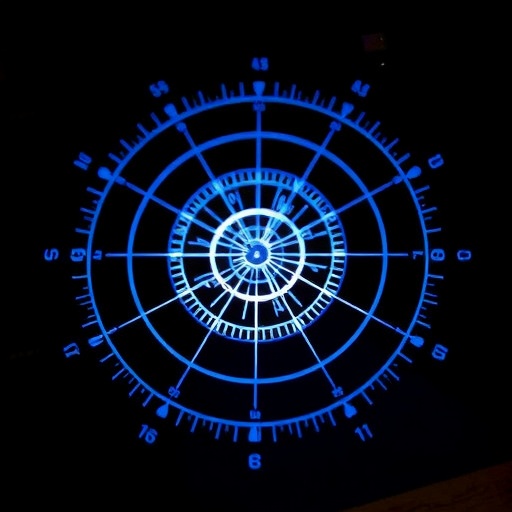
A new “optical singularity protractor” could help laboratories measure rotation with unprecedented sensitivity, using a neuromorphic sensing approach rather than conventional mechanical or purely geometric readouts. Reported in Light: Science & Applications, the device is designed to track angular motion by exploiting a light-based phenomenon: optical singularities, where the phase structure of a beam creates distinctive points that are highly responsive to changes in orientation.
The core idea is to convert rotational information into changes in an optical interference pattern that can be interpreted by an artificial sensory system. Instead of reading a rotating stage with a camera and then performing heavy post-processing, the protractor is built to let the measurement “happen” in the sensor response. This can reduce latency and improve robustness when the environment is noisy or when real-time tracking is required.
Optical singularities are particularly attractive for metrology because they act like optical landmarks. As the system rotates, the singularity-related features shift in a controlled way, providing a natural mapping between angle and the observed signal. The researchers combine these physics with neuromorphic sensing to recognize the pattern changes efficiently. Neuromorphic sensors emulate aspects of neural computation, enabling event-driven detection that focuses on meaningful variations rather than continuously sampling every pixel.
In practical terms, the neuromorphic element processes the optical output to produce an angular estimate that can update rapidly as rotation occurs. This event-based behavior is expected to be advantageous in fast scanning systems, vibration-prone setups, or applications where power consumption and data bandwidth are critical.
The work also targets a longstanding challenge in rotating metrology: maintaining accuracy across varying speeds and conditions. By anchoring the measurement to singularity-sensitive optical features, the protractor aims to deliver stable performance without relying on precise mechanical alignment alone. The result is a compact, optics-driven strategy for measuring rotation with high fidelity.
Beyond laboratory metrology, such technology could influence advanced microscopy, precision manufacturing, and alignment systems for optical instruments. As optical components become more integrated and dynamic, sensing methods that react quickly to changes—like neuromorphic processing—are likely to become increasingly valuable.
The study, published online on 14 July 2026, adds to a growing trend of hybrid photonic–computational measurement devices. By merging singularity-based optical readout with neuromorphic sensing, the authors present a route toward faster, more resilient rotational calibration and monitoring.
Cite Scienmag News
Denise Maddox. (July 15, 2026). Optical Singularity Protractor Enables Rotating Metrology with Neuromorphic Sensors. Scienmag. https://scienmag.com/optical-singularity-protractor-enables-rotating-metrology-with-neuromorphic-sensors/
Denise Maddox. "Optical Singularity Protractor Enables Rotating Metrology with Neuromorphic Sensors." Scienmag, 15 July 2026, https://scienmag.com/optical-singularity-protractor-enables-rotating-metrology-with-neuromorphic-sensors/. Accessed 4 September 2026.
Denise Maddox. "Optical Singularity Protractor Enables Rotating Metrology with Neuromorphic Sensors." Scienmag. July 15, 2026. https://scienmag.com/optical-singularity-protractor-enables-rotating-metrology-with-neuromorphic-sensors/


