


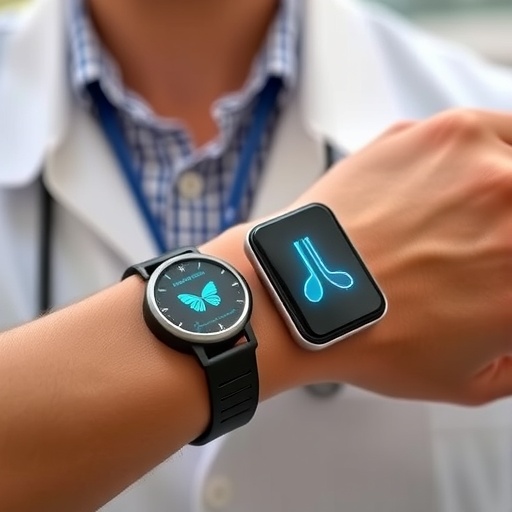
Wearable health technology is getting a new job: measuring how medicines behave inside the body. Researchers at King Abdullah University of Science and Technology (KAUST) have built a microneedle patch designed to continuously track drug concentrations beneath the skin and stream the results to a smartphone in real time. The work highlights a shift from intermittent blood testing toward ongoing therapy monitoring.
The platform targets a long-standing limitation in drug management. Many medicines with tight dosing windows are monitored through periodic blood draws and lab analysis, which provide only a partial snapshot of drug levels. Delays in processing can further obscure how concentrations change over hours—exactly the information clinicians may need to optimize treatment.
At the core of the device is an array of tiny microneedles that reach interstitial fluid just under the skin. Interstitial fluid contains drug molecules that correlate with systemic concentrations, enabling the patch to sense drug levels with minimal invasiveness. The microneedles are coupled to miniaturized electrochemical biosensors that convert chemical information into measurable electrical signals.
Built-in electronics handle sensor readout and wireless data transfer. Instead of requiring a bulky instrument, the patch uses Bluetooth connectivity to transmit continuous measurements to a smartphone display. This design supports near real-time visualization of drug concentration trends, enabling users or clinicians to monitor therapy without frequent clinic visits.
The system was demonstrated using vancomycin, an antibiotic commonly prescribed for serious infections. Vancomycin is a particularly suitable test case because safe and effective outcomes depend on maintaining drug concentrations within a narrow range. Tracking the rise and fall of this antibiotic provided a practical benchmark for continuous drug monitoring.
In laboratory experiments and preclinical studies, the wearable platform successfully followed changing vancomycin concentrations over several hours. The complete device weighs 6.7 grams and integrates microneedle sensing, electrochemical detection, onboard circuitry, wireless communication, and smartphone visualization into a single wearable module.
Although still early-stage, the results establish feasibility for continuous wireless monitoring using a minimally invasive sensing approach. Future development will focus on longer monitoring duration, improved long-term stability of the sensing elements, and validation across broader medical applications.
If these challenges are solved, microneedle-based monitoring could support more personalized medicine—providing clinicians with continuous feedback on how a patient’s body responds to therapy rather than relying solely on periodic measurements.
Keywords
Wearable sensors; microneedle patch; wireless drug monitoring; vancomycin; electrochemical biosensors; interstitial fluid; smartphone connectivity; personalized medicine; Bluetooth; real-time healthcare diagnostics
Cite Scienmag News
Denise Maddox. (July 15, 2026). KAUST Researchers Create Wearable Tech to Monitor Medicines in Real Time. Scienmag. https://scienmag.com/kaust-researchers-create-wearable-tech-to-monitor-medicines-in-real-time/
Denise Maddox. "KAUST Researchers Create Wearable Tech to Monitor Medicines in Real Time." Scienmag, 15 July 2026, https://scienmag.com/kaust-researchers-create-wearable-tech-to-monitor-medicines-in-real-time/. Accessed 3 September 2026.
Denise Maddox. "KAUST Researchers Create Wearable Tech to Monitor Medicines in Real Time." Scienmag. July 15, 2026. https://scienmag.com/kaust-researchers-create-wearable-tech-to-monitor-medicines-in-real-time/


