


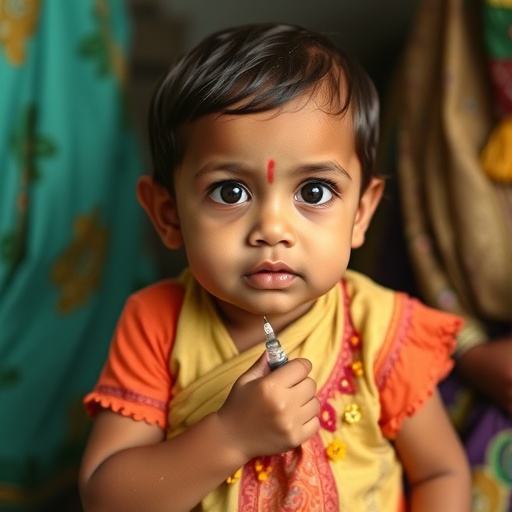
Each year, about 700,000 children worldwide die from vaccine-preventable diseases, with the vast majority in low- and middle-income countries. A new study by University of Notre Dame economist Santosh Kumar Gautam evaluates whether India’s Universal Immunization Programme measurably reduced child mortality—and how those health gains rippled into education.
Published in the Journal of Population Economics (1-Jul-2026), the research uses micro-level evidence from nearly 900,000 children to exploit a key feature of India’s rollout. The programme was introduced district-by-district beginning in 1985 and reached full national coverage by 1990, creating staggered exposure. Because vaccines were targeted to children under age one, Gautam compares outcomes for children born just before versus just after programme arrival in their district.
The findings show meaningful reductions in early deaths. Infant mortality falls by 0.4 percentage points, while under-five mortality declines by 0.5 percentage points—important gains in a context where roughly one in ten infants died before their first birthday.
The mortality benefits are not evenly distributed. Effects are concentrated among rural children, children from poorer households, and children from historically disadvantaged caste groups. For wealthier, urban, or higher-caste families, the changes are smaller, consistent with the possibility that many already had access to vaccination before the programme expanded locally.
Turning to schooling, the study reports mixed educational impacts. Exposure to the immunization programme is associated with lower primary school completion among surviving children, but higher secondary school completion, suggesting that improved survival reshapes educational trajectories through multiple channels rather than a single straightforward effect.
One mechanism highlighted by the author is compositional change: vaccination may save children who otherwise would not survive to school age, and these newly surviving children may, on average, face weaker underlying health or socioeconomic conditions that depress early-grade progress. In addition, strained school infrastructure could amplify early bottlenecks as cohorts grow.
At the same time, healthier survival among children who would have lived anyway may increase the likelihood of completing secondary school. The results therefore point to a dynamic interaction between public health and schooling systems.
Overall, the study argues for integrated policy design: child survival improvements should be matched with investments in education capacity and learning supports, so health gains translate into sustained human capital growth.
Cite Scienmag News
Courtney Benton. (July 15, 2026). India Immunization Program Cuts Child Mortality, Urges Health Education Policy Coordination. Scienmag. https://scienmag.com/india-immunization-program-cuts-child-mortality-urges-health-education-policy-coordination/
Courtney Benton. "India Immunization Program Cuts Child Mortality, Urges Health Education Policy Coordination." Scienmag, 15 July 2026, https://scienmag.com/india-immunization-program-cuts-child-mortality-urges-health-education-policy-coordination/. Accessed 3 September 2026.
Courtney Benton. "India Immunization Program Cuts Child Mortality, Urges Health Education Policy Coordination." Scienmag. July 15, 2026. https://scienmag.com/india-immunization-program-cuts-child-mortality-urges-health-education-policy-coordination/


