
Wednesday, August 26, 2026
Science
No Result
View All Result
  • Login
  • HOME
  • SCIENCE NEWS
  • CONTACT US
  • HOME
  • SCIENCE NEWS
  • CONTACT US
No Result
View All Result
Scienmag
No Result
View All Result
Home Science News Cancer

Immune Ecotypes Could Account for Multiple Myeloma Outcomes Beyond Staging

July 14, 2026
in Cancer
Reading Time: 2 mins read
0
Immune Ecotypes Could Account for Multiple Myeloma Outcomes Beyond Staging

Immune Ecotypes Could Account for Multiple Myeloma Outcomes Beyond Staging

65
SHARES
587
VIEWS
Share on FacebookShare on Twitter
ADVERTISEMENT

Multiple myeloma has long been puzzling: two patients with “the same” diagnosis can diverge dramatically in progression and therapy response. A new study from The University of Texas MD Anderson Cancer Center tackles this problem by looking past the cancer cells alone and instead charting the immune ecosystem living inside bone marrow.

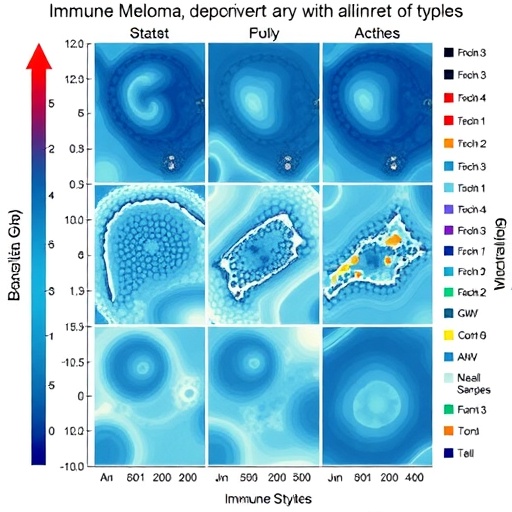
Using advanced single-cell sequencing, the researchers built an atlas from 235 participants spanning precursor conditions, newly diagnosed disease, and relapsed multiple myeloma. Rather than averaging signals across tissues, the team resolved distinct immune-cell populations and the communication patterns linking them.

The resulting map revealed five immune-microenvironment “ecotypes,” each defined by characteristic signaling programs and genetic activity. Crucially, these ecotypes were not fully explained by disease stage. In other words, the immune contexture added structure to the biology that clinicians could not infer from stage alone.

Some ecotypes displayed limited immune infiltration, suggesting a tumor environment that is biologically harder for immune cells to access or activate. Others showed signatures consistent with immune surveillance, cytotoxic T-cell programs, inflammatory signaling, or stress-related immune-cell states.

These differences help explain why tumors can appear more “visible” to the immune system in some patients while remaining suppressed in others—an effect that likely shapes responsiveness to immunotherapies. The study found ecotypes associated with tumor burden, survival, and outcomes after immune-based treatments, including CAR T-cell therapy and T-cell engager approaches.

Notably, several ecotypes were detectable even in precursor conditions. That observation points to a future risk stratification strategy: identifying patients whose immune landscapes already resemble higher-risk disease before overt progression.

The work also highlights therapeutic targets embedded in the immune microenvironment—pathways involving inflammation, metabolic stress, and immune suppression—suggesting combination approaches designed to recondition host immunity rather than treating the tumor in isolation.

As next steps, the team plans to validate the ecotypes in larger cohorts and determine whether they can be measured using practical clinical assays. If successful, the atlas could become a resource for turning immune profiling into more personalized prognostic and treatment decisions.

The journal publication is available in Blood, with the study co-led by Robert Orlowski, M.D., Ph.D., and Linghua Wang, M.D., Ph.D.

Subject of Research: Tumor immune microenvironment in multiple myeloma
Article Title: Single-Cell Analysis of the Tumor Microenvironment
News Publication Date: July 14, 2026
Web References: https://ashpublications.org/blood/article-abstract/doi/10.1182/blood.2025032630/569579/Single-Cell-Analysis-of-the-Tumor-Microenvironment?redirectedFrom=fulltext
References: Blood (doi: 10.1182/blood.2025032630)
Image Credits: The University of Texas MD Anderson Cancer Center

Keywords: multiple myeloma; tumor microenvironment; single-cell sequencing; immune ecotypes; CAR T-cell therapy; cancer immunotherapy; immune infiltration; T-cell activation; tumor immune signaling; biomarker risk stratification


Tags: immune contexture beyond disease stagingimmune ecosystem mapping in hematologic cancersimmune ecotypes in bone marrowimmune response variability in cancerimmune signaling pathways in myelomaimmune surveillance signaturesimmunotherapy response predictors in multiple myelomaMultiple myeloma immune microenvironmentprognostic immune cell populationssingle-cell sequencing in multiple myelomatumor immune infiltration patternstumor-immune communication networks
Share26Tweet16
Previous Post

Tiny Infrared Chip Boosts Gas and Heat Detection Capabilities

Next Post

Challenges of AI speech recognition in clinical settings

Related Posts

CXCR2 antibodies target tumors and neutrophils, enhancing immunotherapy in ARID1A-deficient pancreatic cancer
Cancer

CXCR2 antibodies target tumors and neutrophils, enhancing immunotherapy in ARID1A-deficient pancreatic cancer

August 26, 2026
Interviews Reveal Why Underserved Cancer Patients Visit Emergency Departments During Treatment
Cancer

Interviews Reveal Why Underserved Cancer Patients Visit Emergency Departments During Treatment

August 26, 2026
Study finds racial, ethnic disparities in breast cancer PARP inhibitor trial enrollment
Cancer

Study finds racial, ethnic disparities in breast cancer PARP inhibitor trial enrollment

August 26, 2026
Cancer’s financial toll can deepen challenges for adolescents and young adults
Cancer

Cancer’s financial toll can deepen challenges for adolescents and young adults

August 26, 2026
Onion-Peeling Dissection Balances Resection and Facial Nerve Preservation in Vestibular Schwannoma Surgery
Cancer

Onion-Peeling Dissection Balances Resection and Facial Nerve Preservation in Vestibular Schwannoma Surgery

August 26, 2026
Protecting the thymus during cancer treatment may improve patient outcomes, study suggests
Cancer

Protecting the thymus during cancer treatment may improve patient outcomes, study suggests

August 26, 2026
Next Post
Challenges of AI speech recognition in clinical settings

Challenges of AI speech recognition in clinical settings

  • Mothers who receive childcare support from maternal grandparents show more

    Mothers who receive childcare support from maternal grandparents show more parental warmth, finds NTU Singapore study

    27656 shares
    Share 11059 Tweet 6912
  • University of Seville Breaks 120-Year-Old Mystery, Revises a Key Einstein Concept

    1061 shares
    Share 424 Tweet 265
  • Bee body mass, pathogens and local climate influence heat tolerance

    682 shares
    Share 273 Tweet 171
  • Researchers record first-ever images and data of a shark experiencing a boat strike

    546 shares
    Share 218 Tweet 137
  • Groundbreaking Clinical Trial Reveals Lubiprostone Enhances Kidney Function

    531 shares
    Share 212 Tweet 133
Science

Embark on a thrilling journey of discovery with Scienmag.com—your ultimate source for cutting-edge breakthroughs. Immerse yourself in a world where curiosity knows no limits and tomorrow’s possibilities become today’s reality!

RECENT NEWS

  • CXCR2 antibodies target tumors and neutrophils, enhancing immunotherapy in ARID1A-deficient pancreatic cancer
  • Oxygen-Vacancy V6O13/BiMOF/BiVO4 Heterojunction Enables Piezo-Photocatalytic Nitrogen Fixation and Dye Degradation
  • S-Scheme Quantum-Dot Heterojunction Photocatalysts: Structures, Mechanisms, and Design Strategies
  • How Jupiter’s Galilean Moons Formed and Evolved Within the Jovian System

Categories

  • Agriculture
  • Anthropology
  • Archaeology
  • Athmospheric
  • Biology
  • Biotechnology
  • Blog
  • Bussines
  • Cancer
  • Chemistry
  • Climate
  • Earth Science
  • Editorial Policy
  • Marine
  • Mathematics
  • Medicine
  • Pediatry
  • Policy
  • Psychology & Psychiatry
  • Science Education
  • Social Science
  • Space
  • Technology and Engineering

Subscribe to Blog via Email

Enter your email address to subscribe to this blog and receive notifications of new posts by email.

Join 5,150 other subscribers

© 2025 Scienmag - Science Magazine

Welcome Back!

Login to your account below

Forgotten Password?

Retrieve your password

Please enter your username or email address to reset your password.

Log In
No Result
View All Result
  • HOME
  • SCIENCE NEWS
  • CONTACT US

© 2025 Scienmag - Science Magazine

Discover more from Science

Subscribe now to keep reading and get access to the full archive.

Continue reading