

Tuesday, July 14, 2026
Science
No Result
View All Result
  • Login
  • HOME
  • SCIENCE NEWS
  • CONTACT US
  • HOME
  • SCIENCE NEWS
  • CONTACT US
No Result
View All Result
Scienmag
No Result
View All Result
Home Science News Biology

Uncanny Valley Effect Detected in Macaques Using 3D Animated Monkey Avatars

July 14, 2026
in Biology
Reading Time: 2 mins read
0
Uncanny Valley Effect Detected in Macaques Using 3D Animated Monkey Avatars

Uncanny Valley Effect Detected in Macaques Using 3D Animated Monkey Avatars

65
SHARES
587
VIEWS
Share on FacebookShare on Twitter
ADVERTISEMENT

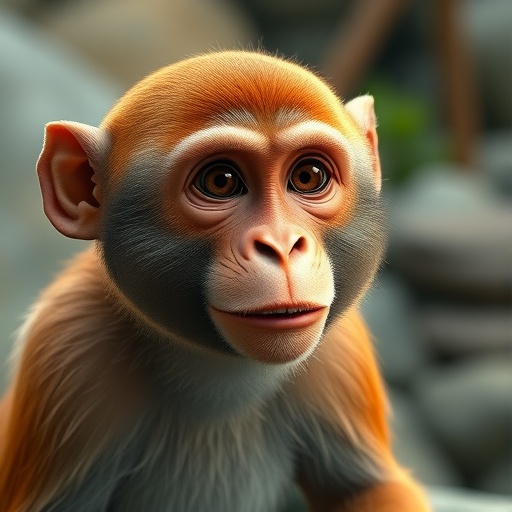
A new study in PLOS Biology reports the first experimental evidence that non-human primates can experience the uncanny valley—an effect long discussed in humans—when viewing artificially generated body animations. The work centers on rhesus macaques, animals whose social lives depend on rich visual signals from both faces and full-body movement.

Researchers built a specialized animation pipeline, dubbed “MacAction,” designed for macaques rather than humans. Conventional motion-capture approaches rely on reflective markers, but applying them to monkeys is impractical. MacAction instead uses deep learning to generate realistic 3D body avatars from multi-camera video footage, producing motion that matches real animals closely enough to support controlled experiments.

To validate realism, the team presented eight male rhesus macaques with paired stimuli: recordings of real monkeys performing specific movements, and an animated avatar executing the same actions. By tracking where the macaques looked, how often they fixated, and for how long, the researchers found no meaningful differences in attention patterns between real and animated targets. In other words, the avatars were believable to the monkeys.

Having established that the system can generate highly convincing motion, the researchers then asked a sharper question: does “almost real” look worse than “not quite real”? They systematically altered the avatar’s appearance in stages, sequentially removing fur, color, and texture to create different realism levels, from uncanny to highly naturalistic.

The results showed a U-shaped relationship between realism and attention. Macaques spent less time looking at avatars with intermediate realism than they did at both extremes—very unrealistic animations and the most lifelike version. This pattern matches the classic uncanny valley signature, suggesting that macaques are sensitive to subtle deviations in body appearance.

Importantly, the uncanny valley effect here is not about faces alone. The study highlights body perception and the motion-and-structure cues primates use to interpret social signals, extending uncanny valley research beyond human-like facial rendering.

Beyond behavioral insight, the tool itself opens new experimental possibilities. By enabling realistic full-body animations with limited resources and marker-less tracking, MacAction offers a practical way to manipulate pose and social dynamics in controlled neurobehavioral studies.

The paper’s findings argue that social perception in macaques and humans shares striking parallels: both systems treat nearly realistic artificial bodies as potentially unsettling, even when the movement is accurate.

The study is open access and can be read here: https://plos.io/3QfoqJe

Subject of Research: Animals; primates (rhesus macaques)
Article Title: Realistic monkey body animation reveals an uncanny valley in macaque body perception.
News Publication Date: 14-Jul-2026
Web References: https://plos.io/3QfoqJe
References: Martini LM, Bognár A, Vogels R, Giese MA (2026) Realistic monkey body animation reveals an uncanny valley in macaque body perception. PLoS Biol 24(7): e3003880. DOI: 10.1371/journal.pbio.3003880
Image Credits: Lucas Martini et al. (CC-BY 4.0)
Keywords: uncanny valley; macaques; 3D avatars; deep learning; markerless tracking; primate social perception; PLOS Biology

Tags: 3D animated monkey avatarsanimation pipeline for non-human primatesartificial body animation in non-human primatesdeep learning for primate motion captureeffects of near-realistic avatars on primatesexperimental evidence of uncanny valley in animalsmacaque gaze and attention trackingprimate response to artificial stimulirealistic primate motion generationrhesus macaque social perceptionuncanny valley in primatesvalidation of animated primate realism
Share26Tweet16
Previous Post

Researchers Identify Therapeutic Vulnerability in Aggressive Childhood Leukemia

Next Post

Griffin Secures Funding for Bullying Prevention Project

Related Posts

Aging Cells Revert to Stem Cells as Self-Repair Mimics
Biology

Aging Cells Revert to Stem Cells as Self-Repair Mimics

July 14, 2026
Study Finds Honey Bees’ Smell Senses Shift from Larvae to Adults
Biology

Study Finds Honey Bees’ Smell Senses Shift from Larvae to Adults

July 14, 2026
Genomic data reveal widespread hybridization and invasion history of saltcedar
Biology

Genomic data reveal widespread hybridization and invasion history of saltcedar

July 14, 2026
Sinkholes shield endangered trees but impose evolutionary risks, study finds
Biology

Sinkholes shield endangered trees but impose evolutionary risks, study finds

July 14, 2026
Enhancing bacteria to accelerate environmental cleanup processes
Biology

Enhancing bacteria to accelerate environmental cleanup processes

July 14, 2026
New Insights into Immune Checkpoints’ Role in Controlling Inflammation
Biology

New Insights into Immune Checkpoints’ Role in Controlling Inflammation

July 14, 2026
Next Post
Griffin Secures Funding for Bullying Prevention Project

Griffin Secures Funding for Bullying Prevention Project

  • Mothers who receive childcare support from maternal grandparents show more

    Mothers who receive childcare support from maternal grandparents show more parental warmth, finds NTU Singapore study

    27656 shares
    Share 11059 Tweet 6912
  • University of Seville Breaks 120-Year-Old Mystery, Revises a Key Einstein Concept

    1061 shares
    Share 424 Tweet 265
  • Bee body mass, pathogens and local climate influence heat tolerance

    682 shares
    Share 273 Tweet 171
  • Researchers record first-ever images and data of a shark experiencing a boat strike

    546 shares
    Share 218 Tweet 137
  • Groundbreaking Clinical Trial Reveals Lubiprostone Enhances Kidney Function

    531 shares
    Share 212 Tweet 133
Science

Embark on a thrilling journey of discovery with Scienmag.com—your ultimate source for cutting-edge breakthroughs. Immerse yourself in a world where curiosity knows no limits and tomorrow’s possibilities become today’s reality!

RECENT NEWS

  • Depression Linked to Hippocampal Subfield Volume Changes in Older Adults
  • Age-Specific Molecular Subgroups in Pediatric and Young-Onset Meningiomas Require Tailored Risk Models
  • RASopathy Subtype Shapes Early Hypertrophic Cardiomyopathy Course, Study Finds
  • Informal Dementia Caregivers as Hidden Second Patients: Stress, Resilience, Burden

Categories

  • Agriculture
  • Anthropology
  • Archaeology
  • Athmospheric
  • Biology
  • Biotechnology
  • Blog
  • Bussines
  • Cancer
  • Chemistry
  • Climate
  • Earth Science
  • Editorial Policy
  • Marine
  • Mathematics
  • Medicine
  • Pediatry
  • Policy
  • Psychology & Psychiatry
  • Science Education
  • Social Science
  • Space
  • Technology and Engineering

Subscribe to Blog via Email

Enter your email address to subscribe to this blog and receive notifications of new posts by email.

Join 5,146 other subscribers

© 2025 Scienmag - Science Magazine

Welcome Back!

Login to your account below

Forgotten Password?

Retrieve your password

Please enter your username or email address to reset your password.

Log In
No Result
View All Result
  • HOME
  • SCIENCE NEWS
  • CONTACT US

© 2025 Scienmag - Science Magazine

Discover more from Science

Subscribe now to keep reading and get access to the full archive.

Continue reading
