

Tuesday, July 14, 2026
Science
No Result
View All Result
  • Login
  • HOME
  • SCIENCE NEWS
  • CONTACT US
  • HOME
  • SCIENCE NEWS
  • CONTACT US
No Result
View All Result
Scienmag
No Result
View All Result
Home Science News Biology

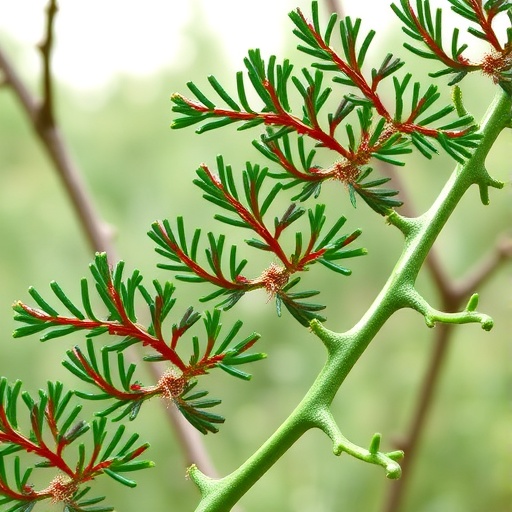
Genomic data reveal widespread hybridization and invasion history of saltcedar

July 14, 2026
in Biology
Reading Time: 2 mins read
0
Genomic data reveal widespread hybridization and invasion history of saltcedar

Genomic data reveal widespread hybridization and invasion history of saltcedar

65
SHARES
587
VIEWS
Share on FacebookShare on Twitter
ADVERTISEMENT

Biological invasions can bring once-isolated lineages into contact, and hybridization often follows. That genetic mixing may generate new combinations of traits and help invasive species establish quickly, even while maintaining unexpected levels of diversity. Now, a new genomic study links these processes to the ongoing spread of invasive saltcedar in the American Southwest.

Saltcedar (Tamarix spp.) poses major ecological challenges along river corridors, where it can alter water use, soil conditions, and native plant communities. Researchers focused on invasive populations in the southwestern United States and asked a central question: were these populations formed from one native source, or do they reflect repeated hybridization between parental lineages?

To investigate, the team analyzed genome-wide SNP data from 319 individuals, including representatives of the proposed parental lineages Tamarix chinensis and Tamarix ramosissima. By combining population genomics with ecological niche modeling and demographic inference, the study reconstructed likely origins of the introduced populations and quantified how ancestry is distributed across major river basins.

The results show that introduced saltcedar populations are predominantly admixed, with different proportions of ancestry from both parental lineages. Instead of a uniform genetic makeup, US populations display basin-specific patterns that suggest multiple waves and sources of genetic input over time.

Multiple statistical and comparative-genomic approaches independently supported widespread admixture. Hybrid indices indicated frequent intermediate ancestry, while f3-statistics provided formal tests consistent with gene flow. Phylogenetic network analyses further captured non-tree-like relationships expected when lineages exchange genes after secondary contact.

Demographic inference pointed to a recent invasion history consistent with historical records of introduction. Importantly, the data suggest that hybrid or admixed propagules were likely introduced first and then expanded, rather than hybridization occurring only after establishment.

Ecological niche modeling added a parallel layer of evidence. The introduced populations showed significant differentiation and signals consistent with niche expansion relative to their native parental counterparts, implying that hybridization may coincide with ecological opportunity in invaded habitats.

Taken together, the study indicates that hybridization—coupled with multiple introductions and post-introduction demographic processes—helped maintain neutral genetic diversity and may have contributed to saltcedar’s persistence. More broadly, it demonstrates how integrating genomic evidence with ecological modeling can clarify the evolutionary dynamics that underpin biological invasions.

Subject of Research: Biological invasions; hybridization; population genomics and ecological niche modeling
Article Title: Genomic evidence for widespread hybridization and demographic history in invasive saltcedar
Article References:

Lee, SR., Choi, TY. Genomic evidence for widespread hybridization and demographic history in invasive saltcedar. Heredity (2026). https://doi.org/10.1038/s41437-026-00866-1

Image Credits: AI Generated
DOI: https://doi.org/10.1038/s41437-026-00866-1
Keywords: not provided

Tags: basin-specific genetic structure in Tamarixecological impact of saltcedarecological niche modeling of invasive plantsgenetic diversity in invasive populationsgenomic analysis of invasive specieshybrid origin of saltcedarhybridization in invasive plantsinvasion pathways of saltcedarinvasive species demographic historySaltcedar invasion geneticsSNP data in plant invasionsTamarix spp. population genomics
Share26Tweet16
Previous Post

JMIR News: CMR-CLIP, Stroke Rehab Simulators, and Menopause Tracking Apps

Next Post

Treatment delays in colorectal cancer linked to higher metastasis risk thresholds

Related Posts

Study Finds Honey Bees’ Smell Senses Shift from Larvae to Adults
Biology

Study Finds Honey Bees’ Smell Senses Shift from Larvae to Adults

July 14, 2026
Sinkholes shield endangered trees but impose evolutionary risks, study finds
Biology

Sinkholes shield endangered trees but impose evolutionary risks, study finds

July 14, 2026
Enhancing bacteria to accelerate environmental cleanup processes
Biology

Enhancing bacteria to accelerate environmental cleanup processes

July 14, 2026
New Insights into Immune Checkpoints’ Role in Controlling Inflammation
Biology

New Insights into Immune Checkpoints’ Role in Controlling Inflammation

July 14, 2026
UMA Scientists Enhance Morphine’s Pain-Relief Effectiveness
Biology

UMA Scientists Enhance Morphine’s Pain-Relief Effectiveness

July 13, 2026
Adolescent Brain Responses to Faces Could Forecast Social Development
Biology

Adolescent Brain Responses to Faces Could Forecast Social Development

July 13, 2026
Next Post
Treatment delays in colorectal cancer linked to higher metastasis risk thresholds

Treatment delays in colorectal cancer linked to higher metastasis risk thresholds

  • Mothers who receive childcare support from maternal grandparents show more

    Mothers who receive childcare support from maternal grandparents show more parental warmth, finds NTU Singapore study

    27656 shares
    Share 11059 Tweet 6912
  • University of Seville Breaks 120-Year-Old Mystery, Revises a Key Einstein Concept

    1061 shares
    Share 424 Tweet 265
  • Bee body mass, pathogens and local climate influence heat tolerance

    682 shares
    Share 273 Tweet 171
  • Researchers record first-ever images and data of a shark experiencing a boat strike

    546 shares
    Share 218 Tweet 137
  • Groundbreaking Clinical Trial Reveals Lubiprostone Enhances Kidney Function

    531 shares
    Share 212 Tweet 133
Science

Embark on a thrilling journey of discovery with Scienmag.com—your ultimate source for cutting-edge breakthroughs. Immerse yourself in a world where curiosity knows no limits and tomorrow’s possibilities become today’s reality!

RECENT NEWS

  • Hasmonean and Qumran calendars combine to solve a Dead Sea Scrolls mystery
  • Plasma Farming Advances Toward Outperforming Conventional Agricultural Methods
  • Modern Slavery Is Managed Like a Business Choice, Not an Accident
  • Shear Loading Causes Accelerating Damage Growth in Metals

Categories

  • Agriculture
  • Anthropology
  • Archaeology
  • Athmospheric
  • Biology
  • Biotechnology
  • Blog
  • Bussines
  • Cancer
  • Chemistry
  • Climate
  • Earth Science
  • Editorial Policy
  • Marine
  • Mathematics
  • Medicine
  • Pediatry
  • Policy
  • Psychology & Psychiatry
  • Science Education
  • Social Science
  • Space
  • Technology and Engineering

Subscribe to Blog via Email

Enter your email address to subscribe to this blog and receive notifications of new posts by email.

Join 5,146 other subscribers

© 2025 Scienmag - Science Magazine

Welcome Back!

Login to your account below

Forgotten Password?

Retrieve your password

Please enter your username or email address to reset your password.

Log In
No Result
View All Result
  • HOME
  • SCIENCE NEWS
  • CONTACT US

© 2025 Scienmag - Science Magazine

Discover more from Science

Subscribe now to keep reading and get access to the full archive.

Continue reading
