

Friday, September 4, 2026
Science
No Result
View All Result
  • Login
  • HOME
  • SCIENCE NEWS
  • CONTACT US
  • HOME
  • SCIENCE NEWS
  • CONTACT US
No Result
View All Result
Scienmag
No Result
View All Result
Home Science News Technology and Engineering

3D-Printable Elastic Polymer Demonstrates Unexpectedly High Strength

July 14, 2026
in Technology and Engineering
Neil Sanderson
By Neil Sanderson Scienmag Editorial Profile - Materials Characterization
Reading Time: 2 mins read
0
3D-Printable Elastic Polymer Demonstrates Unexpectedly High Strength

3D-Printable Elastic Polymer Demonstrates Unexpectedly High Strength

65
SHARES
587
VIEWS
Share on FacebookShare on Twitter
ADVERTISEMENT

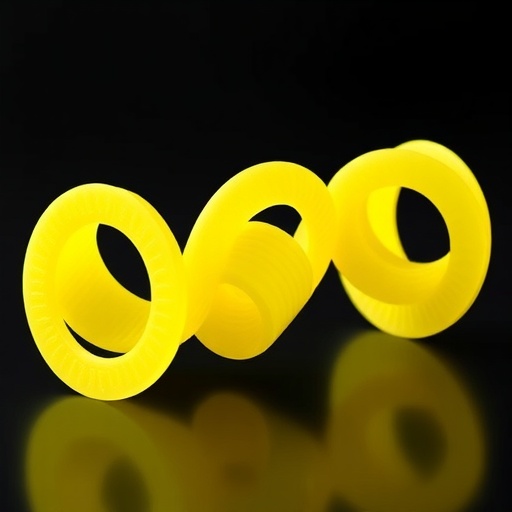
In a groundbreaking development from EPFL’s Soft Materials Laboratory, researchers have unveiled a novel class of rubber-like materials known as double network granular elastomers (DNGEs). These materials, consisting of microscopic elastomer particles embedded within a softer elastomer matrix, were initially engineered as innovative inks for 3D printing flexible devices. Their unique dual-network architecture allows unprecedented control over mechanical properties, overcoming longstanding challenges in soft material fabrication.

The latest study published in Science Advances reveals that beyond facilitating advanced 3D printing, DNGEs exhibit a remarkable combination of toughness and fatigue resistance—a rare feat in elastomers. Typically, materials that resist fractures tend to accumulate damage under cyclic stress, leading to shorter lifespans, while those that endure repetitive strain often sacrifice ultimate strength. DNGEs defy this trade-off through their specialized microstructure.

The secret lies in the interplay between their two constituent networks. One network is composed of rigid granular elastomer particles, while the second is a softer, more compliant elastomer. When subjected to mechanical stress, these networks share and redistribute strain, preventing concentration of damage in any single region. This strain-sharing mechanism enhances overall material robustness, allowing DNGEs to absorb and dissipate energy repeatedly without irreversible bond breakage.

Experimental evaluations demonstrated fracture toughness values up to 15 times greater than comparable elastomers, with fatigue resistance improvements reaching threefold. Crucially, the granular structure alters crack propagation pathways. Instead of a direct fracture line, cracks navigate a tortuous route through the softer matrix regions, significantly slowing crack growth and delaying failure.

At the molecular level, the softer elastomer regions accommodate strain by enabling polymer chains to slide and rearrange, dissipating energy through reversible mechanisms rather than permanent damage. This dynamic energy absorption is key to the materials’ durability under repeated mechanical loading.

The implications of this research are profound for the design of longer-lasting flexible materials in emerging technologies such as soft robotics, wearable electronics, and biomedical devices. Components in these fields are often exposed to continual deformation and loading cycles, demanding materials that withstand both sudden shocks and chronic fatigue.

Looking forward, the EPFL team is working toward enhancing sustainability by incorporating biodegradable and recycled elastomers into their double network design. This approach aims to maintain the high-performance mechanical characteristics of DNGEs while reducing environmental impact. By broadening material choices and preserving processability, they hope to democratize access to these advanced elastomer inks, making them widely available to labs equipped with standard commercial 3D printers.

This innovative research not only redefines what’s possible in elastomer toughness and fatigue resistance but also offers a scalable, adaptable platform for next-generation soft materials with vast applications.

Keywords

Materials science, elastomers, 3D printing, fatigue resistance, fracture toughness, soft robotics, sustainable materials

Subject of Research: Double network granular elastomers for advanced 3D printing and enhanced mechanical durability
Article Title: Fatigue-resistant and tough double network granular elastomers
News Publication Date: 10-Jul-2026
Web References: https://doi.org/10.1126/sciadv.aec3482
Image Credits: 2026 SMaL EPFL CC BY Sa

Article Title: 3D-Printable Elastic Polymer Demonstrates Unexpectedly High Strength

Article References: Original research article

Image Credits: AI Generated

DOI: Not provided

Keywords: 3D printing flexible devices, double network granular elastomers, Elastic polymer, elastomer fracture toughness, high-strength soft materials, innovative elastomer inks, microstructural control of mechanical properties, microstructure of elastomers, rubber-like materials, soft material fabrication advancements, strain-sharing mechanisms in polymers, tough and fatigue-resistant elastomers

Cite Scienmag News

Neil Sanderson. (July 14, 2026). 3D-Printable Elastic Polymer Demonstrates Unexpectedly High Strength. Scienmag. https://scienmag.com/3d-printable-elastic-polymer-demonstrates-unexpectedly-high-strength/

Neil Sanderson. "3D-Printable Elastic Polymer Demonstrates Unexpectedly High Strength." Scienmag, 14 July 2026, https://scienmag.com/3d-printable-elastic-polymer-demonstrates-unexpectedly-high-strength/. Accessed 4 September 2026.

Neil Sanderson. "3D-Printable Elastic Polymer Demonstrates Unexpectedly High Strength." Scienmag. July 14, 2026. https://scienmag.com/3d-printable-elastic-polymer-demonstrates-unexpectedly-high-strength/


Tags: 3D printing flexible devicesdouble network granular elastomersElastic polymerelastomer fracture toughnesshigh-strength soft materialsinnovative elastomer inksmicrostructural control of mechanical propertiesmicrostructure of elastomersrubber-like materialssoft material fabrication advancementsstrain-sharing mechanisms in polymerstough and fatigue-resistant elastomers
Share26Tweet16
Previous Post

Cellular Recycling Protein Crucial for Gut Protection and Health

Next Post

Reducing Muscle Stiffness Could Help Myotonic Dystrophy Patients

Related Posts

Graph neural networks automate conjecture discovery in number theory research
Technology and Engineering

Graph neural networks automate conjecture discovery in number theory research

September 4, 2026
Dual-mode charge storage achieved in laser-induced graphene supercapacitors
Technology and Engineering

Dual-mode charge storage achieved in laser-induced graphene supercapacitors

September 4, 2026
Graphene microcavity sensor tracks blood pressure in single vessels
Technology and Engineering

Graphene microcavity sensor tracks blood pressure in single vessels

September 4, 2026
Econometric and machine learning models improve volatility forecasting with capacity control
Technology and Engineering

Econometric and machine learning models improve volatility forecasting with capacity control

September 4, 2026
How AI systems reshape human judgement in mediated society
Technology and Engineering

How AI systems reshape human judgement in mediated society

September 4, 2026
Quantum computers tackle image loading and classification at utility scale
Technology and Engineering

Quantum computers tackle image loading and classification at utility scale

September 4, 2026
Next Post
Reducing Muscle Stiffness Could Help Myotonic Dystrophy Patients

Reducing Muscle Stiffness Could Help Myotonic Dystrophy Patients

  • Mothers who receive childcare support from maternal grandparents show more optimized

    Mothers who receive childcare support from maternal grandparents show more parental warmth, finds NTU Singapore study

    27656 shares
    Share 11059 Tweet 6912
  • University of Seville Breaks 120-Year-Old Mystery, Revises a Key Einstein Concept

    1061 shares
    Share 424 Tweet 265
  • Bee body mass, pathogens and local climate influence heat tolerance

    682 shares
    Share 273 Tweet 171
  • Researchers record first-ever images and data of a shark experiencing a boat strike

    546 shares
    Share 218 Tweet 137
  • Groundbreaking Clinical Trial Reveals Lubiprostone Enhances Kidney Function

    531 shares
    Share 212 Tweet 133
Science

Embark on a thrilling journey of discovery with Scienmag.com—your ultimate source for cutting-edge breakthroughs. Immerse yourself in a world where curiosity knows no limits and tomorrow’s possibilities become today’s reality!

RECENT NEWS

  • Graph neural networks automate conjecture discovery in number theory research
  • Mesoamerican midsummer drought shows surprising diversity across regions
  • How people in South Sudan’s Sudd wetlands adapt to flood risk
  • Metformin restores mitochondrial quality control in Down syndrome fibroblasts

Categories

  • Agriculture
  • Anthropology
  • Archaeology
  • Athmospheric
  • Biology
  • Biotechnology
  • Blog
  • Bussines
  • Cancer
  • Chemistry
  • Climate
  • Earth Science
  • Editorial Policy
  • Marine
  • Mathematics
  • Medicine
  • Pediatry
  • Policy
  • Psychology & Psychiatry
  • Science Education
  • Social Science
  • Space
  • Technology and Engineering

Subscribe to Blog via Email

Enter your email address to subscribe to this blog and receive notifications of new posts by email.

Join 5,151 other subscribers

© 2025 Scienmag - Science Magazine

Welcome Back!

Login to your account below

Forgotten Password?

Retrieve your password

Please enter your username or email address to reset your password.

Log In
No Result
View All Result
  • HOME
  • SCIENCE NEWS
  • CONTACT US

© 2025 Scienmag - Science Magazine

Discover more from Science

Subscribe now to keep reading and get access to the full archive.

Continue reading