


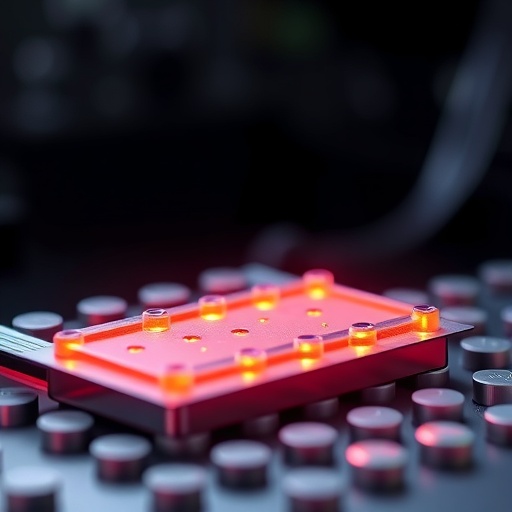
In a groundbreaking study, researchers from North Carolina State University have developed an innovative method to visualize the dynamic behavior of ferroelectric domain walls under electric fields in real time. This advancement offers unprecedented insight into the complex processes occurring during poling—when domains within ferroelectric materials align under applied electric fields—a phenomenon critical to improving technologies from sensors to actuators.
Traditionally, understanding ferroelectric polarization changes relied on comparing before-and-after measurements, obscuring the transient dynamics that govern device performance. Conventional techniques involved capturing multiple images with varying optical polarization states, which limited temporal resolution and prevented real-time observation of domain wall motion.
The team’s novel approach circumvents these limitations by employing a broadband white light source split into multiple wavelengths, each with distinct optical polarizations. Capturing this multiplexed data in a single image allows for significantly higher frame rates—up to thousands per second—enabling researchers to resolve rapid domain wall dynamics as they unfold. For their experiments, a frame rate of 100 frames per second was sufficient to reveal critical details during the electric poling and depoling processes.
Using this technique, the researchers observed the movement and transformation of domain walls in unparalleled detail, shedding light on debates that have persisted within the ferroelectric materials community. One significant controversy revolved around the application of alternating current (AC) fields: whether they induce rapid polarization switching synchronized with the field oscillations. The real-time imagery confirms that polarization indeed oscillates with the applied AC field, a phenomenon previously unverifiable due to technological constraints.
These insights have broad implications for designing more efficient and reliable ferroelectric devices. Understanding how domain walls react to different electrical stimuli—AC poling, direct current (DC) poling, and depoling—opens pathways to engineer materials with tailored electrical responses, improving performance in applications ranging from memory storage to precision actuators.
The research was meticulously documented in an open-access article published in Advanced Science, authored by a multidisciplinary team including doctoral students, professors, and postdoctoral researchers. Their combined expertise spanning mechanical and aerospace engineering to materials science facilitated the integration of advanced optical techniques with materials characterization.
Supporting this scientific leap were grants from the National Science Foundation and various U.S. Department of Defense agencies, emphasizing the strategic importance of ferroelectric research. Future work aims to harness these insights to develop optimized poling protocols, pushing the boundaries of how ferroelectric materials can be manipulated for technological breakthroughs.
This novel imaging method not only resolves longstanding debates but also establishes a new experimental paradigm for studying ultrafast phenomena in complex materials, marking a significant milestone in materials science.
Cite Scienmag News
Reid Dalton. (July 13, 2026). New method clarifies debates on ferroelectric materials. Scienmag. https://scienmag.com/new-method-clarifies-debates-on-ferroelectric-materials/
Reid Dalton. "New method clarifies debates on ferroelectric materials." Scienmag, 13 July 2026, https://scienmag.com/new-method-clarifies-debates-on-ferroelectric-materials/. Accessed 3 September 2026.
Reid Dalton. "New method clarifies debates on ferroelectric materials." Scienmag. July 13, 2026. https://scienmag.com/new-method-clarifies-debates-on-ferroelectric-materials/


