


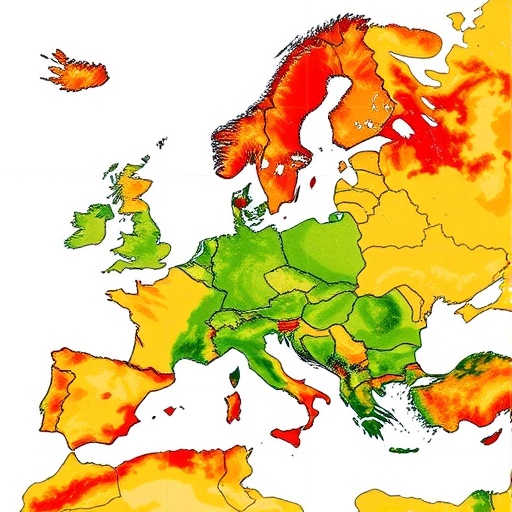
In the face of mounting climate challenges across Europe, a groundbreaking study spearheaded by researchers Gohari, Saboori, Ghadimi, and their colleagues unveils a pioneering approach to understanding the complex interactions of extreme weather events impacting agricultural ecosystems. This new research introduces a multivariate framework designed to assess compound agroclimatic extremes, an advancement poised to revolutionize how scientists, policymakers, and farmers comprehend and respond to the intertwined nature of climatic threats to crop production and food security.
This study, published in Communications Earth & Environment in 2026, tackles the long-standing difficulty in quantifying compound climate extremes—events that do not occur in isolation but rather in combination, heightening risks in ways that single-variable analyses have traditionally missed. Compound extremes might involve simultaneous or sequential occurrences of heatwaves, drought, excessive precipitation, and frost events, the interactions of which amplify their destructive impacts on crops, soils, and water availability. By developing a multivariate statistical framework, the authors aim to create a more holistic and predictive understanding of these overlapping agroclimatic hazards.
At the heart of the research is the recognition that agricultural production is vulnerable to multiple stressors that can coincide in space and time. Traditional risk assessment models typically examine climatic variables like temperature or rainfall independently, neglecting their joint occurrence and the resulting compound effects. The framework put forward by this research integrates these multiple variables into a unified model, enabling the capture of the complex dependency structures between climatic factors that drive compound extremes.
The methodology leverages advanced statistical techniques to model the joint probability distributions of relevant climatic variables. Multivariate copula methods, a cornerstone of this approach, allow the researchers to capture non-linear dependencies and tail correlations where extreme values of multiple variables co-occur. This nuanced modeling is key to understanding how, for example, a hot dry spell combined with an early frost period can severely impact crop yields, far beyond what isolated extremes might predict.
Data analysis within the study draws upon extensive European agroclimatic datasets, incorporating meteorological observations and climate model outputs that encompass temperature, precipitation, humidity, and soil moisture variables, among others. The synthesis of observational and modeled data positions the framework not only as a diagnostic tool to understand historical compound extremes but also as a forecasting instrument vital for projecting future risks under varying climate scenarios.
One of the significant revelations in this work is the spatial heterogeneity of compound agroclimatic extremes across Europe. Different regions experience varying patterns of compound risk due to local climatic regimes, agricultural practices, and topographical influences. The framework adeptly identifies hotspots where compound extremes are becoming more frequent and intense, information crucial for targeted adaptation strategies and resource allocation.
A critical implication of this multivariate framework lies in its utility for agricultural risk management and policy development. By revealing complex risk profiles, the framework empowers stakeholders to devise more resilient farming systems that can withstand multiple simultaneous climatic shocks. This includes optimizing crop selection, altering planting schedules, and investing in irrigation infrastructure responsive to compound climate stressors.
Furthermore, the model’s predictive capability supports early warning systems by highlighting periods when multiple extreme conditions are expected to coincide. These predictions can underpin preemptive actions – such as mobilizing relief resources or adjusting market strategies – mitigating adverse crop losses and stabilizing food supply chains.
In addition to operational farming benefits, the research provides a pivotal scientific foundation for advancing climate impact models beyond Europe, as the multivariate framework is adaptable to other global agroclimatic zones. As climate change intensifies the frequency and severity of compound extremes worldwide, such a tool becomes indispensable for global food security analyses and international cooperation on climate resilience.
The study also emphasizes the importance of integrating interdisciplinary data, blending climatology, agronomy, and statistical science to achieve insightful assessments. This holistic approach highlights the future direction of climate impact research, where compound risk evaluation will become standard to fully capture the scope of climate-related vulnerabilities in agroecosystems.
Despite these advances, the authors acknowledge limitations, including the challenges of downscaling climate model outputs to agriculturally relevant spatial resolutions and the complexity of capturing all environmental interactions in a single framework. However, the study lays out a roadmap for ongoing refinement and encourages the coupling of this framework with real-time monitoring technologies such as remote sensing and soil sensors for enhanced precision.
As the global agricultural community grapples with escalating climate risks, this research represents a timely and essential leap forward, offering a sophisticated lens for analyzing the multifaceted threats posed by compound climate extremes. Its innovative statistical approach shines as a beacon for future studies and practical applications, bridging the gap between theoretical risk quantification and applied agroclimatic resilience.
In conclusion, this multivariate framework by Gohari and colleagues does not merely add another tool to the climate science arsenal — it transforms our ability to decode the intertwined nature of extreme weather events in agriculture. As Europe and the world face an uncertain climatic future, such integrative innovations become fundamental to safeguarding the stability of food production and, ultimately, human wellbeing.
Cite Scienmag News
Alan Morgan. (July 4, 2026). Mapping Compound Agroclimatic Extremes Across Europe. Scienmag. https://scienmag.com/mapping-compound-agroclimatic-extremes-across-europe/
Alan Morgan. "Mapping Compound Agroclimatic Extremes Across Europe." Scienmag, 4 July 2026, https://scienmag.com/mapping-compound-agroclimatic-extremes-across-europe/. Accessed 5 September 2026.
Alan Morgan. "Mapping Compound Agroclimatic Extremes Across Europe." Scienmag. July 4, 2026. https://scienmag.com/mapping-compound-agroclimatic-extremes-across-europe/


