


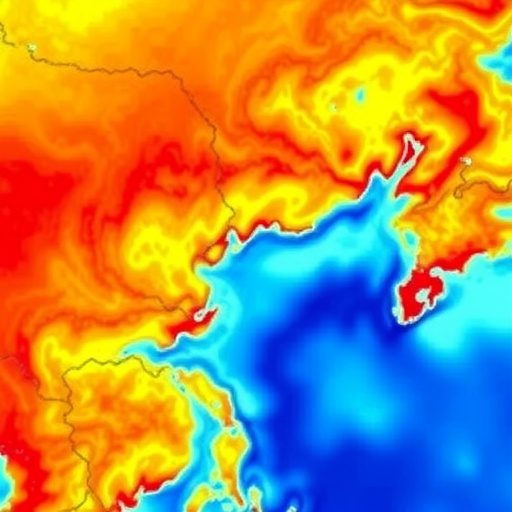
Perfluorooctanoic acid (PFOA), a heavily scrutinized member of the per- and polyfluoroalkyl substances (PFAS) family, has captivated scientific and public attention due to its pervasive presence and persistence in natural environments. Characterized by its remarkable chemical stability and resistance to degradation, PFOA’s widespread industrial utilization over recent decades has rendered it a global contaminant, raising significant concerns regarding its toxicological impact on both human health and ecological systems. Recent hydrodynamic and chemical modeling efforts focused on the Seto Inland Sea of Japan reveal critical insights into the distribution, transport, and environmental fate of PFOA in a complex coastal marine setting, with implications that extend far beyond regional boundaries.
The Seto Inland Sea, a semi-enclosed body of water surrounded by Japan’s main islands, acts as a critical receptor zone for numerous riverine inputs, many of which convey substantial loads of anthropogenic pollutants. Elevated concentrations of PFOA have been documented in the rivers draining into this sea, notably from industrial and urbanized watersheds such as those encompassing the Yodo and Yamato rivers. These river systems contribute significantly to the PFOA burden within the sea, making the Seto Inland Sea not only a recipient of contamination but also potentially a source of PFOA export to adjacent marine environments such as the Pacific Ocean.
Advanced coupled hydrodynamic-ecosystem-PFOA models have been developed to simulate the behavior of both dissolved and particulate phases of PFOA within the Seto Inland Sea. These models integrate physical water circulation patterns with biogeochemical processes, enabling precise characterization of the spatial and temporal variability of PFOA concentrations. The modeling approach accounts for the partitioning of PFOA between dissolved forms and its association with biogenic particles, reflecting natural interactions that influence transport dynamics and bioavailability.
Spatial analysis of model outputs reveals a pronounced gradient in PFOA concentration between the eastern and western parts of the Seto Inland Sea. The eastern region exhibits markedly higher mean concentrations of PFOA, averaging approximately 468.5 nanograms per cubic meter. In stark contrast, the western sector demonstrates significantly lower values, around 11.5 nanograms per cubic meter. This disparity underscores the dominant influence of riverine discharges, particularly those from the Yodo and Yamato rivers, in shaping contaminant distribution patterns within the sea. The heterogeneity in PFOA concentrations highlights the importance of localized source control in managing regional pollution.
Another pivotal aspect of PFOA’s environmental behavior is its phase partitioning, which the study found to vary distinctly between nearshore and offshore zones. Near coastal areas, particulate association is more pronounced, suggesting that PFOA binds effectively to suspended biogenic matter before being transported. Offshore waters, by contrast, exhibit a lower ratio of particulate to dissolved PFOA, indicating a predominance of free dissolved forms. This phase differentiation influences not only the transport pathways but also the potential for bioaccumulation and trophic transfer in marine food webs.
Upon entering Osaka Bay, a critical subregion of the Seto Inland Sea, the fate of PFOA becomes clearer through detailed hydrodynamic assessments. About one quarter of the PFOA introduced into Osaka Bay is transported westward into Harima Nada, while a majority, roughly 63%, flows southward through the Kii Channel. This channel functions as a conduit, allowing PFOA to transit from coastal waters into the open Pacific Ocean, primarily within the upper 20 meters of the water column. Such stratified transport processes highlight the vertical and horizontal complexity inherent in coastal contaminant dispersal.
Considering the broader geographic scale, the research estimates that rivers discharging into Osaka Bay and Suo Nada collectively contribute an estimated annual PFOA flux into the Pacific Ocean ranging from 328 to 348.9 kilograms. The Seto Inland Sea is identified as the principal contributor within this estimate, emphasizing the regional significance of this water body in the ongoing dissemination of PFOA into marine environments. This quantification aids in understanding the loadings that might influence oceanic PFOA concentrations and potential long-range transport mechanisms.
Environmental implications of these findings are multifaceted. The persistence and bioaccumulative potential of PFOA pose risks to marine organisms, particularly in nearshore regions where particulate-bound forms are prevalent. Since PFOA does not readily degrade, continual input from rivers creates a sustained contamination source, which may have cascading ecological effects. Furthermore, the transport into open ocean waters raises concerns regarding the pollutant’s eventual integration into larger oceanic systems and exposure to a wider array of marine biota.
From a management and policy perspective, these insights underscore the necessity of targeting riverine sources for pollution mitigation. Since the Yodo and Yamato rivers disproportionately affect PFOA levels in the eastern Seto Inland Sea, regulatory measures focusing on industrial discharge controls and improved wastewater treatment within these watersheds could substantially reduce the contaminant load entering the marine environment.
Moreover, the study’s methodology—integrating hydrodynamic modeling with ecosystem and contaminant transport simulations—provides a robust framework that can be applied to other coastal systems worldwide. Such advanced modeling approaches afford greater predictive capacity and the ability to assess mitigation scenarios, guiding evidence-based decisions aimed at curbing persistent pollutants on a global scale.
In conclusion, the research illuminates critical processes governing the distribution, partitioning, and fate of PFOA in a vital coastal marine environment. The Seto Inland Sea acts as both a sink and a source, where riverine inputs significantly influence local concentration gradients and where hydrodynamic conditions facilitate the transfer of PFOA to the open ocean. These findings enhance the scientific understanding of PFAS dynamics in coastal waters and highlight the urgency of addressing riverine pollution to safeguard marine ecosystems and public health.
News Publication Date: (Not specified)
Web References: http://dx.doi.org/10.1016/j.jhazmat.2026.142343
Cite Scienmag News
Violet Maxwell. (July 1, 2026). Tracing PFOA in the Seto Inland Sea: Patterns, Movement, and Environmental Impact. Scienmag. https://scienmag.com/tracing-pfoa-in-the-seto-inland-sea-patterns-movement-and-environmental-impact/
Violet Maxwell. "Tracing PFOA in the Seto Inland Sea: Patterns, Movement, and Environmental Impact." Scienmag, 1 July 2026, https://scienmag.com/tracing-pfoa-in-the-seto-inland-sea-patterns-movement-and-environmental-impact/. Accessed 2 September 2026.
Violet Maxwell. "Tracing PFOA in the Seto Inland Sea: Patterns, Movement, and Environmental Impact." Scienmag. July 1, 2026. https://scienmag.com/tracing-pfoa-in-the-seto-inland-sea-patterns-movement-and-environmental-impact/


