


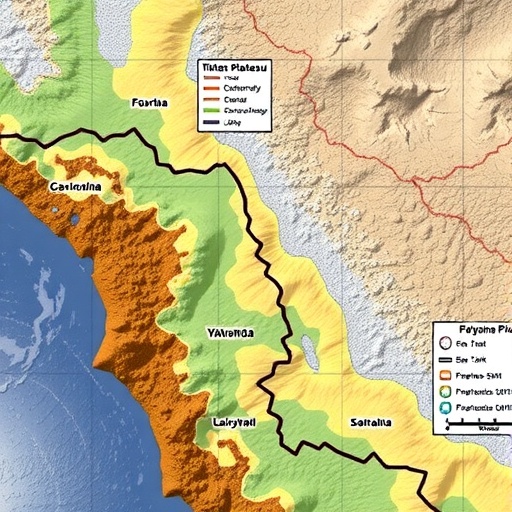
In a landmark study published in Communications Earth & Environment, researchers He, Wang, Song, and colleagues have unveiled groundbreaking insights into the tectonic evolution of the northwestern Tibetan Plateau from the Late Eocene to the Oligocene epochs. This timely research sheds new light on the intricate intracontinental deformation processes that shaped one of Earth’s most formidable geological features, fundamentally advancing our understanding of plateau growth and intracontinental tectonics.
Spanning a pivotal period between approximately 40 and 23 million years ago, the Late Eocene to Oligocene interval corresponds to a dynamic phase in Earth’s history marked by dramatic shifts in climate, ocean circulation, and of course, tectonic forces. The northwestern Tibetan Plateau, already a complex mosaic of geological units, experienced profound internal deformation due to ongoing convergence and collisional processes driven by the India-Asia plate interaction. This internal deformation was key to the plateau’s progressive thickening and surface uplift.
The researchers employed an array of advanced structural geology techniques combined with sedimentological and geochronological data to unravel the timing, style, and magnitude of deformation events. Through meticulous field investigations, supplemented by cutting-edge remote sensing and geospatial analysis, they reconstructed the tectonic evolution of intracontinental zones that had remained enigmatic until now. Their integrated approach allowed for a refined chronology of deformation phases, highlighting episodic yet sustained tectonic reorganization within the plateau interior.
One of the most striking revelations concerns how deformation was not confined to established plate boundary zones but instead propagated deep into the plateau’s interior. This intracontinental deformation manifested primarily through strike-slip faulting, thrusting, and crustal shortening mechanisms that collectively contributed to the vertical growth of the plateau. It challenges the traditional paradigm that plateau uplift predominantly occurs via margin-focused tectonic processes, emphasizing instead the vital role of distributed deformation.
Additionally, the study reveals that tectonic deformation within the northwestern Tibetan Plateau was remarkably heterogeneous, controlled by pre-existing crustal structures and lithological contrasts. This heterogeneity led to differential uplift patterns that synchronized with episodic tectonic pulses. By integrating sediment provenance studies, the authors linked these uplift episodes to sediment dispersal changes in adjacent basins, proving that tectonics and surface processes were intimately coupled during this interval.
Crucially, the authors leverage annular basin sediments embedded within the deformation zones to constrain the timing of deformation pulses with unprecedented precision. This sheds light on the temporal evolution of mountain building and plateau uplift mechanisms, indicating distinct tectonic phases that correspond with larger plate motion reconfigurations and regional stress field modifications. Their work thereby bridges the often-disparate time scales of tectonic deformation and basin development.
Moreover, these findings reinforce the understanding that plateau growth is not a smooth, monolithic process but rather a punctuated series of deformation events interspersed with intervals of relative quiescence. This model aligns with numerical simulations of lithospheric deformation under convergent stress regimes and emphasizes the non-linear nature of orogenic growth. Such an insight is paramount to reconstructing Earth’s dynamic topography evolution and the interplay between tectonic forces and climate.
From a geodynamic perspective, the study presents compelling evidence that intracontinental deformation in the Tibetan Plateau is strongly influenced by crustal rheology variations. These influence the mechanical behavior of the lithosphere, directing strain localization and fault network development. As a result, the plateau’s evolution reflects a complex feedback system where crustal properties and tectonic forces co-regulate deformation patterns over millions of years.
The ramifications of this research extend far beyond the Tibetan Plateau. It provides an archetypal case for intracontinental deformation processes relevant to other large orogenic plateaus worldwide. By synthesizing multidisciplinary datasets, the team successfully deciphers the tectonic signature embedded in mountain belts and plate interiors
Cite Scienmag News
Violet Maxwell. (July 1, 2026). Northwestern Tibetan Plateau: Late Eocene–Oligocene Intracontinental Deformation. Scienmag. https://scienmag.com/northwestern-tibetan-plateau-late-eocene-oligocene-intracontinental-deformation/
Violet Maxwell. "Northwestern Tibetan Plateau: Late Eocene–Oligocene Intracontinental Deformation." Scienmag, 1 July 2026, https://scienmag.com/northwestern-tibetan-plateau-late-eocene-oligocene-intracontinental-deformation/. Accessed 1 September 2026.
Violet Maxwell. "Northwestern Tibetan Plateau: Late Eocene–Oligocene Intracontinental Deformation." Scienmag. July 1, 2026. https://scienmag.com/northwestern-tibetan-plateau-late-eocene-oligocene-intracontinental-deformation/


