


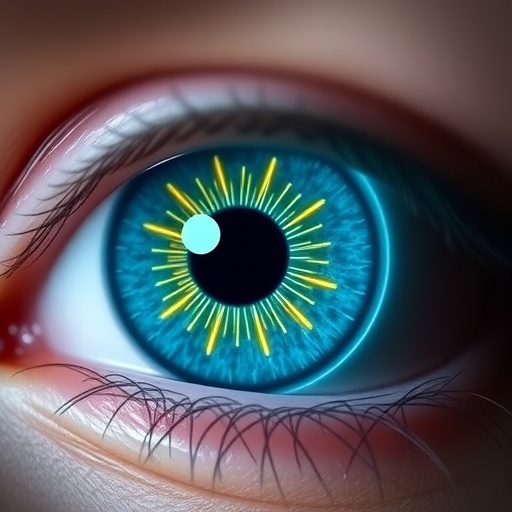
In a groundbreaking development poised to transform wearable health technology, researchers have unveiled a revolutionary smart contact lens capable of non-invasively monitoring ocular blood oxygen saturation. This cutting-edge device harnesses the power of plasmonic nano-confinement within a nanowire array, enabling unparalleled sensitivity and precision in detecting physiological markers directly through the eye. Published in npj Flexible Electronics in 2026 by Kan, Fan, Guo, and colleagues, this innovation not only paves the way for continuous, real-time health monitoring but also exemplifies the convergence of nanophotonics, flexible electronics, and biomedical engineering.
Monitoring blood oxygen saturation traditionally involves bulky, external devices or invasive methods that can cause discomfort and limit continuous observation. Pulse oximetry, the standard approach, relies on measurements from fingertips or earlobes, which can be affected by motion artifacts or poor perfusion. The emergence of smart contact lenses as a non-invasive interface offers a compelling alternative, given the eye’s rich vasculature and the unique optical properties of the cornea and conjunctiva. The research team’s novel approach leverages an intricately designed nanowire array, embedded within a flexible, biocompatible lens, to probe ocular blood oxygenation through advanced plasmonic interactions.
At the heart of this technology lies the principle of plasmonic nano-confinement, whereby localized surface plasmon resonances are tightly confined within metallic nanostructures, amplifying optical signals at specific wavelengths. The researchers engineered a precisely ordered array of nanowires with dimensions fine-tuned to achieve strong plasmonic coupling. This configuration magnifies subtle changes in the absorption spectra corresponding to varying oxygen saturation levels within the microvasculature of the eye. As a result, even minute fluctuations in blood oxygen levels manifest as clear, detectable optical signatures.
Fabricated using state-of-the-art nanolithography and nanoimprint techniques, the nanowire array is seamlessly integrated onto a flexible substrate that mimics the curvature and biomechanical properties of human corneal tissue. This ensures that the smart contact lens remains comfortable and stable during wear, avoiding irritation or disruption of normal vision. The flexible substrate also incorporates transparent conductive materials that facilitate signal transduction without compromising the user’s field of view or ocular health.
Data acquisition and processing occur through an embedded microelectronic system miniaturized to fit within the slim profile of the contact lens. This system includes a tiny light source that emits specific wavelengths optimized for plasmonic excitation, alongside photodetectors that capture reflected and transmitted signals altered by blood oxygen concentration. The onboard electronics filter and amplify these signals, converting them into digital data streams. This information is wirelessly transmitted to external devices such as smartphones or medical monitors, enabling continuous remote tracking of ocular oxygenation status.
Beyond mere technical prowess, this smart lens represents a leap forward in personalized medicine. Continuous, real-time monitoring opens new horizons in the management of chronic conditions like glaucoma, diabetic retinopathy, and systemic cardiovascular diseases, which can manifest ocular manifestations linked to hypoxia. Early detection of oxygen saturation anomalies could enable timely therapeutic interventions, potentially improving prognosis and reducing healthcare costs. Furthermore, in high-altitude or aviation contexts, the device could safeguard individuals exposed to hypoxic environments.
The integration of plasmonic nanostructures for biosensing within flexible electronics also addresses significant challenges related to miniaturization and sensitivity. Conventional optical sensors often struggle with low signal-to-noise ratios and limited spatial resolution when applied in wearable formats. The plasmonic nano-confinement approach effectively amplifies these signals at the nanoscale, while the nanowire array geometry ensures consistency and reproducibility across the sensor surface. This approach, therefore, elevates both performance and reliability in a compact design inherently suited for long-term usage.
Critically, biocompatibility and user safety were central considerations throughout the development process. The researchers employed materials known for ocular compatibility, minimizing risks of cytotoxicity or inflammatory responses. Rigorous in vitro and in vivo assessments confirmed the lens’s safe interaction with tear fluid and corneal epithelia over prolonged wear periods. Moreover, the device’s power consumption is optimized to ensure minimal heat generation, preserving ocular comfort and preventing adverse effects linked to thermal exposure.
Another remarkable aspect of this smart contact lens is its potential adaptability. The modular nature of the nanowire array allows tuning for detection of other biomarkers beyond blood oxygen saturation, such as glucose, lactate, or intraocular pressure. By coupling plasmonic biosensors with multiplexed electronic circuits, future iterations could evolve into multifunctional platforms providing a comprehensive ocular health profile accessible through a single, discreet interface.
From an engineering perspective, the fabrication methods were meticulously refined to ensure scalability and cost-effectiveness, crucial factors for mass-market adoption. Techniques such as roll-to-roll nanoimprinting and advanced lithographic processes were leveraged to produce uniform nanowire arrays over large lens areas. The choice of flexible substrates compatible with these processes ensures that industrial manufacturing can meet anticipated demand without compromising device quality or performance consistency.
The interdisciplinary nature of this work exemplifies the fusion of nanophotonics, materials science, biomedical engineering, and data analytics necessary to realize truly smart wearable devices. By seamlessly integrating these domains within a biocompatible, vision-compatible platform, the researchers have addressed fundamental barriers that have hindered the practical deployment of ocular biosensors. Their success marks a promising milestone toward widespread implementation of next-generation, non-invasive health monitoring technologies.
Looking ahead, clinical trials are envisioned to validate the device’s diagnostic utility across diverse patient populations with ocular and systemic diseases featuring hypoxic components. Regulatory pathways will need to be navigated, considering the device’s hybrid status as both a medical sensor and a contact lens. Nonetheless, the device’s non-invasive nature, coupled with its potential for continuous longitudinal data capture, strongly supports its integration into future healthcare ecosystems that emphasize preventive care and personalized medicine.
In conclusion, the advent of a smart contact lens embedding plasmonic nano-confinement nanowire arrays for ocular blood oxygen saturation monitoring represents a transformative advance poised to redefine how we perceive and manage health. Combining nanoscale optical engineering with flexible biocompatible electronics, this technology delivers unprecedented opportunities for real-time, non-invasive physiological sensing. As it moves from laboratory innovation toward clinical reality, it promises to enrich medical diagnostics and empower individuals with finer control over their well-being — all encapsulated within a seemingly simple, yet marvelously sophisticated, contact lens.
Cite Scienmag News
Denise Maddox. (July 1, 2026). Smart Contact Lens Monitors Eye Blood Oxygen Levels. Scienmag. https://scienmag.com/smart-contact-lens-monitors-eye-blood-oxygen-levels/
Denise Maddox. "Smart Contact Lens Monitors Eye Blood Oxygen Levels." Scienmag, 1 July 2026, https://scienmag.com/smart-contact-lens-monitors-eye-blood-oxygen-levels/. Accessed 1 September 2026.
Denise Maddox. "Smart Contact Lens Monitors Eye Blood Oxygen Levels." Scienmag. July 1, 2026. https://scienmag.com/smart-contact-lens-monitors-eye-blood-oxygen-levels/


