


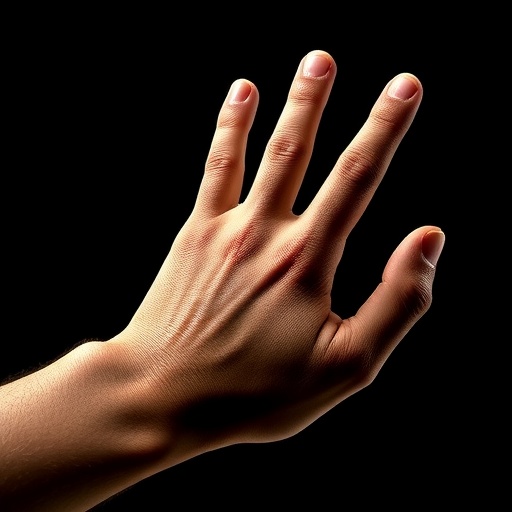
For decades, the common assumption in neuroscience has been that a person’s dominant hand excels at tasks such as writing, throwing, and tool use because the brain’s dominant hemisphere harbors inherent motor control advantages. However, groundbreaking new research from UCLA Health disrupts this long-standing belief, providing compelling evidence that the superior skill of the dominant hand is not an innate brain advantage but rather a result of extensive practice and experience. This revelation promises to redefine our understanding of lateralization in motor skills and has substantial implications for rehabilitative medicine and neuroplasticity research.
This research, spearheaded by neurologist Dr. Ahmet Arac at UCLA’s David Geffen School of Medicine, challenges the entrenched hypothesis that the dominant hemisphere is prewired for enhanced motor control. Instead, the study elucidates that the experience and practice executing complex, tool-related trajectories is what sculpts arm dominance over a lifetime. The team’s approach involved meticulous tracking of three-dimensional arm movements, employing sophisticated motion-capture technology that captures nuances of motor behavior with unprecedented precision.
The investigators enlisted healthy adult participants to perform a series of reaching tasks aimed at distinguishing innate motor skill differences from those acquired through experience. Participants reached towards targets under multiple conditions: normal reaching, reaching while burdened with a four-pound wrist weight, and reaching while manipulating a lightweight stick attached to their forearm designed to simulate tool use. This stratification allowed for parsing out mechanical difficulty from the complexity of the movement required for tool handling.
Remarkably, under the conditions of simple reaching motions, and even when physical difficulty was increased by adding weight, both the dominant and non-dominant arms performed comparably, suggesting no intrinsic superiority in motor control from one cerebral hemisphere over the other. This marked the first strong indication that the motor skill asymmetry traditionally observed arises not from biology alone but from contextual task demands.
However, when participants were required to perform reaching movements with the attached stick—mimicking the curved, intricate trajectories integral to tool use—the dominant arm outperformed its counterpart. These findings illuminate how the dominant arm’s proficiency emerges specifically through the complexity and precision necessitated by tool-related actions, which are honed through repeated practice rather than hardwired neural superiority.
In an equally illuminating second experiment, participants wrote letters and numbers using a pen held in their hand and then with a pen taped to the elbow. This innovative design disrupted habitual motor patterns by forcing individuals to attempt writing with an effector— the elbow— which none had previously trained for this fine motor task. Initially, both elbows performed equally poorly, and the dominant hand’s usual edge disappeared, underscoring that the motor advantage is context-dependent instead of neuroanatomically fixed.
Following a period of practice with elbow writing, both the dominant and nondominant elbows improved substantially, with their performance surpassing that of the nondominant hand at baseline. This demonstrates that motor skill acquisition can generalize to different effectors given adequate practice and that dominance emerges as a function of learned motor sequences rather than structural brain asymmetries alone.
Dr. Ahmet Arac emphasizes that arm dominance is an emergent property arising from the lifelong honing of complex movement patterns required particularly in handwriting and object manipulation, not because of intrinsic biomechanical or hemispheric brain control advantages. This revelation prompts a shift in our conceptual framework concerning how skilled motor control develops and how the nervous system adapts to environmental and use-dependent factors.
The implications of this research extend beyond theoretical neuroscience. For clinicians involved in stroke rehabilitation and motor skill retraining, understanding that motor dominance is experience-driven opens the possibility for targeted therapies that harness neuroplasticity to train nondominant limbs and non-traditional effectors effectively. This could lead to novel rehabilitative approaches that exploit task-specific practice rather than relying solely on presumed hemispheric functional potential.
Moreover, the study offers invaluable insights into the fundamental processes of skill learning and motor memory encoding in the brain. By revealing how complex tool-use trajectories shape motor dominance, it bridges the gap between the biology of motor control and the environmental interactions that sculpt motor capabilities throughout the lifespan. This paves the way for future investigations into the neural representations of learned motor patterns and their consolidation.
This research was conducted collaboratively with coauthor Nicolas Y.H. Jeong Lee and senior author Dr. John W. Krakauer, affiliated with Johns Hopkins University and the Santa Fe Institute, representing a confluence of expertise in neurology, motor neuroscience, and computational modeling. The study was supported by premier funding agencies, including the National Institutes of Health, the US-Israel Binational Science Foundation, NVIDIA, and UCLA’s Department of Neurology, underscoring its high scientific merit.
The full details of the research can be accessed in the peer-reviewed article titled “Arm Dominance Is an Emergent Effect of Practice Executing Complex Trajectory Shapes Required by Tools and Objects,” published in the Proceedings of the National Academy of Sciences. The study not only revolutionizes the understanding of limb dominance but also holds enormous promise for applications in neural rehabilitation, motor learning research, and the development of brain-computer interfaces.
This landmark research invites us to reconsider the intricate relationship between brain structure, motor function, and experience. It shines a light on the transformative power of practice in sculpting the way we interact with the world, highlighting that the dominion of our dominant hand is not predestined in neurons alone but is shaped and forged by a lifetime of dedicated movement and skill acquisition.
Cite Scienmag News
Cassandra Pierce. (June 30, 2026). New Study Reveals Why Your Dominant Hand Excels at Everyday Tasks. Scienmag. https://scienmag.com/new-study-reveals-why-your-dominant-hand-excels-at-everyday-tasks/
Cassandra Pierce. "New Study Reveals Why Your Dominant Hand Excels at Everyday Tasks." Scienmag, 30 June 2026, https://scienmag.com/new-study-reveals-why-your-dominant-hand-excels-at-everyday-tasks/. Accessed 1 September 2026.
Cassandra Pierce. "New Study Reveals Why Your Dominant Hand Excels at Everyday Tasks." Scienmag. June 30, 2026. https://scienmag.com/new-study-reveals-why-your-dominant-hand-excels-at-everyday-tasks/


