


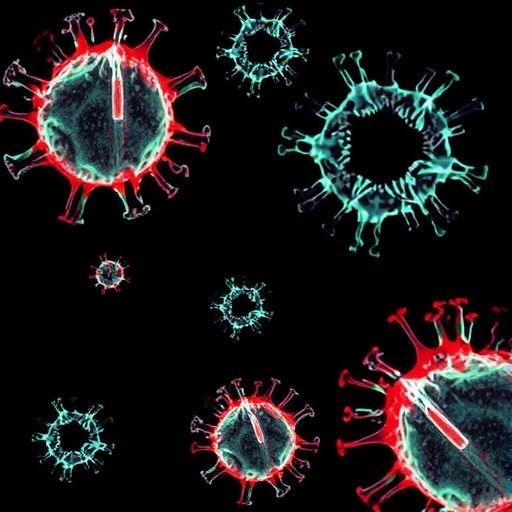
In a groundbreaking stride for virology and imaging technology, an international team of researchers has unveiled a revolutionary approach for observing viral capsids as they undergo dehydration in real time. This innovative method combines high-throughput, in situ single-particle X-ray imaging with advanced analytical techniques, enabling scientists to capture unprecedented structural details of viral particles during the critical dehydration process. The work, published in “Light: Science & Applications,” promises to open new frontiers in understanding viral stability, infectivity, and the physical mechanisms that govern viral lifecycle stages outside host environments.
Viral capsids, the protein shells encasing viral genetic material, play a fundamental role in protecting and delivering viral genomes during infection. Their structural integrity is paramount, influencing viral survival in diverse environments ranging from bodily fluids to dry aerosols. However, traditional imaging methods have long been challenged by the capsids’ dynamic changes caused by dehydration, a phenomenon that alters their shape, mechanical properties, and, ultimately, their ability to infect host cells. The new technique developed by Mall, Munke, Mazumder, et al. enables direct observation of these subtle yet critical transformations.
Prior to this advancement, most structural insights into viral capsids were derived from cryo-electron microscopy or X-ray crystallography, both techniques that provide static snapshots of hydrated or crystallized particles. While informative, these approaches fail to capture transient intermediate states or the kinetics of dehydration-induced conformational changes. The team’s in situ X-ray method surmounts these limitations by applying a high-energy, coherent X-ray source, which illuminates individual viral particles under controlled dehydration conditions, allowing researchers to acquire data thousands of times faster than before.
This imaging process leverages a combination of X-ray free-electron lasers (XFELs) and novel scanning techniques that can isolate single viral particles within a microfluidic environment. The particles are gradually subjected to dehydration by modulating relative humidity, mimicking environmental stressors that viruses encounter outside the host. As the viral capsids lose water, their morphology and internal structure evolve, changes that are captured with exceptional spatial and temporal resolution. The ability to observe these processes in situ removes the need to rehydrate or chemically fix samples, thereby preserving native-like behaviors throughout the experiment.
One of the most compelling findings reported involves the elastic deformation of viral shells. The researchers observed how dehydration leads to a remarkable compression of the capsid lattice, causing the proteins to rearrange and in some cases form novel contacts. These nanoscale rearrangements are crucial for understanding viral robustness; some viruses appear to transiently reinforce their capsids upon water loss, potentially increasing durability in airborne transmission, while others become more fragile and liable to degradation.
Moreover, the high-throughput nature of the imaging technique means that thousands of viral particles can be analyzed within a single experimental run. This statistical power enables researchers not only to pinpoint average behavior but also to identify heterogeneous responses within a viral population. Such insights are especially valuable for developing antiviral strategies, as certain particles with altered properties may escape immune detection or resist drug action.
The interdisciplinary collaboration behind this work involved virologists, physicists, and engineers who refined the microfluidic chambers and radiation sources to achieve a near-perfect balance between imaging speed, resolution, and particle survival. Importantly, the radiation dose was carefully controlled to prevent damage to the delicate viral proteins while still yielding clear diffraction patterns. The success of this balance paves the way for applying similar methodologies to other nanoscale biological assemblies such as protein complexes and cellular organelles.
Beyond structural biology, this research has substantial implications for environmental virology and public health. Viruses transmitted through aerosols or fomites often encounter drying conditions that determine their infectious lifespan. The newly accessible real-time data on capsid dehydration helps elucidate how viral particles endure or succumb to desiccation stress, potentially informing better containment protocols or surface sterilization techniques during outbreaks.
The detailed X-ray diffraction patterns generated during these experiments also feed into computational models that simulate viral mechanical behavior under stress. Integrating empirical data with simulation enhances the predictive power of such models, enabling scientists to engineer more robust viral vectors for gene therapy or vaccine delivery, or, conversely, to design destabilizing agents that render harmful viruses inactive more efficiently.
Furthermore, this methodology is highly adaptable. The team demonstrated its applicability across multiple virus types, including those with icosahedral capsids and those with more complex architectures, indicating broad utility in virology. As the demand for rapid and accurate single-particle characterization grows, especially in response to emerging viral threats, this technique represents a timely and versatile tool for the scientific community.
The ramifications extend into pharmaceutical development as well. By tracking how dehydration affects viral packaging and capsid assembly, pharmaceutical scientists can better mimic physiological conditions when screening antiviral compounds. This relevance to drug discovery processes may accelerate the development of medications that target virus stability rather than just replication.
In the grander scope of nanotechnology, the principles uncovered through this X-ray imaging approach may inspire the design of synthetic nanocapsules with tunable properties. Understanding natural viral responses to environmental challenges is instrumental for creating robust nanocarriers for therapeutics or diagnostic agents that can withstand variable conditions while maintaining payload integrity.
In summary, the high-throughput in situ single-particle X-ray imaging technique developed by Mall and colleagues ushers in a transformative understanding of viral dehydration dynamics. Combining cutting-edge physics with biological inquiry, it captures viral capsids in a living-like state as they navigate complex environmental changes. This breakthrough stands to revolutionize numerous fields—structural virology, environmental health, nanomedicine—and exemplifies the power of cross-disciplinary innovation in tackling some of the most pressing challenges in viral research today.
As the study progresses, further refinements in imaging sensitivity and sample handling will likely unlock even more detailed views into viral life cycles, shedding light on long-standing questions about virus resilience and transmission. The promise of real-time, high-throughput analysis heralds a future where viral monitoring and intervention can be more precise, proactive, and effective, guarding populations against pandemics and opening new avenues for biomedical innovation.
Cite Scienmag News
Kristina Jarvis. (June 23, 2026). High-Throughput X-Ray Imaging of Drying Viral Capsids. Scienmag. https://scienmag.com/high-throughput-x-ray-imaging-of-drying-viral-capsids/
Kristina Jarvis. "High-Throughput X-Ray Imaging of Drying Viral Capsids." Scienmag, 23 June 2026, https://scienmag.com/high-throughput-x-ray-imaging-of-drying-viral-capsids/. Accessed 4 September 2026.
Kristina Jarvis. "High-Throughput X-Ray Imaging of Drying Viral Capsids." Scienmag. June 23, 2026. https://scienmag.com/high-throughput-x-ray-imaging-of-drying-viral-capsids/


