


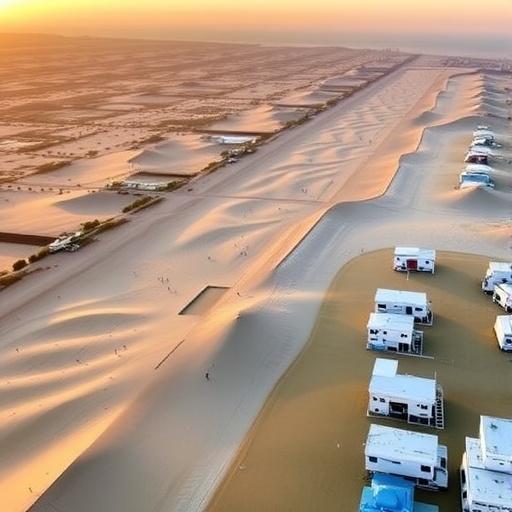
A recent groundbreaking study spearheaded by researchers at the University of California, Santa Barbara, in collaboration with several other institutions, has unveiled a stark reality: California has lost more than half of its coastal sand dune systems since the mid-19th century. This extensive analysis, published in the esteemed journal Earth’s Future, meticulously quantifies the erosion and disappearance of these critical natural formations—a loss that carries significant ecological and climatological repercussions for the state’s expansive coastline.
Historically, California’s coastline was adorned with approximately 739 square kilometers (285 square miles) of coastal dunes around 1850, a period coinciding with the state’s nascent stage after joining the United States. Today, this once vast dune network has dwindled to roughly 300 square kilometers (116 square miles), reflecting a staggering 60% reduction. While natural erosional processes such as those at estuaries and river mouths accounted for a fraction of this decline, the overwhelming majority stems from anthropogenic influences including urban expansion, infrastructure development, and changes in land use.
The implications of this dramatic dune loss extend beyond mere geography. Coastal dunes serve as vital ecological niches, hosting diverse communities of specialized flora, insects, birds, and small mammals. Their decline destabilizes these habitats, threatening biodiversity and disrupting intricate ecological webs. More alarmingly, dunes function as dynamic barriers against storm surges and the inexorable rise of sea levels, offering a natural defense that is self-sustaining and resilient—qualities that are increasingly sought after in the face of climate change and its attendant challenges.
Researchers employed a multifaceted, high-precision methodology to map and analyze the changing landscape of California’s dunes over more than a century and a half. Tim Baxter, a postdoctoral physical geographer and the lead author, detailed the complex integration of historical cartographic archives, aerial imagery, and modern LiDAR technology, combined with machine learning algorithms. This holistic approach enabled the detection of subtle shifts in dune morphology and spatial distribution, providing unprecedented temporal depth and geographic resolution.
A striking finding highlighted the unparalleled scale of dune elimination in urban epicenters such as San Francisco and Los Angeles, where more than 95% of the historic dune systems have been obliterated. These areas, transformed into dense urban agglomerations, vividly illustrate the tension between human development and natural coastal processes. Central California’s coast also witnessed extensive degradation, with approximately 60% of its sand dunes lost, signaling a statewide trend underscored by infrastructure encroachment and environmental modification.
Interestingly, the study notes isolated pockets of dune restoration and accretion in Southern California, underscoring the potential for human intervention to partially reverse historical losses. Restoration initiatives are increasingly recognized for their dual role in biodiversity conservation and climate resiliency by reinstating these natural coastal expanse buffers that can dynamically respond to changing sea levels and storm patterns.
The findings come at a crucial moment when coastal communities throughout California grapple with the urgent need to mitigate the impacts of climate change, particularly sea level rise. Traditional engineering solutions such as seawalls and bulkheads, while effective in the short term, often fail to provide sustainable, adaptive protection. In contrast, restored and preserved coastal dunes embody a nature-based solution characterized by their ability to self-repair and migrate inland, maintaining dynamic equilibrium with shifting shoreline environments.
Despite the clear benefits, the study cautions that sand dune restoration is not uniformly applicable or feasible across all coastal settings. Critical variables such as geographic location, economic considerations, available space, and municipal priorities significantly influence the viability and effectiveness of dune-based defenses. This calls for tailored, site-specific planning grounded in robust scientific understanding and socioeconomic context.
The research team’s comprehensive mapping effort not only enriches our comprehension of historical and present-day dune dynamics but also sets the stage for informed future coastal management. By identifying key areas of dune loss and potential restoration, the framework supports strategic prioritization, enabling policymakers and conservationists to optimize resource allocation and advance resilience strategies in tandem with climate adaptation goals.
Moreover, their innovative analytical techniques possess global applicability. As coastal regions worldwide confront similar threats of sea level rise and habitat degradation, the methodologies applied here offer a replicable blueprint for monitoring dune transformations and guiding restoration projects. The coupling of archival data and cutting-edge technology epitomizes a new frontier in environmental research, blending historical insight with modern data science.
In sum, this landmark study not only quantifies an alarming environmental change but also advocates for leveraging natural coastal formations as a frontline defense. California’s experience underscores the critical importance of integrating ecological restoration with urban and climate planning to safeguard coastal ecosystems and the human communities dependent upon them. The continued loss of sand dunes threatens biodiversity and diminishes the coast’s resilience, reinforcing the urgency for coordinated action and innovative stewardship.
News Publication Date: 22-Jun-2026
Web References: https://agupubs.onlinelibrary.wiley.com/doi/10.1029/2025EF007790
References: Research conducted by Tim Baxter, Ian J. Walker, Jenifer E. Dugan, David M. Hubbard, Karina K. Johnston, Sarah Smith, Dakota R. Fee, Dan Willett (UCSB); Laura Engeman, Jenna Wisniewski (UC San Diego); Sean Vitousek (U.S. Geological Survey Pacific Coastal and Marine Science Center); Andrea J. Pickart (U.S. Fish and Wildlife Service).
Keywords
Coastal dunes, California coastline, habitat loss, biodiversity, climate resilience, sea level rise, urban development, sand dune restoration, LiDAR mapping, machine learning, ecological conservation, coastal protection
Cite Scienmag News
Margaret Porter. (June 22, 2026). Comprehensive Assessment Reveals California Has Lost Over Half of Its Coastal Sand Dunes. Scienmag. https://scienmag.com/comprehensive-assessment-reveals-california-has-lost-over-half-of-its-coastal-sand-dunes/
Margaret Porter. "Comprehensive Assessment Reveals California Has Lost Over Half of Its Coastal Sand Dunes." Scienmag, 22 June 2026, https://scienmag.com/comprehensive-assessment-reveals-california-has-lost-over-half-of-its-coastal-sand-dunes/. Accessed 3 September 2026.
Margaret Porter. "Comprehensive Assessment Reveals California Has Lost Over Half of Its Coastal Sand Dunes." Scienmag. June 22, 2026. https://scienmag.com/comprehensive-assessment-reveals-california-has-lost-over-half-of-its-coastal-sand-dunes/


