


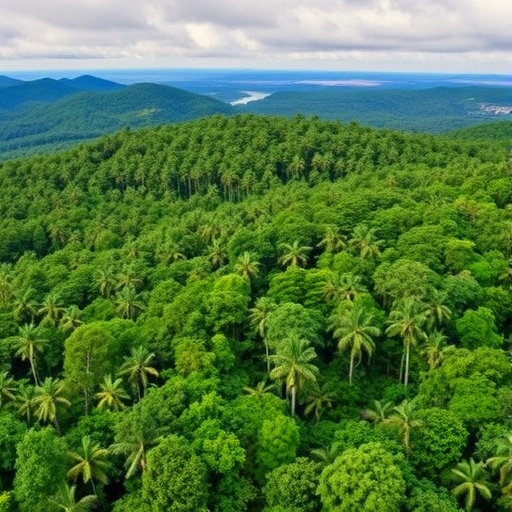
In recent years, the global community has increasingly embraced avoided deforestation projects as a cornerstone in climate change mitigation strategies. These initiatives, which aim to reduce carbon emissions by preserving existing forests, have been hailed not only for their potential to curb greenhouse gases but also for their role in safeguarding biodiversity and ecosystem services. However, a groundbreaking study published in Nature Climate Change in 2026 challenges the assumption that these projects unequivocally benefit forest ecosystems. The research, conducted by Ong, Chen, and colleagues, rigorously assesses the ecological integrity of 133 avoided deforestation projects worldwide, revealing a complex and concerning picture.
At the heart of the study is a critical question: do carbon offset projects centered on preventing deforestation truly maintain the ecological conditions of forests, or do they deliver carbon benefits at the expense of forest health and biodiversity? To answer this, the researchers implemented a robust methodology comparing ecological outcomes across project areas with matched control sites unaffected by intervention. This comparative approach enabled them to isolate the specific impacts of avoided deforestation interventions, going beyond simple forest cover metrics to evaluate deeper ecological indicators.
The analysis employed five comprehensive ecological-integrity indicators, carefully selected to capture myriad aspects of forest health from vegetation structure and biodiversity levels to the presence of human disturbance. This multidimensional framework was crucial in uncovering nuanced outcomes that single metrics might obscure. Rather than concluding that avoided deforestation projects universally enhance forest ecosystems, their findings present a nuanced mosaic: many projects show mixed results, with some having negligible effects or, alarmingly, even negative impacts relative to their control areas.
One particularly striking outcome of this analysis was the realization that carbon-centric forest interventions sometimes prioritize emission reductions over ecological function. In some projects, forest preservation efforts succeeded in maintaining or increasing canopy cover, but this did not always translate into the preservation of native biodiversity or ecosystem services. In certain cases, human activities such as increased logging pressure on surrounding forests, the introduction of monoculture plantations, or insufficient enforcement mechanisms undermined ecological quality within the project boundaries.
This paradox where forest area is conserved but ecological integrity declines points to fundamental shortcomings in how avoided deforestation projects are designed and implemented. Many existing schemes rely heavily on satellite-based monitoring of tree cover to demonstrate carbon benefits. Yet, such remote sensing approaches cannot fully capture on-the-ground ecosystem conditions, such as species diversity and forest regeneration dynamics. Consequently, misleading assurances of project success may mask subtle ecologically degrading processes.
The implications of these results extend far beyond just carbon accounting. Maintaining biodiversity and ecosystem function within forests is integral to their long-term resilience and capacity to sequester carbon effectively. Intact forests with rich biological communities are more resistant to disturbances such as fires, pest outbreaks, and climate variability – all of which can undermine carbon storage and exacerbate emissions over time. Thus, a narrow focus on avoided deforestation projects’ carbon benefits without ecological safeguards risks compromising the very climate goals they intend to serve.
Moreover, the study sheds light on governance, funding, and policy gaps in the avoided deforestation landscape. Many projects analyzed lacked robust community engagement or failed to integrate indigenous knowledge systems, which are vital for sustainable forest stewardship. Social dynamics such as land tenure conflicts and inequitable benefit-sharing arrangements frequently hindered effective conservation outcomes. These socio-ecological disconnects reveal the need for more holistic project frameworks that balance carbon goals with ecological and social dimensions.
Another important dimension highlighted by the researchers is the spatial heterogeneity in project outcomes. Successes and failures were not evenly distributed across regions or biomes. For instance, certain tropical forest regions exhibited better ecological maintenance compared to projects established in temperate zones or degraded landscapes. These variations emphasize the importance of context-specific strategies that account for local ecological baselines, threats, and socio-economic conditions.
This study offers critical insights for future climate mitigation policies. To harness the full potential of avoided deforestation, projects must evolve beyond simplistic “tree cover equals success” narratives. Instead, they should integrate rigorous ecosystem monitoring, encompassing biodiversity inventories, soil quality metrics, and long-term ecological assessments. Advanced technologies, such as drone-based surveys, environmental DNA sampling, and machine learning algorithms, can complement traditional fieldwork to provide holistic forest health evaluations.
Furthermore, international carbon markets and financing mechanisms supporting avoided deforestation need recalibration. Incorporating ecological integrity as a mandatory prerequisite for project validation and credit issuance would incentivize practices that align carbon goals with genuine ecosystem conservation. Transparent reporting standards and independent audits can bolster accountability, ensuring that carbon offsets translate into durable ecological benefits.
In the broader context of global climate action, this research underscores the inherent complexity of forest-based solutions. While halted deforestation remains vital to curbing emissions, it cannot be treated as a silver bullet in isolation. Synergistic approaches integrating reforestation, forest restoration, community empowerment, and sustainable land management are essential to achieve robust climate resilience and biodiversity preservation concurrently.
The findings also resonate within debates about the carbon neutrality claims of various industries relying on offsets. Skepticism toward the ecological soundness of avoided deforestation projects calls for caution in counting such offsets toward corporate or national emissions reduction targets without stringent ecological validation. The climate science community and policymakers must collaborate closely to refine frameworks that capture the multifaceted nature of forests as carbon sinks and living ecosystems.
Ultimately, the research by Ong, Chen, et al. serves as a wake-up call to rethink how climate interventions involving forests are conceptualized, implemented, and evaluated. It challenges simplistic assumptions and advocates for integrated, science-driven approaches that safeguard both carbon stocks and the rich tapestry of life within them. Preserving forests is not merely about preventing tree loss—it is about nurturing the intricate ecological processes that sustain our planet’s climate, biodiversity, and human well-being.
As global momentum builds toward ambitious climate goals in the coming decades, ensuring the ecological integrity of avoided deforestation projects is paramount. This will require interdisciplinary collaboration, innovative technologies, inclusive governance, and sustained commitment. Only then can such projects fulfill their promise as true climate solutions that protect the Earth’s forests in all their complexity and vitality, securing a healthier future for generations to come.
Cite Scienmag News
Sloane Callahan. (June 22, 2026). Ecological Integrity of Avoided Deforestation Projects Explained. Scienmag. https://scienmag.com/ecological-integrity-of-avoided-deforestation-projects-explained/
Sloane Callahan. "Ecological Integrity of Avoided Deforestation Projects Explained." Scienmag, 22 June 2026, https://scienmag.com/ecological-integrity-of-avoided-deforestation-projects-explained/. Accessed 4 September 2026.
Sloane Callahan. "Ecological Integrity of Avoided Deforestation Projects Explained." Scienmag. June 22, 2026. https://scienmag.com/ecological-integrity-of-avoided-deforestation-projects-explained/


