


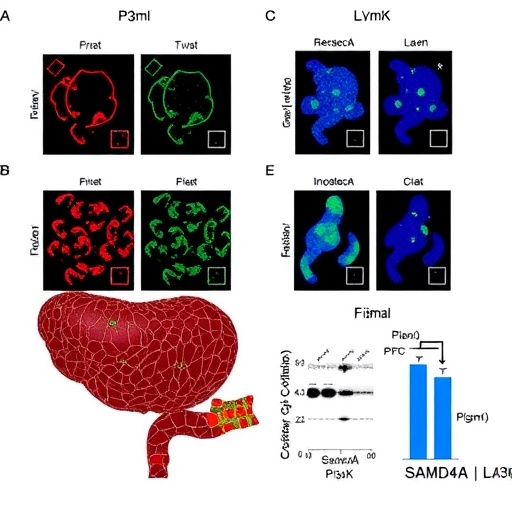
Laminin subunit beta 3 (LAMB3) has emerged as a critical player in the molecular landscape of cancer, yet its precise role in gastric cancer (GC) progression has remained elusive until now. A groundbreaking study published in the British Journal of Cancer unravels the intricate mechanisms by which LAMB3 exacerbates malignancy in GC, shedding light on a novel molecular axis that could revolutionize therapeutic approaches. This research uncovers how LAMB3 orchestrates the sustained activation of the PI3K-Akt pathway—one of the most prominent signaling routes involved in tumor growth and survival—through targeted degradation of PHLPP2 mRNA mediated by the RNA-binding protein SAMD4A.
Gastric cancer continues to rank among the leading causes of cancer mortality worldwide, with its complex molecular underpinnings posing a significant challenge to effective treatment. Despite advances in understanding various oncogenic drivers, the involvement of extracellular matrix components like LAMB3 has been underappreciated. Laminins, as glycoproteins critical for basement membrane structure and signaling, influence cell adhesion, migration, and differentiation. The aberrant overexpression of LAMB3 in various cancers hinted at its potential role in tumor aggressiveness, yet the mechanistic details remained uncharted until the present study’s in-depth molecular analyses.
The authors employed a comprehensive experimental framework combining transcriptomic analysis, RNA immunoprecipitation, and functional assays in gastric cancer cell lines and murine xenograft models. They demonstrated that LAMB3 upregulation correlates with increased GC cell proliferation, invasion, and metastatic potential. More strikingly, LAMB3 was found to exert these oncogenic effects by destabilizing PHLPP2 mRNA, a known tumor suppressor that negatively regulates the PI3K-Akt signaling axis. This discovery positions LAMB3 as a pivotal regulator of intracellular signaling networks that propel oncogenesis.
At the heart of this regulatory pathway lies SAMD4A, an RNA-binding protein previously unlinked to gastric cancer pathophysiology. The study reveals that LAMB3 enhances the interaction between SAMD4A and PHLPP2 mRNA, promoting its degradation through post-transcriptional mechanisms. This SAMD4A-mediated mRNA decay leads to a marked reduction in PHLPP2 protein levels, unleashing hyperactivation of the PI3K-Akt pathway. Such persistent signaling drives uncontrolled cellular proliferation and survival, hallmark features of aggressive cancer phenotypes.
Mechanistically, the suppression of PHLPP2 removes a vital check on Akt phosphorylation, facilitating an unchecked flow of pro-survival signals inside the cancer cells. The PI3K-Akt pathway modulates diverse cellular functions, including metabolism, apoptosis resistance, and cell cycle progression. By unraveling this axis, the study prominently positions LAMB3—and its downstream effectors—as promising biomarkers and therapeutic targets in GC, where tailored interventions are urgently needed.
Notably, the research team extended their findings to patient-derived GC tissues, confirming that elevated LAMB3 expression significantly correlates with poor prognosis and advanced disease stages. The clinical relevance strengthens the translational potential of targeting the LAMB3-SAMD4A-PHLPP2 axis, suggesting that disrupting this molecular cascade might curtail tumor progression and improve patient outcomes.
Beyond the intrinsic mechanistic insights, the study raises intriguing possibilities for drug development. Small molecules or RNA-based therapeutics that inhibit LAMB3 expression or interfere with SAMD4A’s binding to PHLPP2 mRNA could restore tumor suppressor function and dampen aberrant signaling. Given the centrality of PI3K-Akt in many cancers, such interventions might have broad applicability beyond just gastric malignancies, positioning this discovery at the forefront of precision oncology.
Moreover, the findings provoke a reevaluation of how extracellular matrix components, traditionally viewed as structural elements, actively participate in intracellular oncogenic signaling. The delineation of LAMB3’s role in manipulating RNA stability via SAMD4A opens a relatively unexplored frontier in cancer biology: the crosstalk between the extracellular milieu and post-transcriptional gene regulation. This interplay hints at a complex regulatory network that underpins cancer cells’ adaptability and survival in hostile microenvironments.
The study also highlights the importance of integrating multi-omics data to dissect the sophisticated molecular interactions governing cancer progression. Through the use of advanced RNA immunoprecipitation and sequencing techniques, the researchers mapped the dynamic interactions between RNA-binding proteins and specific mRNA targets, elucidating a critical post-transcriptional regulatory node controlled by LAMB3. Such approaches exemplify the power of cutting-edge molecular biology tools in unveiling hidden layers of cancer biology.
Future research is poised to explore whether similar mechanisms operate in other epithelial cancers where LAMB3 is dysregulated. Comparative analyses across tumor types could validate the universality of this pathway, potentially expanding the clinical impact of these findings. Furthermore, understanding how LAMB3 expression itself is regulated, including potential epigenetic and transcriptional modulators, could unveil additional therapeutic leverage points.
Identifying effective inhibitors of the LAMB3-SAMD4A interaction stands as an exciting therapeutic frontier. While challenging, the small interface between RNA-binding proteins and target mRNAs offers a unique opportunity to develop molecules with high specificity and minimal off-target effects. Collaboration between molecular biologists, chemists, and clinical researchers will be critical to translate these molecular insights into viable therapies.
In summary, this landmark study elucidates a novel molecular mechanism whereby LAMB3 promotes gastric cancer progression through the SAMD4A-mediated degradation of PHLPP2 mRNA, sustaining PI3K-Akt signaling. By connecting extracellular matrix components to post-transcriptional gene regulation and oncogenic signaling, it not only advances fundamental understanding of gastric cancer biology but also charts a promising path toward innovative treatment strategies. As gastric cancer continues to exact a heavy toll worldwide, such pioneering research offers new hope for improved diagnosis, prognosis, and therapeutic intervention.
The implications of this discovery extend beyond the realm of gastric cancer, potentially influencing broader fields of oncology and RNA biology. As the scientific community delves deeper into the non-canonical functions of extracellular proteins and RNA-binding factors, the intricate tapestry of cancer’s molecular underpinnings becomes progressively clearer. The LAMB3-SAMD4A-PHLPP2 axis may well become a focal point in the ongoing quest to outmaneuver cancer at its molecular roots.
With continued investment in translational research and clinical trials inspired by these findings, the next decade could herald significant breakthroughs in managing gastric cancer and related malignancies. This study stands as a testament to the power of multidisciplinary approaches in tackling one of humanity’s most formidable health challenges, combining molecular precision with clinical urgency to pave the way toward a future where gastric cancer progression can be effectively stalled or reversed.
Cite Scienmag News
Nathaniel Bowman. (June 17, 2026). LAMB3 Boosts Gastric Cancer via SAMD4A and PI3K. Scienmag. https://scienmag.com/lamb3-boosts-gastric-cancer-via-samd4a-and-pi3k/
Nathaniel Bowman. "LAMB3 Boosts Gastric Cancer via SAMD4A and PI3K." Scienmag, 17 June 2026, https://scienmag.com/lamb3-boosts-gastric-cancer-via-samd4a-and-pi3k/. Accessed 3 September 2026.
Nathaniel Bowman. "LAMB3 Boosts Gastric Cancer via SAMD4A and PI3K." Scienmag. June 17, 2026. https://scienmag.com/lamb3-boosts-gastric-cancer-via-samd4a-and-pi3k/


