


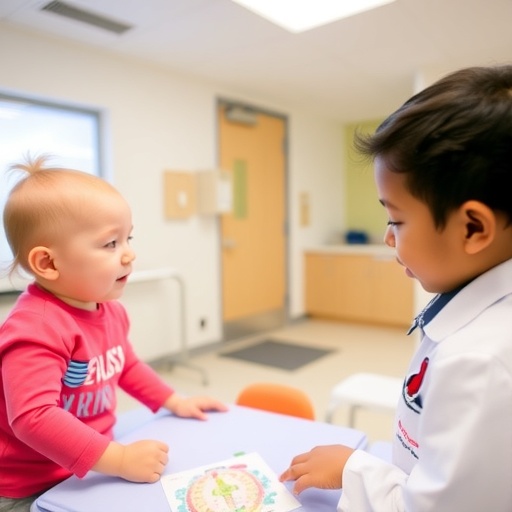
The University of Louisville (UofL), in partnership with UofL Health and Kosair for Kids, has officially inaugurated the newly expanded Kosair for Kids Center for Pediatric NeuroRecovery. This groundbreaking facility represents a significant advancement in the field of pediatric rehabilitation, merging cutting-edge clinical care, innovative therapy, and pioneering research into a unified environment specifically designed to enhance recovery outcomes for children affected by spinal cord injuries and other neurological disorders. Situated within the UofL Health – Frazier Rehabilitation Institute, the center now boasts a sprawling 13,631-square-foot space meticulously crafted to foster accelerated healing and broader access to vital therapies.
This state-of-the-art expansion is not merely architectural; it symbolizes a transformative shift in pediatric neurorehabilitation capabilities. UofL President Gerry Bradley emphasized the tangible nature of this shift, highlighting that the center transcends former promises to become a beacon of hope that materially improves children’s recovery journeys. The new facility’s design actively promotes multidisciplinary collaboration among clinicians, therapists, researchers, and families — a factor crucial to advancing the efficacy and personalization of neurorehabilitative treatments.
A chief driver of this innovation is a vibrant integration of clinical care and research. For more than ten years, the Kosair for Kids Center has led the nation in pediatric neurorecovery services, evolving from a modest facility serving a single child daily to one conducting over 20 specialized therapy sessions each day. The current expansion increases treatment capacity by approximately 33%, enabling up to 24 children daily to benefit from intensive, tailored neurorehabilitation interventions that are informed by the latest scientific insights.
Andrea Behrman, the center’s director and a professor in UofL’s Department of Neurological Surgery, underlined the importance of this alignment between infrastructure and innovation. The new environment mirrors the pioneering nature of the center’s clinical research and treatment methodologies, allowing for an integrated therapeutic model that advances the continuum from laboratory breakthroughs to bedside applications. This seamless interaction ensures rapid translation of novel neurorehabilitation techniques into practical therapy regimens that can dramatically enhance neural plasticity and functional recovery in pediatric patients.
A pivotal element of the expanded center’s capability stems from its sophisticated therapeutic technologies tailored specifically for children and adolescents. Unlike adult neurorehabilitation, pediatric therapy demands nuanced modifications to account for developmental neurobiology and psychosocial factors. As such, the center incorporates advanced rehabilitation equipment and adaptive devices engineered to stimulate neurological reorganization during critical windows of neural development, thereby fostering improved motor function, sensory integration, and cognitive processing in young patients.
Fundamental to the center’s growth was the philanthropic contribution of Kosair for Kids, which provided a $1 million grant, supplemented by $2 million in federal funding from the Health Resources and Services Administration and additional donations. This financial backing was instrumental in not only expanding physical capacity but also in updating and acquiring cutting-edge research and therapeutic tools. Such investments underpin the center’s ability to deliver innovative care protocols that emphasize high-intensity, task-specific therapies designed to maximize neuroregenerative potential.
The expansion also incorporates specialized spaces that support both patients and their families. Recognizing the essential role of caregivers in neurorecovery, the facility includes private consultation rooms designed to facilitate comprehensive communication between families and multidisciplinary teams. Moreover, family-centered common areas foster a supportive atmosphere conducive to emotional well-being, which is increasingly acknowledged as a critical component of successful rehabilitation.
Federal support for this project underscores the national importance of pediatric neurorehabilitation research and clinical excellence. Contributions from policymakers, including Congressman Morgan McGarvey and former Congressman John Yarmuth, were vital in securing funds that helped realize this vision. Additionally, the estate bequest from Jane Burian, commemorating Dr. Frank J. Burian and Henrietta S. Burian, ensures enduring legacy funding for the center’s mission, promoting sustainability of its impact on children’s health.
The Kosair for Kids Center also functions as an academic hub, training the next generation of therapists, neurologists, and researchers. Its integrated model provides a unique educational resource, combining real-time clinical exposure with hands-on research opportunities. This prepares healthcare professionals to implement evidence-based, pediatric-specialized neurorehabilitation strategies that address the complex neurological needs of children recovering from spinal injuries and similar conditions.
The therapeutic modalities employed at the center are grounded in a robust research framework maintained by the Kentucky Spinal Cord Injury Research Center. This alliance facilitates translational research whereby inventions, from neuroprosthetics to neurostimulation paradigms, are tested and refined under clinical conditions. Such synergy accelerates the progression from theoretical neuroscience advancements to tangible improvements in pediatric patient outcomes—rendering UofL an international leader in this specialized field.
Notably, the expansion’s infrastructure supports novel neuroimaging, biomarker analysis, and neurophysiological monitoring techniques. These technological capabilities enable real-time assessment of neural recovery trajectories and therapy efficacy, allowing clinicians to tailor interventions dynamically. This personalized medicine approach marks a paradigm shift in pediatric neurorehabilitation, moving away from generalized treatment plans toward evidence-driven, patient-specific therapies with higher likelihood of success.
Financial access remains a priority, with ongoing support from the Shelley Trimble Fund for Pediatric NeuroRecovery easing the economic burden on families by subsidizing treatments irrespective of insurance hurdles. This commitment ensures equity in care delivery and maximizes the potential reach and societal impact of the center’s trailblazing work, making life-altering neurorecovery therapies available to a broader pediatric population vulnerable to neurological injury.
In sum, the newly expanded Kosair for Kids Center for Pediatric NeuroRecovery at UofL represents a transformative advancement in pediatric neurorehabilitation, seamlessly fusing clinical excellence, avant-garde research, and compassionate family-centered care. Its innovative design and groundbreaking therapeutic approaches position it at the vanguard of efforts to rewrite the trajectories for children recovering from spinal cord injuries and neurological disorders—with hope that this model will inspire similar advances on a global scale.
News Publication Date: Not provided
Web References:
- Kosair for Kids Center for Pediatric NeuroRecovery
- Frazier Rehabilitation Institute Pediatric NeuroRecovery Services
- Kentucky Spinal Cord Injury Research Center
Keywords
Pediatric NeuroRecovery, Spinal Cord Injury, Pediatric Rehabilitation, Neurological Disorders, Neuroplasticity, Translational Research, UofL Health, Kosair for Kids, Clinical Care Innovation, Pediatric Therapy Technology, Neurological Surgery, Child Neurorehabilitation
Cite Scienmag News
Harold Sullivan. (June 17, 2026). UofL, UofL Health, and Kosair for Kids Launch Expanded Pediatric NeuroRecovery Center. Scienmag. https://scienmag.com/uofl-uofl-health-and-kosair-for-kids-launch-expanded-pediatric-neurorecovery-center/
Harold Sullivan. "UofL, UofL Health, and Kosair for Kids Launch Expanded Pediatric NeuroRecovery Center." Scienmag, 17 June 2026, https://scienmag.com/uofl-uofl-health-and-kosair-for-kids-launch-expanded-pediatric-neurorecovery-center/. Accessed 3 September 2026.
Harold Sullivan. "UofL, UofL Health, and Kosair for Kids Launch Expanded Pediatric NeuroRecovery Center." Scienmag. June 17, 2026. https://scienmag.com/uofl-uofl-health-and-kosair-for-kids-launch-expanded-pediatric-neurorecovery-center/


