


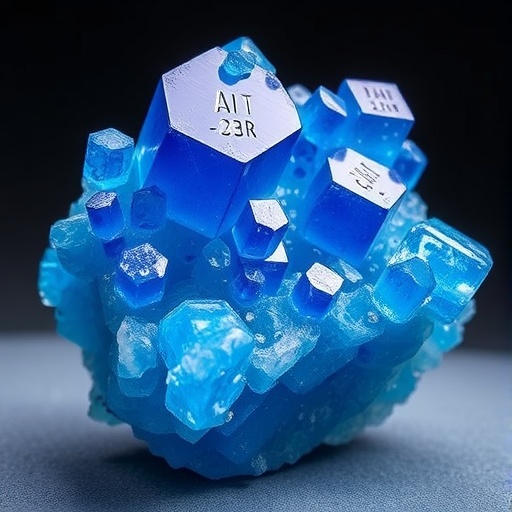
In a remarkable advancement that promises to redefine materials science, researchers have developed an extraordinary crystal exhibiting isotropic zero thermal expansion (ZTE) across an unprecedentedly wide temperature range. This pioneering work focuses on a sodalite-structured compound, Cd4Al6O12SO4, abbreviated as CASO, which maintains near-perfect dimensional stability from cryogenic temperatures as low as 11 K up to an exceptional 893 K. Such a feat addresses one of the most persistent challenges in materials engineering—achieving consistent, isotropic ZTE behavior over a broad thermal window, well beyond the typical operating limit of 400 K commonly found in existing materials.
Thermal expansion, the tendency of materials to expand or contract in response to temperature changes, significantly influences the reliability and precision of components in advanced technological systems. This is particularly critical in optics, aerospace, and microelectronics, where slight dimensional deviations can lead to catastrophic failures or degraded performance. Traditionally, materials exhibiting zero or near-zero thermal expansion either operate within narrow temperature bands or display anisotropic expansion, complicating their practical application. CASO emerges as a groundbreaking solution by combining flexibility and robustness within a closed-framework sodalite structure, a geometry celebrated for its remarkable stability.
What sets CASO apart is the ingenious incorporation of flexible interstitial groups realized via fractionally occupied atoms nestled within the sodalite framework. This strategic design introduces subtle positional disorder among ligand atoms, a feature that amplifies transverse atomic vibrations responsible for generating negative thermal expansion. These enhanced transverse vibrations effectively counterbalance the intrinsic positive thermal expansion that arises from atomic lattice expansion at elevated temperatures. As a result, CASO achieves a finely tuned, cancellatory interplay between positive and negative thermal expansion mechanisms, yielding an overall coefficient of thermal expansion measured at a negligible 0.21(23) × 10^−6 K^−1.
The research team’s exploration of CASO’s structural integrity under rigorous thermal cycling reveals impressive resilience, with the material maintaining its crystalline structure up to 1,100 K. This high thermal threshold expands the operational capacity of ZTE materials into regimes previously inaccessible, paving the way for applications in extreme thermal environments such as space exploration technologies and high-temperature sensor systems. Importantly, the integrity of CASO at such elevated temperatures also suggests potential advancements in engineering components that must endure thermal shocks without suffering deformation or failure.
Beyond mechanical stability, CASO exhibits a solar-blind ultraviolet (UV) transparency window extending down to 275 nm. This optical property signifies that the material can transmit UV light within this range without absorption, rendering it valuable for specialized UV optics and photonics applications. Devices requiring minimal optical noise and high stability, such as spaceborne UV detectors and precision laser optics, stand to benefit from CASO’s unique optical-transparency combined with its unparalleled thermal stability.
Optical materials are notoriously susceptible to thermal fluctuations, which induce refractive index changes and distort beam paths, complicating precision measurements and laser operations. CASO’s thermally induced optical fluctuations are at least twice as low as those found in conventional optical media, an achievement that underscores its potential to revolutionize precision optics. This property not only enhances the performance of existing systems but also reduces the need for complex compensatory mechanisms, simplifying designs and improving reliability in challenging thermal environments.
Substantially, CASO’s isotropic ZTE capacity challenges and expands the conventional understanding of thermomechanical behavior in framework materials. The sodalite structure itself provides a three-dimensional network that constrains thermal responses isotropically, a feature critical for applications demanding uniform response in all spatial directions. The partial occupation and flexibility of interstitial species suggest new dimensions of control over lattice dynamics and open pathways for tailored ZTE behavior through chemical modification and structural engineering.
The discovery underscores the significance of lattice dynamics modulation via controlled disorder—a concept that holds promise far beyond ZTE materials. Manipulating atomic vibrational modes through fractional occupancy and positional disorder reshapes how scientists can exploit negative thermal expansion while mitigating positive expansion, with implications for diverse fields from thermal barrier coatings to quantum materials.
Moreover, the work by Liu, Jiang, Molokeev, and colleagues establishes a universal strategy for engineering ZTE materials, thus serving as a blueprint for future crystal design. Rather than relying on complex composites or layered heterostructures, this approach leverages the intrinsic vibrational characteristics and flexibility within single-phase crystals. Such simplicity in design may accelerate industrial adoption and reduce costs associated with fabricating advanced thermal-stable materials.
The implications of this discovery are profound for the electronics and precision engineering industries. Components fabricated from CASO could maintain micron-scale tolerances across vast thermal gradients, thereby improving the longevity and performance of microelectromechanical systems (MEMS), precision optics, and high-frequency electronic devices. The broad temperature stability and isotropy also alleviate challenges associated with thermal mismatch and interface stresses in multilayered devices.
In addition to immediate technological applications, CASO’s unique properties may spur new scientific inquiries into the fundamental physics of thermal expansion. Investigating how flexible ligand atoms interact within complex frameworks provides insights into phonon dynamics, anharmonic lattice vibrations, and thermodynamic stability. This research advances theoretical models and computational simulations aiming to predict and control thermal properties at the atomic scale.
As society increasingly demands materials that withstand extreme environmental conditions without compromising structural or optical performance, CASO stands as a beacon of hope and innovation. Its extended temperature operational window combines mechanical robustness, optical transparency, and thermal stability into a single crystalline phase—attributes that are rarely coexistent. This convergence could lead to breakthroughs in harsh-environment sensors, satellite optics, and next-generation aerospace components.
Furthermore, the concept of embedding fractionally occupied flexible groups within stable frameworks could be extrapolated to customize other physical properties such as thermal conductivity, dielectric constants, and even magneto-thermal behavior. This multifunctionality potential situates CASO not just as a material of the present, but as a foundation for multifunctional crystals engineered at the atomic level for bespoke applications.
In conclusion, CASO embodies a paradigm shift in thermal expansion control, marrying structural ingenuity with atomic-scale dynamism. Its validation as an isotropic zero thermal expansion material from cryogenic to near-1100 K temperatures resolves a longstanding challenge and invites a new era of functional materials science. This elegant interplay of lattice architecture and vibrational physics heralds a future where materials no longer passively endure thermal fluctuations but actively neutralize them, ushering in unprecedented precision and resilience in advanced technologies.
Such groundbreaking discoveries, as reported by Liu and colleagues in Nature Chemistry, showcase the transformative power of crystal engineering and vibrational control. The research propels us beyond incremental advances to a realm where materials can be custom-tuned for the harshest and most demanding environments known to science and industry, reshaping what is possible across technological frontiers.
Cite Scienmag News
Bethany Barker. (June 17, 2026). Sodalite Crystals Show Zero Thermal Expansion Up to 893K. Scienmag. https://scienmag.com/sodalite-crystals-show-zero-thermal-expansion-up-to-893k/
Bethany Barker. "Sodalite Crystals Show Zero Thermal Expansion Up to 893K." Scienmag, 17 June 2026, https://scienmag.com/sodalite-crystals-show-zero-thermal-expansion-up-to-893k/. Accessed 4 September 2026.
Bethany Barker. "Sodalite Crystals Show Zero Thermal Expansion Up to 893K." Scienmag. June 17, 2026. https://scienmag.com/sodalite-crystals-show-zero-thermal-expansion-up-to-893k/


