


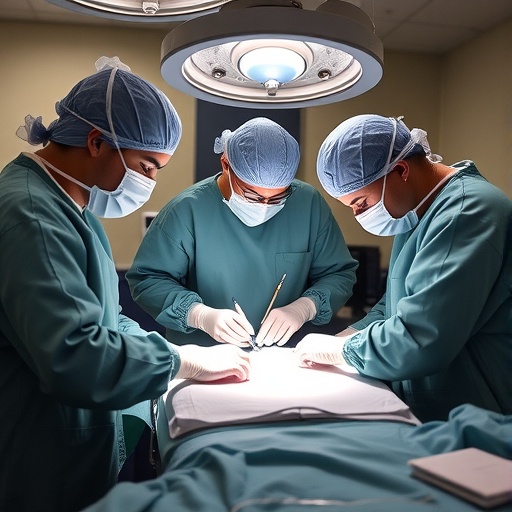
Semmelweis University’s recently inaugurated Anatomy & Innovation Center for Education and Research (AICER) has swiftly emerged as a revolutionary hub for surgical and trauma education. Officially launched in April, this state-of-the-art facility integrates cutting-edge simulation technologies and advanced anatomical resources, setting a new benchmark for clinical training. Among the first programs hosted were NATO battlefield surgery and trauma courses, underscoring the center’s commitment to equipping healthcare professionals with the critical skills needed for life-threatening injuries in conflict zones.
The NATO-affiliated courses, developed collaboratively by Semmelweis University, the Hungarian Defence Forces, and NATO partners, provided an immersive experience where participants managed complex hemorrhagic trauma scenarios under intensely realistic conditions. Expert instructors, including military medical personnel from the United States, guided these sessions, which emphasized hands-on application in a fully equipped environment replicating battlefield medical exigencies. This pioneering approach bridges the gap between theoretical knowledge and clinical application, ensuring a seamless transition of skills into real-world medical emergencies.
Behind the scenes, the Anatomy & Innovation Center’s infrastructure was rigorously tested through these initial courses. The center’s sophisticated operating suites, integrated support systems, and robust technological platforms were evaluated under operational loads that simulate real clinical pressures. Feedback from participants highlighted the facility’s efficacy in delivering high-fidelity training, noting the critical value of performing procedures in an environment mirroring actual patient care settings. This pilot phase demonstrates the center’s readiness to serve as a cornerstone for future medical education endeavors.
Beyond military applications, AICER extends its capabilities to a broader array of medical disciplines. Early programs included intensive training in oral surgery, orthopedic interventions, and ultrasound-guided joint injections. The incorporation of ultrasound techniques, particularly for rheumatologists and rehabilitation specialists, allows practitioners to refine minimally invasive procedures on cadaveric models. This is crucial for advancing the safe treatment of joint disorders, providing tactile and visual feedback that conventional classroom or textbook learning cannot replicate.
Looking ahead, the center’s calendar boasts specialized courses in upper-limb surgery, advanced airway management, and cadaver-based knee surgery protocols designed for experts in traumatology, orthopedics, anesthesiology, and critical care medicine. Such training opportunities reinforce AICER’s multidisciplinary approach, fostering cross-specialty collaboration and knowledge exchange. This integrated educational strategy is poised to elevate clinical proficiency and ultimately improve patient outcomes across various surgical fields.
Integral to AICER’s mission is the utilization of donated human cadavers, ethically sourced for teaching and research. These specimens underpin a realistic platform that enables physicians to experiment with novel surgical techniques, honing their competencies before clinical implementation. This approach substantially mitigates risks associated with adopting new interventions, directly enhancing patient safety by allowing repeated practice in lifelike anatomical contexts.
What distinguishes the center is its fusion of traditional anatomy with pioneering digital innovations. Through advanced imaging modalities, detailed digital reconstructions of cadavers are generated, creating three-dimensional virtual models—or “digital cadaver twins.” These models serve as invaluable adjuncts for preoperative planning, educational simulations, and translational medical research. The convergence of physical and digital tools embodies the future of surgical education, offering customizable, interactive experiences that cater to diverse learning needs.
AICER also serves as an incubator for translating medical technology innovations from concept to clinical practice. By providing an environment where new devices, diagnostic tools, and procedural techniques can be safely tested and refined, the center accelerates the pace of medical advancement. This translational pipeline ensures that emerging healthcare solutions meet stringent safety and efficacy standards before widespread adoption, reinforcing the university’s role as a leader in evidence-based medical education.
Currently in its pilot phase, the center is actively refining operational workflows, educational methodologies, and facility capabilities based on ongoing user feedback. This iterative process ensures that both technical and pedagogical elements align with evolving clinical demands. Semmelweis University’s vision extends beyond national boundaries, aiming to position AICER as a premier educational resource within Central and Eastern Europe, fostering regional collaboration and elevating medical training standards.
Expanding its specialty portfolio in the near future, AICER plans to introduce courses in thoracic surgery, vascular surgery, gynecologic surgery, spinal surgery, abdominal surgery, and endoscopy. These additions reflect a comprehensive approach to surgical education, addressing an array of clinical challenges. Furthermore, the center aims to support a continuum of medical education, from undergraduates and residents to seasoned specialists, enhancing lifelong learning and professional development.
The integration of sophisticated simulation tools, including a beating-heart model, further enhances the tactile and visual realism of training scenarios. These dynamic models replicate physiological behaviors, enabling practitioners to appreciate the complexities of living tissue interactions during surgical procedures. Such innovations foster deeper understanding and improve manual dexterity, essential qualities for mastering intricate operations.
Ultimately, AICER exemplifies a transformative platform for surgical innovation and education, marrying anatomical fidelity with technological prowess. Its comprehensive, multidisciplinary training programs offer a blueprint for future medical education centers worldwide, emphasizing patient safety, procedural mastery, and rapid clinical translation. As the center advances, it is expected to contribute significantly to the augmentation of healthcare quality, ensuring that tomorrow’s surgeons and clinicians are profoundly prepared to meet the challenges of modern medicine.
News Publication Date: June 2026
Web References:
- Semmelweis University AICER official page: https://semmelweis.hu/noikk/
- First courses at AICER: https://semmelweis.hu/english/2026/06/first-courses-kick-off-at-the-anatomy-innovation-center-for-education-and-research/
Cite Scienmag News
Ophelia Keating. (June 16, 2026). Semmelweis University Launches NATO Battlefield Surgery Training and Surgical Simulation Courses at New Innovation Center. Scienmag. https://scienmag.com/semmelweis-university-launches-nato-battlefield-surgery-training-and-surgical-simulation-courses-at-new-innovation-center/
Ophelia Keating. "Semmelweis University Launches NATO Battlefield Surgery Training and Surgical Simulation Courses at New Innovation Center." Scienmag, 16 June 2026, https://scienmag.com/semmelweis-university-launches-nato-battlefield-surgery-training-and-surgical-simulation-courses-at-new-innovation-center/. Accessed 4 September 2026.
Ophelia Keating. "Semmelweis University Launches NATO Battlefield Surgery Training and Surgical Simulation Courses at New Innovation Center." Scienmag. June 16, 2026. https://scienmag.com/semmelweis-university-launches-nato-battlefield-surgery-training-and-surgical-simulation-courses-at-new-innovation-center/


