


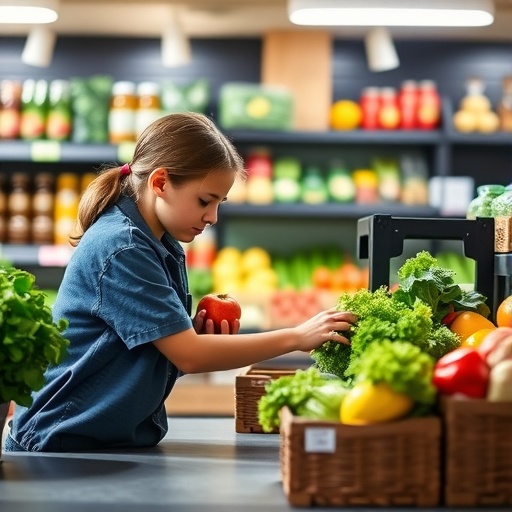
In an era where digital solutions permeate every facet of daily life, a groundbreaking study from Cornell University reveals that online grocery shopping, when paired with targeted incentive programs, has the potential to reshape healthy eating habits among low-income families. This research dives deep into the structural barriers faced by Supplemental Nutrition Assistance Program (SNAP) participants and illustrates how digital commerce can serve not just as a convenience, but as a crucial avenue to access fresh fruits and vegetables — vital components of a nutritious diet.
The cost and perishability of fresh produce have long been formidable challenges for economically disadvantaged households. These barriers are compounded by the frequency needed to restock fruits and vegetables, which often deters low-income families with limited time and resources from purchasing them consistently. By analyzing the shopping behaviors of SNAP beneficiaries enrolled in New York’s Double Up Food Bucks program—a financial incentive designed to enhance fruit and vegetable purchases—the study uncovers how online grocery platforms mitigate these issues and extend reach to under-served populations.
Eunyoung Myung, the study’s lead researcher, highlights that the impetus behind adopting online shopping for these families transcends mere convenience. “For households with young children or those challenged by transportation, the act of physically reaching a store regularly is inherently difficult,” Myung explains. “Our data suggest that online purchasing operates as an essential access strategy—one that accommodates their daily complexities and logistical constraints.” This nuance redefines the role of digital grocery shopping from a luxury to a necessity within these communities.
This insight is critical, particularly as policy and societal perceptions often underestimate the digital engagement of low-income populations. Co-author and associate professor Tashara Leak challenges the common misconception that families with limited financial means rarely engage in online grocery shopping. “Contrary to prevailing assumptions, our findings demonstrate substantial online shopping activity among SNAP participants,” Leak asserts. “The national dialogue increasingly focuses on integrating SNAP with digital platforms, but empirical studies like ours are essential to guide effective policy and program design.”
The Double Up Food Bucks initiative further exemplifies the strategic leverage of financial incentives to encourage healthier food choices. Families frequently allocate a significant portion of their limited SNAP benefits towards staples, leaving fewer resources for nutrient-dense produce. By deploying incentive models that reduce the effective cost of fruits and vegetables, the program helps reorient spending towards balanced diets and addresses nutritional deficits prevalent in low-income households.
Current economic pressures and forthcoming regulatory shifts underscore the urgency of these findings. Cornell researchers have identified that proposed federal SNAP policy changes will likely impose heavier financial responsibilities on states and intensify food insecurity risks. Leak elaborates on this looming challenge: “With states anticipating increased fiscal burdens starting next year, optimizing incentive programs and easing the pathway to fresh produce for SNAP families is more relevant than ever.”
Embedded within the study’s rigorous methodology was a comprehensive survey involving over 450 Double Up participants across New York State. Remarkably, nearly half reported allocating SNAP benefits to purchase fruits and vegetables via online channels such as store-specific sites or the Instacart delivery service. This demographic skewed towards households with children under the age of five, as well as those facing considerable travel times exceeding 20 minutes to the nearest grocery outlet. These correlations highlight how geographic and temporal obstacles shape purchasing avenues.
Building on these findings, ongoing research by the Cornell team is investigating automated enrollment mechanisms and streamlined communication strategies aimed at expanding participation in fruit and vegetable incentive programs. The goal is to overcome entry barriers and bolster engagement rates, ultimately amplifying the programs’ impact on dietary habits and public health outcomes. This iterative research approach signals a commitment to continuous improvement grounded in robust data analytics.
The funding for this critical study was graciously provided by the United States Department of Agriculture (USDA), underscoring institutional recognition of the importance of food security and nutrition-access innovation. By marrying technological convenience with evidence-based policy, this research paves the way for scalable solutions in confronting persistent nutritional inequities.
In sum, the Cornell study contributes a vital perspective to the evolving discourse around digital inclusion, food policy, and health equity. It articulates a compelling argument that online grocery shopping—coupled with targeted financial incentives—serves not only as a tool to enhance dietary quality for SNAP families, but also as a critical framework to address broader socioeconomic disparities. As federal and state agencies navigate forthcoming SNAP reforms, harnessing these insights will be key to fostering resilient, health-oriented food systems.
With public health at a crucial juncture, this evidence-based exploration of online food access strategies offers a roadmap for transforming how vulnerable populations engage with nutritious food options. As the food retail landscape continues to digitize rapidly, integrating incentive programs like Double Up Food Bucks with online shopping infrastructures emerges as a promising frontier to close the nutritional gap for millions of low-income Americans.
News Publication Date: June 2026
Web References:
- Cornell Chronicle story: https://news.cornell.edu/stories/2026/06/online-grocery-shopping-could-bring-more-fresh-produce-snap-families
- American Journal of Health Promotion DOI: http://dx.doi.org/10.1177/0890117126145365
References:
- Eunyoung Myung et al., “Impacts of Online Shopping and Incentive Programs on Fresh Produce Purchase Among SNAP Participants,” American Journal of Health Promotion, 2026.
Keywords
Food security, Food resources, Food science, Applied sciences and engineering, Food policy, Public policy, Political science, Social sciences
Cite Scienmag News
Daisy Hatcher. (June 16, 2026). Online Grocery Shopping Enhances Access to Fresh Produce for SNAP Families. Scienmag. https://scienmag.com/online-grocery-shopping-enhances-access-to-fresh-produce-for-snap-families/
Daisy Hatcher. "Online Grocery Shopping Enhances Access to Fresh Produce for SNAP Families." Scienmag, 16 June 2026, https://scienmag.com/online-grocery-shopping-enhances-access-to-fresh-produce-for-snap-families/. Accessed 4 September 2026.
Daisy Hatcher. "Online Grocery Shopping Enhances Access to Fresh Produce for SNAP Families." Scienmag. June 16, 2026. https://scienmag.com/online-grocery-shopping-enhances-access-to-fresh-produce-for-snap-families/


