


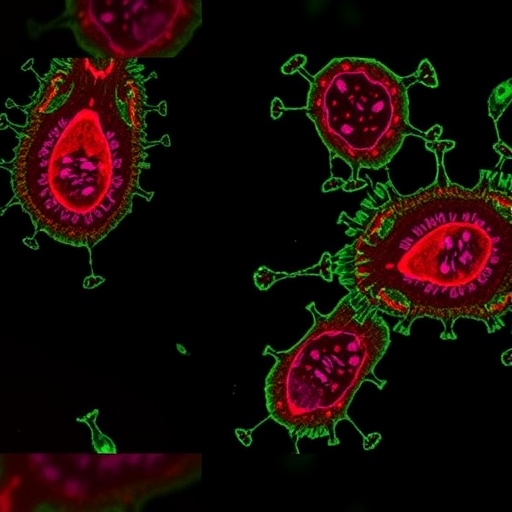
In a groundbreaking advancement for pediatric oncology, researchers have unveiled a novel immunotherapy strategy that holds promise to revolutionize treatment outcomes for children diagnosed with acute myeloid leukemia (AML). The innovative approach leverages a uniquely engineered immunoconjugate combining Bacillus Calmette-Guérin (BCG) heat shock protein 70 (Hsp70) with an anti-CD123 antibody, a mechanism designed to specifically target malignant leukemic cells while sparing healthy tissue. This pioneering work, recently published in Pediatric Research, illuminates a new direction in the fight against AML, a notoriously aggressive and challenging childhood cancer.
The research team’s approach capitalizes on the dual functionalities of BCG Hsp70, a potent immunostimulatory molecule known to activate innate immune responses, and the monoclonal antibody anti-CD123, which homes in on a surface antigen highly expressed on leukemia stem cells. By conjugating these two components, the scientists have engineered an immunoconjugate that not only seeks out leukemic cells with high precision but also enhances immune-mediated cytotoxicity within the tumor microenvironment. Through this synergy, the treatment intensifies the immune system’s ability to eradicate leukemic cells, addressing one of the major hurdles in AML therapy: minimal residual disease and subsequent relapse.
Acute myeloid leukemia presents a formidable challenge, particularly in the pediatric population, due to its heterogeneity and aggressive clinical course. Traditional chemotherapeutic regimens, while effective to some extent, are associated with severe toxicities and often fail to eliminate leukemic stem cells that serve as a reservoir for disease recurrence. The novel BCG Hsp70–anti-CD123 immunoconjugate demonstrates remarkable potential in overcoming these limitations by instigating a robust, targeted immune response that could reduce the need for high-dose chemotherapy and its attendant complications.
At the heart of this therapeutic innovation is the exploitation of CD123, an interleukin-3 receptor alpha chain found disproportionately on leukemic blasts and stem cells, but minimally expressed on normal hematopoietic stem cells. By honing in on this marker, the immunoconjugate achieves a high level of specificity, theoretically minimizing off-target effects and thus improving safety profiles. Experimental data presented in the study reveal that the conjugate effectively binds to CD123-expressing cells and triggers apoptosis, thereby reducing leukemic burden in preclinical models.
The immunostimulatory component, BCG-derived Hsp70, is instrumental in transforming the tumor milieu. Heat shock proteins like Hsp70 are molecular chaperones involved in antigen presentation and can stimulate innate immune cells such as dendritic cells and macrophages. The BCG Hsp70 fragment employed in the conjugate not only acts as a pathogen-associated molecular pattern (PAMP) to ignite immune activation but also enhances the recruitment and maturation of antigen-presenting cells, setting the stage for a downstream adaptive immune response that provides durable tumor control.
Perhaps most compelling is the reported capacity of the BCG Hsp70–anti-CD123 immunoconjugate to breach the immune-suppressive microenvironment that characterizes AML. The leukemic niche often employs regulatory T cells, myeloid-derived suppressor cells, and inhibitory cytokines to thwart immune attack. However, the presence of BCG Hsp70 appears to recalibrate this balance, shifting the microenvironment toward immunogenicity by promoting the secretion of proinflammatory cytokines and reducing immune checkpoints. This invigorated immunological landscape enables a sustained assault on leukemic cells, thereby holding promise for long-term remission.
The implications of this research extend beyond immediate clinical outcomes—this approach exemplifies how host-directed therapies can be effectively combined with targeted antibody strategies to deliver multifaceted anti-cancer effects. By integrating immunological adjuvants like Hsp70 with precision-targeted antibodies, this strategy could pave the way for treatments that are as intelligent as they are potent. The translational potential is significant, with ongoing efforts anticipated to optimize dosing, delivery methods, and combinatorial regimens to maximize efficacy in clinical settings.
Detailed mechanistic studies have illuminated key aspects of the intracellular signaling pathways modulated by the immunoconjugate. Upon binding to CD123-positive cells, the conjugate induces receptor-mediated endocytosis, followed by the activation of apoptotic cascades involving caspase enzymes. Concurrently, the released Hsp70 components engage pattern recognition receptors, including Toll-like receptor 4 (TLR4), on surrounding immune cells, triggering NF-κB signaling and upregulation of co-stimulatory molecules essential for adaptive immunity. This dual activation creates a feedback loop that amplifies antitumor immunity while promoting leukemic cell death.
In addition, the study meticulously explored the pharmacokinetics and biodistribution profiles of the conjugate in preclinical animal models. The BCG Hsp70–anti-CD123 immunoconjugate exhibited favorable stability and retention in leukemic tissue, with minimal accumulation in non-target organs. This biodistribution pattern underscores the therapeutic’s specificity and supports its potential for reduced systemic toxicity—a frequent concern with conventional chemotherapies and less specific biologics.
Patient-derived xenograft models further reinforced the efficacy of the immunoconjugate, where treatment yielded significant reduction in leukemic engraftment and prolonged survival compared to control groups. Importantly, the regimen demonstrated a wide therapeutic window, indicating that the immunoconjugate can achieve effective leukemic targeting without triggering detrimental hematopoietic suppression or systemic inflammatory responses, a challenge that often limits other immune-based therapies.
While this study represents a pivotal leap forward, the authors acknowledge that clinical translation will require careful validation through phased clinical trials to assess safety, immunogenicity, and efficacy in diverse pediatric patient populations. Potential hurdles include managing immune-related adverse events and confirming consistent expression of CD123 in various AML subtypes. Nonetheless, the robust preclinical evidence offers a strong foundation for optimism.
Moreover, the BCG Hsp70–anti-CD123 conjugate may serve as a platform technology adaptable to other hematological malignancies and solid tumors characterized by distinct surface markers. This conceptual groundwork could inspire a new generation of precision immunotherapies that harness endogenous immune stimulators coupled with targeted antibodies to generate customizable, patient-specific treatment modalities.
Emerging from this investigation is the tantalizing prospect that immunotherapy, historically overshadowed by chemotherapy in pediatric AML, may soon claim its rightful place as a frontline treatment. This shift could dramatically redefine therapeutic paradigms, ushering in an era where immune targeting not only improves survival but also quality of life for young patients afflicted by leukemia.
In summary, the innovative fusion of BCG-derived Hsp70 with an anti-CD123 antibody constitutes a sophisticated immunoconjugate that orchestrates a targeted, multipronged assault on leukemic cells in childhood AML. With its promising preclinical results and mechanistic underpinnings, this strategy exemplifies the cutting edge of translational cancer immunotherapy. As the research community looks ahead, this work stands as a beacon of hope, signaling new horizons for conquering one of pediatric oncology’s most formidable foes.
Cite Scienmag News
Nathaniel Bowman. (June 15, 2026). BCG Hsp70–CD123 Immunoconjugate Targets Childhood AML. Scienmag. https://scienmag.com/bcg-hsp70-cd123-immunoconjugate-targets-childhood-aml/
Nathaniel Bowman. "BCG Hsp70–CD123 Immunoconjugate Targets Childhood AML." Scienmag, 15 June 2026, https://scienmag.com/bcg-hsp70-cd123-immunoconjugate-targets-childhood-aml/. Accessed 4 September 2026.
Nathaniel Bowman. "BCG Hsp70–CD123 Immunoconjugate Targets Childhood AML." Scienmag. June 15, 2026. https://scienmag.com/bcg-hsp70-cd123-immunoconjugate-targets-childhood-aml/


