


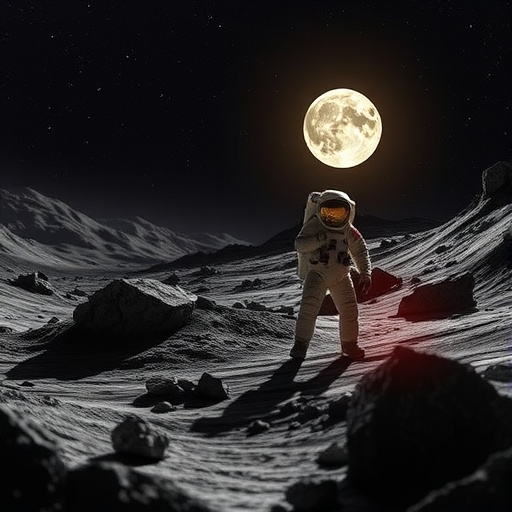
In an unprecedented leap forward in lunar science, researchers from the Center for Lunar Origin and Evolution (CLOE) at the Southwest Research Institute have shed new light on the formation and composition of the Moon’s South Pole-Aitken (SPA) basin. This colossal impact structure, situated on the Moon’s far side, is one of the largest and oldest impact basins in the solar system, serving as a key to understanding the earliest epochs of lunar and planetary evolution. The findings, presented in two cutting-edge studies, detail the extraordinary forces and materials at play during the basin’s formation and highlight the implications for future manned missions aiming to explore the lunar south pole.
The SPA basin’s origin story is rooted in an intense cosmic collision that occurred billions of years ago. Researchers utilized intricate computational simulations to reconstruct the impact event, revealing that an ancient protoplanet or differentiated asteroid, characterized by an iron core surrounded by rocky materials, collided with the Moon at a low angle from north to south. This oblique impact was responsible not only for the basin’s elongated and tapered morphology but also for excavating deep into the Moon’s internal layers, including the mantle, which remains otherwise shrouded beneath surface material.
The notion that the SPA impactor was a differentiated object overturns previous assumptions of simple impact collision dynamics. The differentiation—implying a core and mantle structure within the impactor itself—resulted in a highly asymmetric and vast excavation crater. This cosmic slugger generated a massive cavity and melt sheet in the lunar crust, hurling a tremendous volume of debris, including mantle-derived rocks, across and beneath the surrounding terrain. The simulations accurately replicate the basin’s unique shape, aligning computational output with geological observations, which confirms the power and directionality of the impactor’s trajectory.
But the tale does not end with surface observations. Gravity-based analysis combined with high-resolution data from NASA’s Gravity Recovery and Interior Laboratory (GRAIL) mission allows researchers to peer beneath the basin’s floor. These studies reveal a complex subsurface mosaic interlacing crustal and mantle materials. Contrary to earlier hypotheses that mantle material would be hidden in remote areas of the basin, the data suggest that these mantle-derived rocks are not only present but have been dispersed throughout the basin’s interior as well as the surrounding ejecta blanket. This discovery is paramount as it means that mantle samples—crucial to understanding the Moon’s internal differentiation and geological history—may be accessible within the regions targeted for upcoming Artemis mission landings.
The implications for lunar exploration are profound. With Artemis astronauts poised to touch down on the Moon’s south polar region, the presence of mantle material near proposed landing zones offers an extraordinary scientific opportunity. Sampling mantle-derived rocks could transform our understanding of the Moon’s formation, its subsequent geological evolution, and by extension, the history of the early inner solar system. This could unlock insights into planetary differentiation processes and the timeline of the Moon’s cooling and crust formation, which have until now remained speculative.
Dr. William Bottke, CLOE director, emphasizes the rarity and scientific value of these findings, describing the SPA basin as a natural archive of the Moon’s origins. The basin’s creation event was so cataclysmic that it effectively excavated a window into the deep lunar interior, a feature unparalleled anywhere else on the lunar surface. This window provides a direct link to studying the Moon’s mantle composition and the evolutionary processes that shaped it. Understanding the composition and distribution of mantle ejecta could also refine models of how small bodies in the early solar system contributed to lunar geology and the delivery of materials to the surface.
The computational approach taken by the team is notable for integrating multiple datasets and refining impact modeling techniques. Led by Dr. Shigeru Wakita of Purdue University, the simulations accounted for compositional layering within the impactor and detailed impact angles, factors that had been insufficiently represented in prior models. This nuanced approach elucidated the unique tapered configuration of the SPA basin, a feature which previously puzzled scientists. By effectively capturing both the physical shape and geochemical distribution of impact ejecta, the models set a new standard for planetary impact studies.
Equally important is the companion study led by Dr. Gabriel Gowman of the University of Arizona, which harnessed gravitational field data to map the distribution of mantle sourced materials. The utilization of GRAIL data coupled with Lunar Reconnaissance Orbiter Laser Altimeter readings has unveiled a gravitational signature consistent with buried mantle rocks. Their identification beneath and around the basin floor corroborates the simulation results and elevates our confidence in the accessibility of these deep materials. This integrative research framework not only confirms the presence of mantle ejecta but also offers a geophysical roadmap for where astronauts and robotic explorers should search for these priceless geological samples.
The SPA basin, therefore, stands as a dynamic laboratory for planetary scientists. The rich mix of crustal and mantle materials exposed and scattered by the impact presents a diverse geological palette. The integration of computational physics, geophysical gravity mapping, and lunar mission planning converges to suggest that the Moon’s subsurface secrets are within humanity’s grasp. NASA’s upcoming Artemis missions could pioneer new frontiers in lunar science by probing these deposits, potentially reshaping our understanding of the Moon’s formative years and its broader place in solar system history.
Moreover, the presence of mantle-derived rocks in proximity to the south pole also raises prospects for refining theories about the thermal and compositional evolution of the lunar interior. Sampling mantle materials could shed light on the extent of early lunar volcanism, the nature of the lunar dynamo responsible for its ancient magnetic field, and the timeline over which the Moon’s internal layers differentiated and stabilized. Such insights are indispensable for comparative planetology, enhancing our understanding of terrestrial planet formation and differentiation processes.
In sum, the combination of advanced computational modeling and gravity mapping heralds a new chapter in lunar exploration science. SPA basin research exemplifies the synergy between theoretical and observational lunar science and extends the operational horizons for Artemis astronauts. It sets the stage for profound discoveries about the Moon’s mantle, origin, and geological history by pinpointing where to collect the most significant geological samples. These efforts promise to redefine our knowledge of the Moon and its role as a witness to planetary evolution across the solar system.
These landmark studies underpin a growing consensus that the Moon is more than a barren satellite; it is a repository of critical planetary science data from our solar system’s distant past. Its heavily cratered far side, especially the SPA basin, holds the narrative of early solar system bombardment, planetary differentiation, and crustal development. As humanity prepares to return to the Moon, these discoveries will guide exploration strategies and scientific inquiry, delivering new chapters to the Moon’s enduring story.
For researchers and enthusiasts alike, these findings underscore the transformative potential of upcoming lunar exploration. The integration of simulation, gravity analyses, and robotic reconnaissance positions the SPA basin as a prime site to unlock the Moon’s deepest secrets. Every rock retrieved and sample analyzed near the lunar south pole could bring us closer to unraveling the mysteries of planetary formation, solar system history, and potentially even the origins of life-essential elements.
News Publication Date: June 15, 2026
Web References:
- https://www.science.org/doi/10.1126/sciadv.aea1984
- https://doi.org/10.1029/2026JE009665
- https://www.swri.org/markets/earth-space/space-research-technology/space-science/planetary-science
References:
- Bottke, W., Wakita, S., Gowman, G., et al. “A southward differentiated impactor forms the tapered shape of the South Pole-Aitken impact basin on the Moon.” Science Advances, 6 May 2026. DOI: 10.1126/sciadv.aea1984
- Gowman, G., et al. “Gravity Mapping of Lunar Mantle Material in South Pole-Aitken Basin Ejecta.” Journal of Geophysical Research: Planets, 2026. DOI: 10.1029/2026JE009665
Keywords
Lunar Science, South Pole-Aitken Basin, Moon Mantle, Artemis Missions, Lunar Impact Crater, Computational Modeling, Lunar Geophysics, Gravity Mapping, Planetary Science, Lunar Exploration, NASA, Asteroid Impact
Cite Scienmag News
Grant Pearson. (June 15, 2026). SwRI Researchers Reveal Insights Into What Future Astronauts Might Encounter on the Moon. Scienmag. https://scienmag.com/swri-researchers-reveal-insights-into-what-future-astronauts-might-encounter-on-the-moon/
Grant Pearson. "SwRI Researchers Reveal Insights Into What Future Astronauts Might Encounter on the Moon." Scienmag, 15 June 2026, https://scienmag.com/swri-researchers-reveal-insights-into-what-future-astronauts-might-encounter-on-the-moon/. Accessed 3 September 2026.
Grant Pearson. "SwRI Researchers Reveal Insights Into What Future Astronauts Might Encounter on the Moon." Scienmag. June 15, 2026. https://scienmag.com/swri-researchers-reveal-insights-into-what-future-astronauts-might-encounter-on-the-moon/


