


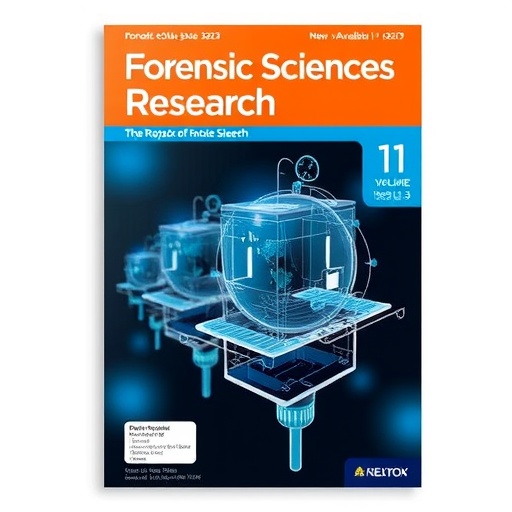
In a landmark revelation poised to reshape the trajectory of forensic sciences, an extraordinary Special Issue has been unveiled, offering a panoramic and forward-thinking perspective on the evolving landscape of forensic and legal medicine. This comprehensive volume, meticulously curated under the stewardship of Santo Davide Ferrara, Emeritus Professor at the University of Padua, emerges as a defining intellectual platform, uniting a global consortium of 53 leading voices from 25 countries and diverse disciplines. Its core mission is to tackle the intricate challenges intrinsic to human identification, encompassing both routine criminal investigations and the complexities of mass disasters, while transcending conventional forensic boundaries through multidisciplinary innovation and technological advancement.
At its essence, this Special Issue serves as a clarion call for reimagining forensic sciences amid the rapid acceleration of digital and scientific revolutions. It critically examines the epistemological roots and scientific autonomy of the discipline, addressing the risks of scientism and emphasizing the delicate balance between objective empirical rigor and the often intangible, conceptual contributions of emerging fields such as quantum physics. These discussions underscore an imperative for forensic sciences to maintain methodological openness, safeguard scientific freedom, and foster harmonized academic frameworks that are adaptive to technological paradigms, including the transformative potential of artificial intelligence and organoid-based superintelligence.
A striking feature of this volume lies in its thoughtful division between a General Section and a Special Section, encompassing 22 scholarly articles that weave together insights from biomolecular medicine, forensic imaging, cardiology, toxicology, and omics technologies, among others. Of particular note is the integration of Large Language and Reasoning Models—advanced AI systems that promise to revolutionize forensic analysis through enhanced data interpretation, pattern recognition, and decision support in psychological and criminological contexts. These contributions herald a new era where machine learning synergizes with human expertise, augmenting investigative accuracy and accelerating case resolutions.
The Special Issue also ventures into the legal and ethical dimensions of artificial intelligence, critically analyzing regulatory frameworks and the potential erosion of legal order amid algorithmic governance. Essays by leading jurists dissect the symbiotic relationships between code, law, and justice, calling for nuanced strategies that reconcile innovation with safeguards against technological overreach. This dialogue resonates powerfully with contemporary debates about the legitimacy and accountability of AI-assisted forensic procedures, a frontier that demands vigilant scrutiny as forensic applications grow increasingly automated.
Parallel to these themes, the volume spotlights advances in forensic pathology and histopathology, championing their evolution into autonomous disciplines that amalgamate meticulous morphological assessments with cutting-edge molecular tools. In cardiovascular forensic sciences, the interplay between clinical cardiology and artificial intelligence is laid bare, illustrating how AI-driven diagnostics and interventions may elucidate causes of sudden cardiac death with unprecedented precision. Such advancements are pivotal in refining the scientific underpinnings of medico-legal investigations and enhancing courtroom evidentiary standards.
Forensic genetics is presented with a visionary lens, elucidating the transition from traditional DNA profiling towards integrative omics approaches, which promise richer biological insights and broader applications in identity verification and individualization. Meanwhile, forensic toxicology is revisited with a critical appraisal of evolving analytical methodologies and detection capabilities that address the complexities of new psychoactive substances and doping agents. The inclusion of an expert interview on the future of doping and anti-doping strategies adds depth to the discourse, highlighting the challenges posed by illicit substance use in sports and societal health.
The volume’s scope further extends to forensic anthropology, odontology, entomology, and palynology, disciplines traditionally anchored in morphological and environmental analyses, now invigorated by data science and AI. These fields exemplify multidisciplinary convergence, as forensic specialists harness genetic markers, biometric data, and ecological patterns to reconstruct identities and postmortem intervals with enhanced accuracy. Equally significant is the emphasis on humanitarian forensic action, endorsing forensic practice as a vehicle for human rights advocacy and societal healing, particularly in contexts of conflict and mass fatality where identity restoration assumes profound ethical dimensions.
Educational paradigms constitute another core pillar, with essays dissecting the curricular evolution in forensic medicine across cultural contexts such as the United Kingdom and Islamic traditions. This educational discourse underscores the necessity of cultivating forensic expertise that is both scientifically robust and culturally sensitive, integrating cutting-edge knowledge with ethical imperatives to train future practitioners who can adeptly navigate the complexities of global forensic challenges.
Through its meticulously curated content, the Special Issue not only delineates the current state and emerging horizons of forensic sciences but also serves as a strategic roadmap for the discipline’s sustainable advancement. It calls for the restoration of disciplinary unity while embracing cross-disciplinary collaboration, advocating for forensic sciences to transcend purely technical functions and embrace a broader humanitarian mission aligned with the imperatives of justice, dignity, and societal welfare. As forensic sciences stand on this epistemological and technological crossroads, the volume articulates a clarion vision for a resilient, innovative, and ethically grounded forensic future that can effectively confront emerging challenges shaped by rapid technological disruption.
In sum, this Special Issue represents an unparalleled convergence of scholarly rigor, international collaboration, and visionary foresight. It charts a path forward that balances the promise of scientific and technological advancement with the enduring values of forensic practice. By integrating multidisciplinary perspectives, embracing digital transformation, and reaffirming the discipline’s humanitarian ethos, it positions forensic sciences to play an essential role in the evolving nexus of science, law, and society throughout the twenty-first century and beyond.
News Publication Date: Not specified (Special Issue presented at the IAFS Congress, Sofia, Bulgaria, May 25–30, 2026)
Cite Scienmag News
Katie Riggs. (June 12, 2026). Forensic Sciences Research Volume 11, Issue 3 Now Available. Scienmag. https://scienmag.com/forensic-sciences-research-volume-11-issue-3-now-available/
Katie Riggs. "Forensic Sciences Research Volume 11, Issue 3 Now Available." Scienmag, 12 June 2026, https://scienmag.com/forensic-sciences-research-volume-11-issue-3-now-available/. Accessed 4 September 2026.
Katie Riggs. "Forensic Sciences Research Volume 11, Issue 3 Now Available." Scienmag. June 12, 2026. https://scienmag.com/forensic-sciences-research-volume-11-issue-3-now-available/


