


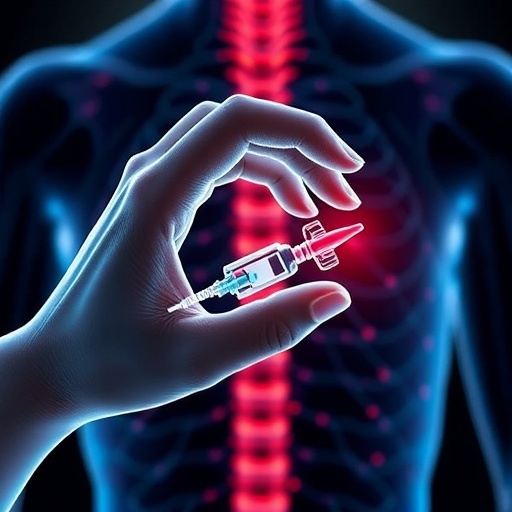
In a groundbreaking collaboration between NYU Abu Dhabi and Cleveland Clinic Abu Dhabi, researchers have introduced a pioneering injectable medical device that promises to transform the landscape of treatment for chronic pain and movement disorders. This innovative technology offers a battery-free, wire-free, and minimally invasive approach to modulate nerve activity, rewriting the conventional paradigms of neuromodulation. By eliminating the need for invasive surgical procedures, this tiny, seed-sized device heralds a new era in neurological therapies, combining technological sophistication with patient-centric convenience.
The device’s design is remarkably simple yet powerful. It can be administered through a standard needle injection, allowing it to be positioned precisely adjacent to a targeted peripheral nerve. Once implanted, the device exerts its effects by delivering finely tuned electrical impulses that modulate nerve signaling, influencing how nerve pathways generate and transmit signals. The capability to wirelessly power the device externally means the nerve stimulation can be dynamically adjusted in real time, offering flexibility and precision in managing complex neurological symptoms.
Published in the esteemed journal Science Advances, this research encapsulates an advantageous fusion of bioengineering, wireless energy transfer, and neurological therapeutics. The device acts as a leadless bioelectronic interface that operates without the burdens of traditional implants—dispensing with batteries and cumbersome wiring systems. This leap in design not only decreases the invasiveness of the intervention but also enhances long-term biocompatibility and patient adherence, setting a new benchmark in bioelectronic medicines.
Prof. Khalil Ramadi, a leading figure in this research and an Assistant Professor of Bioengineering at NYU Abu Dhabi and NYU Tandon, underscores the transformative potential of the device. “This technology challenges established treatment methods by enabling neuromodulation through a minimally invasive, injectable platform,” he remarks. Such adaptability promises to make advanced neurological treatments safer, more accessible, and easier to personalize, addressing the limitations posed by existing surgical implants and pharmacological therapies.
Accurate localization and monitoring are critical for the success of any bioelectronic intervention. To this end, the device is compatible with standardized medical imaging techniques, including ultrasound and computed tomography (CT) scans. This compatibility enables clinicians to verify device placement with high precision and to track its positioning periodically without additional invasive procedures. The programmable nature of the device’s electrical stimulation ensures that therapy can be meticulously tailored to an individual patient’s nerve function and therapeutic response.
From a clinical translation standpoint, the development of this injectable wireless bioelectronic device speaks to a broader movement towards less invasive, patient-friendly medical technologies. Dr. Sawsan Abdel-Razig, Chief Academic Officer at Cleveland Clinic Abu Dhabi, highlights how interdisciplinary partnerships drive medical innovation forward. “Collaborative research efforts are vital in accelerating the development of safer neuromodulation therapies that expand patient access and improve quality of life,” she notes, emphasizing the synergy between academic knowledge and clinical expertise.
The underlying engineering challenges of creating a leadless, injectable device capable of wireless remote control are formidable. The device leverages advances in wireless power transfer technologies, which exploit electromagnetic fields to energize and control the implanted unit without any physical connection. This approach solves problems inherent in traditional implanted neuromodulators that rely on batteries, which have limited lifespans and require replacement surgeries. The novel system also bypasses the infection and mechanical failure risks associated with wired devices.
Experimental validations demonstrate that, under laboratory and preclinical conditions, the device reliably modulates nerve activity with high precision. In vivo experiments, conducted on animal models, confirmed its ability to activate target nerves consistently, attesting to the robustness and real-world applicability of this wireless neuromodulation platform. The demonstrated reproducibility of nerve stimulation suggests promising translational potential for treating diverse neurological disorders, including chronic neuropathic pain and movement impairments like Parkinson’s disease.
Beyond the technological breakthroughs, this injectable device could revolutionize patient care pathways by markedly reducing the risks, costs, and recovery times linked to surgical interventions. Since it is delivered percutaneously, without an incision or implant pocket, it could pivot the treatment paradigm towards outpatient, minimally invasive options. This shift holds particular importance for patients who are elderly, frail, or medically contraindicated for surgery, thereby broadening the inclusiveness and accessibility of neuromodulatory therapies.
The flexibility of this novel device also opens avenues for dynamic and responsive neuromodulation regimens. Future clinical protocols could involve real-time feedback systems that adjust electrical stimulation parameters based on physiological signals or disease progression, optimizing therapeutic outcomes. Such intelligent neuromodulation platforms align with the growing trend toward personalized medicine, where individual patient variability dictates treatment customization.
This research represents an important milestone in the expanding field of bioelectronic medicine, which seeks to interface advanced electronics seamlessly with biological systems to restore or enhance physiological function. As the global burden of chronic neurological disorders continues to rise, innovations like this injectable bioelectronic interface hold the promise of improving millions of lives by making sophisticated treatments safer, simpler, and more effective.
The team behind this breakthrough includes a diverse group of researchers and clinicians spanning multiple disciplines and institutions, epitomizing the collaborative spirit essential for modern biomedical innovations. Key contributors from NYU Abu Dhabi and Cleveland Clinic Abu Dhabi have integrated expertise in bioengineering, neurology, and clinical research to bring this visionary concept from lab bench to potential bedside application.
As ongoing work advances towards human clinical trials, the scientific and medical communities will be watching closely. Success in human subjects could trigger a paradigm shift in how peripheral nerve disorders are managed worldwide. The injected, leadless design promises to overcome many longstanding obstacles in the field, inspiring new device architectures and therapeutic strategies that further leverage wireless bioelectronics.
With its profound implications for patient safety, therapeutic precision, and ease of use, this injectable neuromodulation device exemplifies the confluence of cutting-edge engineering and clinical medicine. It redefines possibilities for treating complex neurological diseases while reducing the burden on patients and healthcare systems alike, marking a pivotal advance in the science of nerve control.
News Publication Date: 12-Jun-2026
Web References:
10.1126/sciadv.aeg1437
Keywords
Applied sciences and engineering
Cite Scienmag News
Denise Maddox. (June 12, 2026). NYU Abu Dhabi and Cleveland Clinic Abu Dhabi Create Injectable Device for Non-Surgical Nerve Control. Scienmag. https://scienmag.com/nyu-abu-dhabi-and-cleveland-clinic-abu-dhabi-create-injectable-device-for-non-surgical-nerve-control/
Denise Maddox. "NYU Abu Dhabi and Cleveland Clinic Abu Dhabi Create Injectable Device for Non-Surgical Nerve Control." Scienmag, 12 June 2026, https://scienmag.com/nyu-abu-dhabi-and-cleveland-clinic-abu-dhabi-create-injectable-device-for-non-surgical-nerve-control/. Accessed 4 September 2026.
Denise Maddox. "NYU Abu Dhabi and Cleveland Clinic Abu Dhabi Create Injectable Device for Non-Surgical Nerve Control." Scienmag. June 12, 2026. https://scienmag.com/nyu-abu-dhabi-and-cleveland-clinic-abu-dhabi-create-injectable-device-for-non-surgical-nerve-control/


