


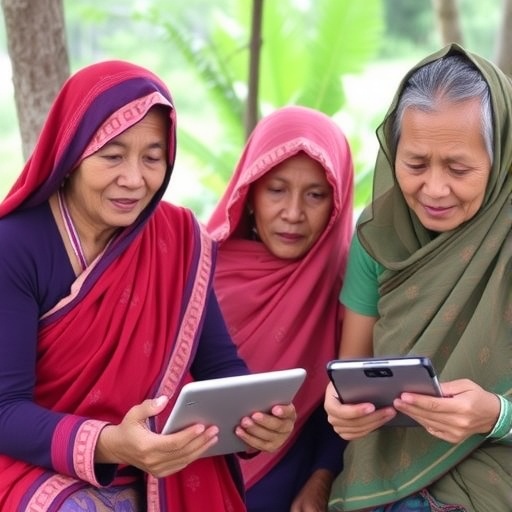
In the remote villages scattered across the tumultuous landscapes of rural Myanmar, where years of civil war have left indelible marks on society, an emerging story of resilience and adaptation is unfolding. Recent research sheds light on how older adults in these conflict-affected areas harness digital technology, fostering social cohesion amid pervasive disruption and uncertainty. This phenomenon, detailed in a groundbreaking study published in BMC Geriatrics, unveils the intricate interplay between technology, social networks, and coping strategies, revealing a nuanced portrait of how digital tools are reshaping lives in one of the world’s most challenging environments.
Myanmar, long marred by internal strife and ethnic tensions, presents a unique setting where the social fabric has been severely tested. The elderly, often overlooked in discussions about technological advancement, are shown to be active participants in the digital realm, using smartphones and other devices to maintain and rebuild community ties. Their engagement with digital platforms is not simply a matter of convenience but rather a crucial lifeline that mitigates isolation and fosters a sense of belonging when physical interactions are restricted or fraught with danger.
The study meticulously examines barriers that older adults face in adopting digital technology amidst war-induced challenges. Limited infrastructure, sporadic internet connectivity, and the scarcity of digital literacy resources form a daunting triad obstructing seamless technology integration. However, the research highlights remarkable coping strategies employed by these individuals, including peer-to-peer support, reliance on family members for guidance, and creative adaptations to low-tech environments. These strategies underscore a profound determination to transcend technological and situational impediments, revealing a digital resilience cultivated under duress.
In terms of social cohesion, the role of digital technology transcends mere information exchange. It becomes a symbolic and functional bridge linking dispersed family members and community networks weakened by conflict. Messaging applications and social media platforms assume new importance, providing spaces for emotional support, news sharing, and collective mobilization. By staying connected, older adults preserve traditions, transmit cultural knowledge, and participate in local decision-making, reinforcing social structures at risk of fragmentation.
Technological adoption among Myanmar’s rural elderly is deeply contextual. The study situates this phenomenon within a landscape where generational gaps, educational disparities, and ethnic diversity influence access and usage patterns. These factors converge to create heterogeneous experiences, with some older adults becoming adept digital navigators, while others remain marginally connected. The research emphasizes the necessity for tailored digital literacy programs that respect linguistic and cultural specificities, ensuring inclusivity in this digital transformation.
Moreover, the intersection of civil war and digital technology use poses novel ethical and security considerations. The potential for surveillance, misinformation, and digital harassment is magnified in conflict zones, demanding heightened awareness and protective measures. The study draws attention to these risks, advocating for the development of secure communication channels and community-based digital safety protocols that safeguard vulnerable populations, particularly the elderly, from exploitation or harm.
From a technological perspective, the research explores the adaptations of digital devices and networks to rural Myanmar’s unique ecological and infrastructural constraints. Innovations such as offline messaging apps, low-bandwidth information dissemination, and solar-charged mobile devices demonstrate how technology providers can rethink design philosophies to meet the specific needs of conflict-affected older adults living far from urban centers. This approach not only improves accessibility but also catalyzes social resilience through sustained connectivity.
The psychological benefits derived from digital engagement form a pivotal theme within the study. Maintaining regular communication via digital tools alleviates feelings of loneliness, depression, and anxiety commonly exacerbated by the isolation of war. Virtual interactions offer a semblance of normalcy and community, enabling elders to witness daily events and maintain social roles despite physical separation. Such emotional support is crucial in mitigating the mental health burden imposed by protracted conflict.
Importantly, the study documents the role of local and international non-governmental organizations in facilitating digital inclusion for older adults. These entities act as catalysts, providing training, distributing devices, and creating content tailored to the elderly’s needs. Collaborative efforts between tech companies, community groups, and healthcare providers emerge as a best practice, transcending traditional aid paradigms to foster sustainable, digitally integrated social care systems.
This research advances the discourse on digital equity by illuminating a demographic often marginalized in technological narratives: the older population living through conflict in rural settings. It challenges assumptions about technology usage linked predominantly to youth or urban areas, spotlighting how digital tools serve as crucial agents for social cohesion and psychosocial well-being under extreme conditions. The findings urge policymakers to incorporate digital inclusion in humanitarian and post-conflict recovery frameworks, ensuring elder populations are prioritized in digital infrastructure investments.
Furthermore, these insights carry global relevance beyond Myanmar, offering a blueprint for other regions grappling with prolonged unrest and ageing populations. The model of digitally facilitated social cohesion among elders demonstrates an adaptive social capital that can be nurtured to uphold community integrity during crises. Replicating such strategies demands a multidisciplinary approach encompassing technology design, social policy, cultural competence, and conflict resolution expertise.
The intersectionality of age, geography, conflict, and technology unfolds as a complex field ripe for ongoing exploration. The study encourages future research to delve deeper into the longitudinal impacts of digital technology on social networks, mental health, and economic opportunities among elder populations. Understanding how these dynamics evolve post-conflict can inform sustainable development goals aiming to foster inclusive, resilient societies harnessing digital innovation.
As Myanmar continues on its uncertain path toward peace and reconstruction, the resilience exhibited by its rural elders underscores the transformative power of technology in humanizing and sustaining social bonds. By illuminating their digital journeys, researchers contribute not only to academic knowledge but also to practical strategies that empower communities to adapt, survive, and thrive amidst adversity.
In sum, this pioneering study from BMC Geriatrics captures a vital facet of the digital age’s reach into even the most remote and disrupted corners of the globe. It offers a powerful testament to the importance of inclusive technology design and deployment, highlighting that even in the shadow of civil war, digital tools can forge connections that underpin the very essence of social cohesion.
Cite Scienmag News
Ophelia Keating. (June 11, 2026). Digital Tools Boost Rural Myanmar Seniors’ Unity Amid War. Scienmag. https://scienmag.com/digital-tools-boost-rural-myanmar-seniors-unity-amid-war/
Ophelia Keating. "Digital Tools Boost Rural Myanmar Seniors’ Unity Amid War." Scienmag, 11 June 2026, https://scienmag.com/digital-tools-boost-rural-myanmar-seniors-unity-amid-war/. Accessed 4 September 2026.
Ophelia Keating. "Digital Tools Boost Rural Myanmar Seniors’ Unity Amid War." Scienmag. June 11, 2026. https://scienmag.com/digital-tools-boost-rural-myanmar-seniors-unity-amid-war/


