


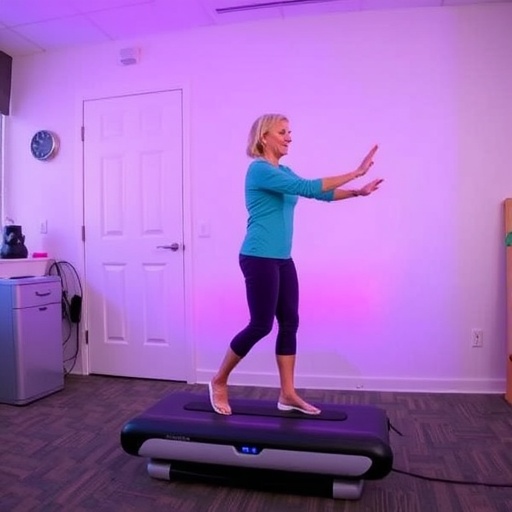
Stroke remains a leading cause of long-term disability worldwide, often leaving survivors with impaired motor function and compromised balance, particularly among older adults. Restoring dynamic balance — the ability to maintain stability during movement — is critical for preventing falls and improving quality of life in this vulnerable population. Recent research spearheaded by Lan, Qin, and Zhang offers a comprehensive synthesis of current evidence on an innovative rehabilitation technique: whole-body vibration (WBV) therapy. Their systematic review and multilevel meta-analysis published in BMC Geriatrics in 2026 present a compelling overview of WBV’s potential to enhance dynamic balance in older stroke patients, positioning this intervention as a promising adjunct to conventional therapies.
Whole-body vibration involves standing, sitting, or exercising on a platform that generates mechanical oscillations at specific frequencies and amplitudes. These vibrations stimulate neuromuscular activation through rapid, involuntary muscle contractions mediated by the tonic vibration reflex. The mechanical signals transmitted by WBV reach the nervous system, eliciting sensorimotor responses that can promote neural plasticity and muscle strengthening without demanding strenuous voluntary effort. For older individuals recovering from stroke, who often face fatigue and limited mobility, WBV offers a less taxing yet effective modality to target balance impairments.
The rationale for employing WBV in stroke rehabilitation hinges on the modulation of proprioceptive inputs and enhancement of postural control. Proprioception—the sensory mechanism by which the body perceives movement and position—is frequently disrupted after cerebrovascular insult, compromising the brain’s ability to coordinate muscle activity required for balance. WBV may recalibrate these sensory signals, fostering improved integration between peripheral feedback and central motor commands. Furthermore, by inducing rapid muscle contractions, WBV potentially counters disuse atrophy and muscle weakness that commonly exacerbate balance deficits after stroke.
Lan and colleagues meticulously aggregated data from multiple clinical trials encompassing diverse WBV protocols, patient ages, stroke chronicity, and outcome measures related to dynamic balance. Their meta-analytic approach considered both within-study variability and differences across studies to generate robust, hierarchical estimates of WBV’s effects. The results demonstrate statistically significant improvements in metrics such as the Timed Up and Go test and Berg Balance Scale scores compared to control interventions, including conventional physical therapy alone. These findings underscore WBV’s capacity to enhance functional mobility and reduce fall risk factors in older stroke populations.
The analysis further reveals that parameters such as vibration frequency, amplitude, session duration, and total intervention length profoundly influence therapeutic efficacy. Optimal protocols identified in the review typically employed vibration frequencies ranging from 20 to 40 Hz and amplitudes between 1 to 4 mm, delivered in sessions lasting 15 to 30 minutes multiple times per week over several weeks. Such fine-tuning of WBV delivery parameters is instrumental in maximizing neuromuscular responsiveness while minimizing discomfort or adverse effects, which are critical for patient adherence and safety.
Mechanistically, the beneficial impact of WBV on balance post-stroke may involve complex neurophysiological processes. Aside from direct muscle activation, WBV may enhance corticospinal excitability, facilitating improved motor output from the brain to affected limbs. It may also contribute to synaptic plasticity within sensorimotor networks, promoting adaptive reorganization essential for functional recovery. Additionally, WBV potentially stimulates vestibular inputs integral to equilibrium, complementing proprioceptive enhancements in comprehensive postural control rehabilitation.
Despite its promise, WBV is not without controversies and challenges. Variability in study methodologies, patient characteristics, and outcome measurements complicates direct comparisons and generalization of findings. Some trials cite modest or transient benefits, prompting calls for larger, well-controlled randomized studies with extended follow-ups to validate long-term efficacy and elucidate precise mechanisms. Moreover, tailoring WBV interventions to individual patient profiles, including stroke severity and comorbidities, remains an evolving clinical art.
Safety considerations also warrant attention, especially in frail elderly patients. While adverse events associated with WBV are infrequent and typically mild, such as transient dizziness or muscle soreness, rigorous screening for contraindications like severe cardiovascular disease, acute thrombosis, or orthopedic instability is essential. Clinicians and therapists must balance maximizing therapeutic intensity with minimizing risk, emphasizing gradual progression and close monitoring throughout treatment courses.
Beyond stroke recovery, the implications of WBV extend to broader geriatric rehabilitation contexts, including frailty syndrome, osteoarthritis, and sarcopenia management. Its potential to improve muscle strength, bone density, circulation, and neuromuscular coordination through non-invasive means makes WBV an attractive modality for multifaceted eldercare strategies. The present meta-analysis galvanizes momentum for integrating WBV into tailored multidisciplinary rehabilitation programs aimed at holistic functional restoration.
In summary, the evidence synthesized by Lan and colleagues elucidates whole-body vibration as a potent, innovative intervention capable of significantly enhancing dynamic balance in older patients recovering from stroke. By leveraging mechanosensory stimulation to activate neuromuscular pathways and promote neuroplastic recovery, WBV complements conventional rehabilitation paradigms with a novel, accessible approach. Ongoing research aimed at optimizing protocol parameters, identifying responders, and clarifying underlying biological mechanisms will be pivotal in translating these promising findings into widespread clinical practice.
The integration of WBV into stroke rehabilitation heralds a paradigm shift toward mechanotherapy approaches that extend beyond traditional exercise regimens. This evolution reflects a broader trend in neuroscience and geriatric rehabilitation, emphasizing technology-driven interventions that harness intrinsic physiological processes to accelerate functional gains. For an aging global population burdened by stroke-related disability, these advances carry substantial potential to transform outcomes, reduce healthcare costs, and improve independent living.
As the scientific and clinical communities continue to unravel the complexities of post-stroke recovery, incorporating multidisciplinary innovations like whole-body vibration will remain essential. Collaborative efforts spanning neurology, physical therapy, biomedical engineering, and geriatrics promise to refine WBV applications, ultimately empowering older stroke survivors to reclaim balance, confidence, and autonomy in their daily lives. This groundbreaking meta-analysis represents a vital milestone, making a strong case for WBV’s emerging role at the forefront of rehabilitation science.
Cite Scienmag News
Cassandra Pierce. (June 10, 2026). Vibration Therapy Boosts Stroke Patients’ Balance. Scienmag. https://scienmag.com/vibration-therapy-boosts-stroke-patients-balance/
Cassandra Pierce. "Vibration Therapy Boosts Stroke Patients’ Balance." Scienmag, 10 June 2026, https://scienmag.com/vibration-therapy-boosts-stroke-patients-balance/. Accessed 4 September 2026.
Cassandra Pierce. "Vibration Therapy Boosts Stroke Patients’ Balance." Scienmag. June 10, 2026. https://scienmag.com/vibration-therapy-boosts-stroke-patients-balance/


