


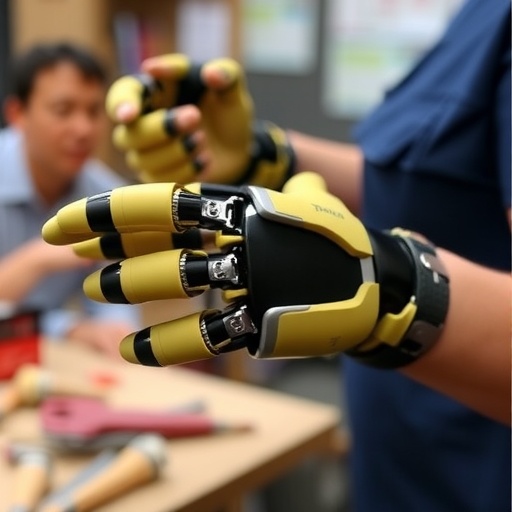
In a groundbreaking advance poised to transform the landscape of prosthetic hand technology, researchers at Wuhan University of Science and Technology have introduced an innovative myoelectric prosthetic control system that skillfully mimics the human hand’s dynamic manipulation capabilities. Upper-limb amputees often face tremendous challenges in everyday tasks requiring tool handling because traditional prostheses tend to operate on static force control principles. This study pioneers a biomimetic approach that significantly elevates the stability and adaptability of prosthetic hands during highly dynamic and forceful interactions such as hammering, sawing, and peeling.
Human hands excel at managing rapid, complex tasks by integrating various sensory signals—tactile feedback, proprioception, and neuromuscular inputs—allowing seamless adjustments to grip force and finger position in real time. Conventional prosthetic systems, however, largely rely on fixed-force or force-following strategies which fail to adequately adapt to sudden impacts, resulting in grasp instability or delayed responses. The novel framework presented here bridges this critical gap by closely replicating the sensorimotor loop of biological hands, enabling prostheses to respond instantaneously to external perturbations during tool use.
Central to this breakthrough is the development of a tactile, kinesthetic, and electromyographic bionic gripping controller (TKE-BGC). This sophisticated controller was trained using multimodal data recorded from able-bodied participants performing realistic tool-use tasks while wearing a data glove embedded with tactile sensors, bend sensors, and EMG electrodes. The collected data encompassed contact forces, joint angles, and muscle activation patterns during dynamic manipulations. A Transformer encoder then fused these temporal signals to allow the controller to predict and adjust joint angle increments in real time with remarkable precision, effectively anticipating and correcting grasp deviations.
The control pipeline initiates by decoding the user’s intended grasping action from surface EMG signals via advanced pattern recognition algorithms. Subsequently, the TKE-BGC system continuously integrates tactile feedback and joint kinematics to make rapid, adaptive corrections during ongoing tool interaction. This feedback-driven mechanism enables the prosthetic hand to maintain a stable grip despite variable loads and strong impacts—scenarios where traditional methods tend to falter. The result is a prosthesis capable of fluidly handling complex, dynamic tasks that were previously infeasible.
Extensive validation of this framework was conducted across multiple challenging real-world tasks including hammering nails, sawing wood, fruit peeling, and desktop organization. Both able-bodied individuals and transradial amputees participated in these experiments, enabling direct comparisons between the novel TKE-BGC approach and established fixed-force and force-following control strategies. The TKE-BGC outperformed its counterparts by a significant margin, exhibiting fewer tool drops and faster task completion times across all tested scenarios, irrespective of whether a task was previously seen or novel to the system.
Moreover, direct measurements revealed that this method produced contact forces closely resembling those observed in natural hand manipulation. This nuanced grip force modulation simultaneously minimized slippage risk and prevented excessive pressure that could damage tools or objects. Electromyographic recordings further demonstrated that users employing TKE-BGC exerted less muscular effort, indicating that the system effectively offloads physical strain through intelligent control. Subjective feedback from amputee users reinforced these objective findings, describing the prosthesis as more efficient, intuitive, and easier to operate compared to prior methods.
Ablation studies highlighted the indispensable role of tactile sensory input in achieving the high level of manipulation dexterity observed. When tactile information was withheld, performance significantly declined, underscoring the need for rich multimodal integration. The successful fusion of kinesthetic, tactile, and EMG data sets a new benchmark for prosthetic control architectures aiming to restore complex, practical hand functions. This paradigm shift marks a move away from rigid, intention-only decoding toward sensor-driven adaptation that emulates the human sensorimotor feedback loop.
The implications of this work extend far beyond incremental technology improvements. It signals a critical conceptual leap toward intelligent prostheses capable of supporting amputees in performing the diverse and demanding manual tasks necessary for independent living and vocational engagement. By achieving stable, real-time grasp adjustments in dynamic, impact-rich environments, the TKE-BGC framework addresses a longstanding clinical challenge and enhances the practical utility of myoelectric prosthetic hands in everyday life.
Nonetheless, the researchers acknowledge current limitations. The tactile sensing system, while effective, remains relatively sparse and does not yet capture comprehensive tactile modalities such as vibration, temperature, or multidirectional shear forces. Additionally, the controller was primarily trained on data from a single demonstrator, which restricts personalization across diverse user preferences and anatomies. The team envisions future developments will incorporate denser tactile sensor arrays, more sophisticated multi-degree-of-freedom modeling, and adaptive mapping techniques to enhance dexterity, generalizability, and real-world applicability.
This transformative research exemplifies how interdisciplinary integration of robotics, neuroscience, and machine learning can unlock new frontiers in assistive technology. By harnessing complex multimodal data and biomimetic control, these advances promise to significantly improve the lives of millions affected by upper limb loss. As intelligent prosthetics advance from static grasping capability to dynamic, human-like manipulation, the gap between biological and artificial hand function narrows, heralding a new era of personalized, practical limb restoration.
The study was led by Boao Li and colleagues, with contributions from a dedicated team of researchers at Wuhan University of Science and Technology. Their work received partial funding from the Brain Science and Brain-like Intelligence Technology Major Project and the National Natural Science Foundation of China, underscoring the strategic priority of advancing brain-inspired intelligent robotics. Published in the esteemed journal Cyborg and Bionic Systems in May 2026, this work has already garnered significant attention from the scientific community and is poised to catalyze further innovations in prosthetic technology and rehabilitation.
With promising early clinical validation and demonstrated superiority to conventional methods, the TKE-BGC control framework charts a clear path forward for next-generation prosthetic hands. The system’s ability to dynamically stabilize grasps during rapid impacts and varying loads fundamentally transforms how tool-use skills are transferred from humans to machines. These advances promise wider prosthesis adoption, increased user autonomy, and improved quality of life, properties essential for integrating intelligent limb replacements into the bustling realities of daily human activity.
News Publication Date: May 13, 2026
Web References: https://mediasvc.eurekalert.org/Api/v1/Multimedia/a274cf34-82aa-4e44-8063-4a3cae9aef73/Rendition/low-res/Content/Public
References: Li, Boao et al. “Dynamic Manipulation Skill Learning for Tactile Myoelectric Prosthetic Hands in Tool Handling.” Cyborg and Bionic Systems, 2026.
Cite Scienmag News
Reid Dalton. (June 9, 2026). Advancing Tactile Myoelectric Prosthetic Hands: Mastering Dynamic Tool Handling Skills. Scienmag. https://scienmag.com/advancing-tactile-myoelectric-prosthetic-hands-mastering-dynamic-tool-handling-skills/
Reid Dalton. "Advancing Tactile Myoelectric Prosthetic Hands: Mastering Dynamic Tool Handling Skills." Scienmag, 9 June 2026, https://scienmag.com/advancing-tactile-myoelectric-prosthetic-hands-mastering-dynamic-tool-handling-skills/. Accessed 4 September 2026.
Reid Dalton. "Advancing Tactile Myoelectric Prosthetic Hands: Mastering Dynamic Tool Handling Skills." Scienmag. June 9, 2026. https://scienmag.com/advancing-tactile-myoelectric-prosthetic-hands-mastering-dynamic-tool-handling-skills/


