


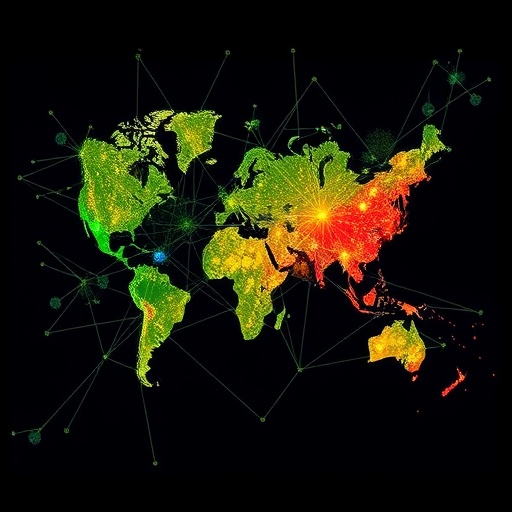
In the ever-evolving field of ecology and environmental science, accurately assessing the risks posed by climate change and anthropogenic land-use alterations is paramount. Recent research conducted by Xu, Dang, and Wu, published in Communications Earth & Environment, presents a groundbreaking critique of the current methodologies employed for ecological risk assessment. Their study unveils that prevalent static connectivity models, which have long been relied upon to predict ecological outcomes, significantly underestimate the risks engendered by prolonged climate variability and changing land-use patterns. This revelation holds profound implications for conservation strategies, environmental management, and policy-making aimed at safeguarding biodiversity and ecosystem services.
For decades, ecological connectivity modelling has served as a foundational tool in landscape ecology, used to understand how various habitats are linked and how species move across fragmented environments. These models are instrumental in designing protected areas, wildlife corridors, and understanding species resilience to disturbances. However, traditional static models operate under the assumption that landscape connectivity remains relatively constant over time, often ignoring dynamic processes such as gradual climate shifts and progressive land transformation. The study by Xu and colleagues challenges this assumption, emphasizing that static models fail to capture the cumulative and temporal nuances of ecological risks.
The research scrutinizes the long-term effects of climate change and land-use modifications by incorporating dynamic landscape changes into connectivity analyses. Xu et al. employed advanced simulation techniques to model ecosystems over extended periods, integrating variables such as temperature fluctuations, precipitation changes, and the expansion of urban or agricultural areas. Their results strikingly demonstrate that ecosystems’ vulnerability is far greater than what static models predict. This discrepancy arises because static models cannot adapt to shifting habitat availabilities or altered species movement patterns driven by environmental transformations.
At the core of this research is the insight that connectivity is not a fixed attribute but a fluctuating property subject to temporal environmental pressures. Habitats that appear well-connected today may become isolated tomorrow as climate conditions render certain regions inhospitable. For example, rising temperatures may force species to migrate to higher altitudes or latitudes, effectively reshaping connectivity networks. Static models, by ignoring these trajectories, can produce overly optimistic risk assessments, potentially leading to misguided conservation policies that fail to prevent biodiversity loss.
Understanding the integration of land-use change with climate dynamics is particularly important because land management decisions often occur over shorter time horizons compared to climate processes. Urban expansion, deforestation, and agricultural intensification continuously reconfigure landscapes, sometimes exacerbating climate-driven stresses. The researchers’ dynamic approach enables a more holistic view wherein land-use alterations compound climatic impacts, heightening ecological risk. This is crucial for ecologists and land managers who must navigate complex scenarios where human activity intersects with natural environmental shifts.
By challenging the status quo, Xu and colleagues call for a paradigm shift in connectivity modelling—moving from static frameworks to models that are inherently adaptive and temporally explicit. Such models would incorporate real-time data feeds, predictive climate scenarios, and landscape change projections to offer more realistic insights into future ecological conditions. This evolution in modelling would empower decision-makers to pre-emptively identify critical habitat corridors that are likely to retain connectivity, or conversely, areas at risk of becoming isolated, facilitating more effective resource allocation.
Moreover, the study highlights the importance of cross-disciplinary integration, combining climatology, land-use science, and spatial ecology. The complexities of environmental change cannot be fully captured within isolated disciplinary silos. The dynamic connectivity model proposed by Xu et al. exemplifies how merging datasets and modelling approaches can yield richer, more actionable knowledge. It stimulates a broader conversation about the need for collaborative frameworks that synthesize data on biodiversity, climate projections, and human land-use patterns.
From a methodological perspective, the study advances the field by employing novel computational algorithms capable of handling large temporal datasets and simulating complex feedback loops. These algorithms enable researchers to track changing ecological networks over decades, accounting for delays and nonlinearities inherent in environmental systems. Such technological innovation not only enhances risk assessment accuracy but also represents a blueprint for future ecological modelling endeavors in the Anthropocene, where unprecedented environmental changes demand equally sophisticated analytical tools.
The implications of underestimating ecological risk are severe. Inaccurate predictions can lead to inadequate conservation responses, resulting in accelerated species decline, habitat fragmentation, and ecosystem service degradation. Given the accelerating pace of climate change and land-use intensification globally, the reliance on outdated static models poses a systemic risk to biodiversity protection efforts. Xu et al.’s findings thus resonate beyond academia, urging policymakers and practitioners to rethink current frameworks to incorporate dynamic, forward-looking assessments.
Importantly, this research aligns with the increasing calls from international conservation bodies to integrate climate adaptation into ecological planning. Static models, by their nature, lack the agility to anticipate the rapid transitions increasingly characteristic of ecosystems worldwide. The dynamic connectivity framework proposed here could serve as a foundational component of adaptive management strategies, offering a mechanism to regularly update risk assessments as new climate or land-use data emerge.
Furthermore, the study elucidates that expanding conservation networks without considering temporal connectivity changes might unwittingly misallocate limited conservation resources. Areas deemed critical today may lose ecological significance tomorrow, while overlooked regions could become vital refugia. This underscores the necessity of continuous monitoring and adaptive planning informed by temporally explicit connectivity analyses, securing long-term ecological resilience amidst environmental uncertainty.
The importance of this research extends into ecosystem services, which underpin human wellbeing through functions like pollination, water purification, and climate regulation. Disruptions in connectivity can impair these services by fragmenting species populations and altering ecosystem processes. The dynamic modelling of connectivity thus offers a pathway to foresee and mitigate potential service losses, ensuring sustainable ecosystem functioning in a changing world.
In sum, the work of Xu, Dang, and Wu represents a seminal contribution to ecological risk modelling, spotlighting the limitations of static connectivity paradigms under conditions of long-term climate and land-use change. Their innovative approach not only refines risk projections but also reinforces the urgent need for iterative, data-driven conservation strategies that reflect the temporal dynamism of natural and anthropogenic systems alike. As global environmental challenges intensify, adopting such sophisticated models could become indispensable in guiding efforts to preserve biodiversity and ecosystem integrity.
Looking forward, the integration of remote sensing technologies, machine learning, and real-time climate monitoring may further enhance these dynamic models, enabling near-instantaneous updates and scenario testing. The future of ecological risk evaluation evidently lies in embracing complexity and temporality, as illuminated by the pioneering research of Xu and co-authors. Their findings constitute a clarion call for the scientific community to revise conventional ecological risk assessments and catalyze innovative approaches that can more effectively confront the ecological uncertainties of the 21st century.
This transformative research not only challenges traditional methodologies but also sets the stage for a new era in ecology where predictive power and realistic risk estimation are viewed through the lens of dynamic environmental interplay. By doing so, it creates a blueprint for resilience-oriented conservation science that better anticipates and manages the cascading effects of climate and land-use changes for the planet’s diverse ecosystems.
Xu, B., Dang, T. & Wu, X. Static connectivity models underestimate ecological risk under long-term climate and land-use change. Commun Earth Environ (2026). https://doi.org/10.1038/s43247-026-03707-5
Cite Scienmag News
Margaret Porter. (June 6, 2026). Static Connectivity Models Undervalue Long-Term Ecological Risk. Scienmag. https://scienmag.com/static-connectivity-models-undervalue-long-term-ecological-risk/
Margaret Porter. "Static Connectivity Models Undervalue Long-Term Ecological Risk." Scienmag, 6 June 2026, https://scienmag.com/static-connectivity-models-undervalue-long-term-ecological-risk/. Accessed 4 September 2026.
Margaret Porter. "Static Connectivity Models Undervalue Long-Term Ecological Risk." Scienmag. June 6, 2026. https://scienmag.com/static-connectivity-models-undervalue-long-term-ecological-risk/


