


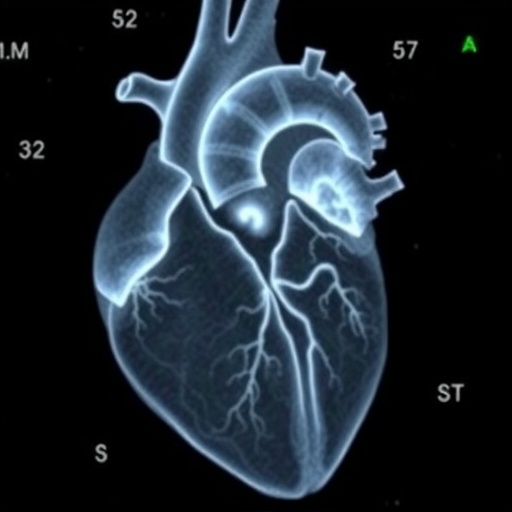
In a groundbreaking advancement in cardiac imaging, researchers at Kyushu University have unveiled a novel, rapid, and minimally invasive X-ray technique capable of accurately assessing the severity of pulmonary valve regurgitation (PR). This condition commonly arises as a long-term complication in patients who have undergone surgical correction for Tetralogy of Fallot (TOF), a serious congenital heart defect. The innovative approach leverages dynamic chest radiography (DCR), offering a much-needed diagnostic alternative that dramatically simplifies evaluation processes while maintaining exceptional precision.
Tetralogy of Fallot is one of the most prevalent cyanotic congenital heart anomalies, characterized by structural defects within the heart that impede adequate blood flow to the lungs. These malformations typically result in diminished oxygenation of blood, leading to potential cyanosis in newborns. Despite significant improvements in surgical techniques that have remarkably enhanced survival rates beyond infancy, many patients face enduring complications such as PR, where the pulmonary valve fails to prevent backwards blood flow into the right ventricle during heartbeats. Left unchecked, severe PR can substantially elevate the risk of sudden cardiac arrest, underscoring the critical importance of timely and precise monitoring.
Traditionally, the gold standard for quantifying PR severity has been cardiac magnetic resonance imaging (MRI). However, cardiac MRI presents multiple challenges: the technology requires substantial infrastructure, is costly, and often necessitates highly specialized personnel. Moreover, it is contraindicated in patients with implanted devices like pacemakers or defibrillators, and its enclosed nature can induce claustrophobia, limiting accessibility and patient compliance. These restrictions necessitated the search for alternative modalities capable of bridging the diagnostic gap.
Kyushu University’s research team focused on dynamic chest radiography, an emerging imaging technique that employs standard X-ray machinery to capture sequential images of chest anatomy over a brief period. In this protocol, patients are instructed to hold their breath for a mere seven seconds, during which a rapid series of X-ray frames documents the dynamic motion of cardiac structures and blood flow. This approach dramatically reduces scan times and complexity, making it far more practical for routine clinical use.
Unlike conventional interpretations of DCR images that rely heavily on subjective visual assessment, the researchers developed an innovative computational method that tracks temporal changes in pixel intensities specifically over the pulmonary arteries. These fluctuations correspond to the pulsatile flow of blood, and converting these data into clear, quantifiable waveforms enables objective analysis of regurgitation severity. When PR is present, reversed blood flow during cardiac cycles produces distinctive waveform signatures proportionate to the degree of valve incompetence.
In a comprehensive study involving 58 individuals with repaired TOF and 14 healthy controls, the team validated this new technique’s diagnostic power. Remarkably, they achieved a detection accuracy of 93% in identifying cases of severe pulmonary regurgitation, with sensitivity and specificity metrics both nearing that figure. Such performance places this method on par with, or even exceeding in certain contexts, more cumbersome and expensive imaging approaches.
An additional advantage of DCR is its remarkably low radiation dose, approximately 0.2 millisieverts (mSv), significantly lower than standard chest computed tomography (CT) scans which typically deliver around 6 mSv. Moreover, this method requires no contrast agents, reducing patient risk and discomfort associated with contrast-induced side effects. Consequently, it presents a safer, faster, and more accessible solution, particularly advantageous in pediatric or vulnerable populations who might demand frequent follow-up imaging.
The implications of this innovation extend beyond simply diagnosing PR. As the technique non-invasively visualizes blood flow dynamics in real-time, it holds promise for broader cardiological applications, including evaluating heart failure and pulmonary hypertension. Utilizing DCR in these contexts could revolutionize how clinicians monitor progression and response to therapy for a variety of cardiac ailments, optimizing patient outcomes.
Kyushu University researchers are poised to expand their work beyond initial proof-of-concept studies. Plans are underway for multicenter trials that will rigorously assess the reproducibility and effectiveness of DCR in diverse patient populations and clinical settings. Such validation will be crucial for establishing the technique as a standard diagnostic tool and integrating it into routine cardiovascular care protocols.
The potential economic impact cannot be overlooked. By facilitating earlier detection and ongoing surveillance of PR with decreased operational costs, this technology could reduce healthcare expenditures substantially. Hospitals, especially those in resource-limited regions, stand to benefit from simpler diagnostic workflows that do not sacrifice accuracy, enhancing overall healthcare delivery equity.
Assistant Professor Yuzo Yamasaki, the first author of the study, emphasizes that this tool can fundamentally reshape the cardiology landscape. The ability to readily monitor PR severity in repaired TOF patients noninvasively addresses a critical clinical need, while offering a scalable, patient-friendly alternative to existing methods. The team’s commitment to extending this technology’s reach promises to transform cardiovascular diagnostics worldwide.
As the field of medical imaging continues to evolve, innovations like dynamic chest radiography exemplify how advanced computational analyses married with accessible imaging technology can bridge longstanding gaps in patient care. With continued research and clinical adoption, this approach may well become a cornerstone of cardiovascular medicine, bringing timely, accurate diagnostics within reach for countless patients.
In summary, Kyushu University’s development of a dynamic chest radiography technique for assessing pulmonary regurgitation represents a quantum leap in cardiac imaging. Combining convenience, safety, and diagnostic excellence, it heralds a future where complex heart conditions can be monitored with minimal burden to patients and healthcare systems alike. This innovation opens new frontiers for managing congenital heart disease and associated complications, underscoring the transformative power of technology-driven medicine.
News Publication Date: 19-May-2026
Web References:
DOI: 10.1148/radiol.252344
Cite Scienmag News
Ophelia Keating. (June 4, 2026). Seven-Second X-Ray Scan Precisely Measures Heart Valve Regurgitation Severity in Patients with Repaired Congenital Defects. Scienmag. https://scienmag.com/seven-second-x-ray-scan-precisely-measures-heart-valve-regurgitation-severity-in-patients-with-repaired-congenital-defects/
Ophelia Keating. "Seven-Second X-Ray Scan Precisely Measures Heart Valve Regurgitation Severity in Patients with Repaired Congenital Defects." Scienmag, 4 June 2026, https://scienmag.com/seven-second-x-ray-scan-precisely-measures-heart-valve-regurgitation-severity-in-patients-with-repaired-congenital-defects/. Accessed 5 September 2026.
Ophelia Keating. "Seven-Second X-Ray Scan Precisely Measures Heart Valve Regurgitation Severity in Patients with Repaired Congenital Defects." Scienmag. June 4, 2026. https://scienmag.com/seven-second-x-ray-scan-precisely-measures-heart-valve-regurgitation-severity-in-patients-with-repaired-congenital-defects/


