


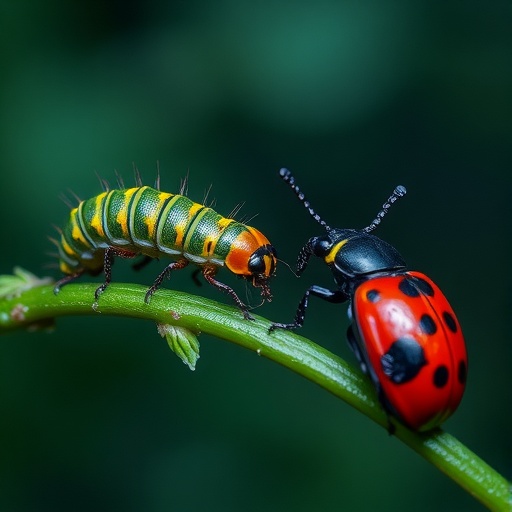
In a remarkable discovery that sheds light on the intricate survival strategies of the tiniest creatures, researchers from Carleton University have revealed that warty birch caterpillars—minute larvae measuring less than 1.5 millimeters—predictably respond to different threats based on the subtle vibrations transmitted through their leaf homes. This groundbreaking study, published in the Journal of Experimental Biology, demonstrates that these near-microscopic insects possess a sophisticated sensory ability to distinguish the footsteps of predatory ladybeetles from the approach of other invading caterpillars, enabling remarkably adaptive defensive behaviors.
The warty birch caterpillar (Falcaria bilineata) is a species that intensely guards its territory on birch leaf tips. Previous studies had shown that mature caterpillars exhibit defensive percussion on the leaf surface to deter conspecific intruders. However, the recent investigation spearheaded by Jayne Yack and her colleagues delves into the behavioral repertoire of newly hatched individuals—a stage when survival is critical but defenses are presumably limited.
To unravel how newborn caterpillars assess impending danger, the research team devised an innovative experimental paradigm. They allowed freshly emerged larvae to settle on birch leaf tips and observed their behavior using high-speed videography synchronized with laser Doppler vibrometry. This method enabled non-contact measurement of the vibration signatures generated by various intruders as they moved over the leaf, providing unprecedented granularity in understanding the vibrational cues the caterpillars receive.
Adult ladybeetles (Hippodamia convergens), known for their voracious appetite for soft-bodied insects, were introduced onto the leaves to act as natural predators. The study found that the tiny caterpillars immediately ceased all vibrational signaling and remained motionless, effectively “going silent” to avoid detection. This freezing behavior was frequently followed by a rapid escape response, where the caterpillars dropped from the leaf, dangling on silken threads to evade the predator’s grasp. This stark contrast to the usual aggressive leaf-beating signals displayed when confronted by other caterpillars illustrates an evolved strategy of risk assessment and adaptive response.
The data revealed a striking survival pressure: nearly 43% of the caterpillars succumbed to predation by adult ladybeetles, highlighting the immense challenge faced by these diminutive insects. Interestingly, the researchers also introduced ladybeetle larvae—smaller and six-legged compared to the adults—and noted a nuanced intermediate response. While the warty birch caterpillars initially attempted to warn off the intruders with increased scraping and beating behaviors, they eventually resorted to silence and evacuation, albeit with a delayed timing up to 40 seconds, reflecting a graded perception of threat based on intruder type.
Perhaps even more fascinating was the caterpillar’s reaction to conspecific intruders. When juvenile warty birch caterpillars encountered leaf tip territories already occupied by resident larvae, the resident ramped up their percussive signals, beating and scraping the leaf rhythmically every few seconds. This heightened vibrational output serves as a clear warning to potential rivals, reinforcing that these caterpillars possess the ability not only to discern predator pelvis from prey but also to understand nuances within their own species’ social context.
Central to this repertoire is the caterpillar’s vibrational sensing system. The research uncovered that the substrate-borne vibrations generated by different intruders are categorically distinct. Using laser vibrometry, the team analyzed several parameters including frequency spectrum, amplitude, and temporal patterns of these vibrations. Adult ladybeetles, weighing approximately 20 milligrams, produced the most intense and broadband signals—essentially thundering footfalls—that propagate across the leaf, providing early auditory-warning cues for the caterpillars. Conversely, the vibrations from ladybeetle larvae closely resembled those of other caterpillars, explaining the initial behavioral confusion observed.
The implication of these findings is profound: these caterpillars employ a complex multisensory integration of vibrational information to discriminate threats and adapt behavior accordingly despite their diminutive size. The capacity to differentiate threats at less than a millimeter scale, based solely on mechanical cues transmitted through a living substrate, challenges assumptions about the sensory capabilities of early instar insects and points to sophisticated evolutionary survival mechanisms.
Crucially, this research also broadens the conceptual framework for understanding insect communication and predator-prey interactions. It highlights the significance of substrate-borne vibrational signals as essential ecological information channels and suggests that even miniature species participate in elaborate behavioral signaling networks invisible to the human eye. The reliance on vibration-based threat assessment aligns with an ecological niche where visual or chemical cues are less reliable or effective.
The research team’s integrative approach, combining behavioral observation, advanced vibrational measurement, and ecological relevance, provides a compelling model for future studies on microscale animal communication. The discovery underscores how evolutionary pressures can drive the emergence of refined sensory faculties even in organisms with limited neural complexity, pushing boundaries on what is considered possible in insect perception.
In summation, the warty birch caterpillar’s ability to parse the vibrational footprints of enemies allows nuanced decision-making, balancing the costs of fleeing unnecessarily against the risks posed by hungry predators. Such a sensory and behavioral orchestra in creatures barely visible to the naked eye not only fascinates but invites deeper investigation into the microecological dynamics governing survival.
This study was led by Jayne Yack and Emilie Mauduit from Carleton University and is documented in the Journal of Experimental Biology (DOI: 10.1242/jeb.252329), offering a new vantage point on insect behavior and evolutionary ecology.
Cite Scienmag News
Gavin Prescott. (June 4, 2026). Thundering Footsteps Alert Minute Caterpillars to Deadly Ladybeetle Attacks. Scienmag. https://scienmag.com/thundering-footsteps-alert-minute-caterpillars-to-deadly-ladybeetle-attacks/
Gavin Prescott. "Thundering Footsteps Alert Minute Caterpillars to Deadly Ladybeetle Attacks." Scienmag, 4 June 2026, https://scienmag.com/thundering-footsteps-alert-minute-caterpillars-to-deadly-ladybeetle-attacks/. Accessed 4 September 2026.
Gavin Prescott. "Thundering Footsteps Alert Minute Caterpillars to Deadly Ladybeetle Attacks." Scienmag. June 4, 2026. https://scienmag.com/thundering-footsteps-alert-minute-caterpillars-to-deadly-ladybeetle-attacks/


