


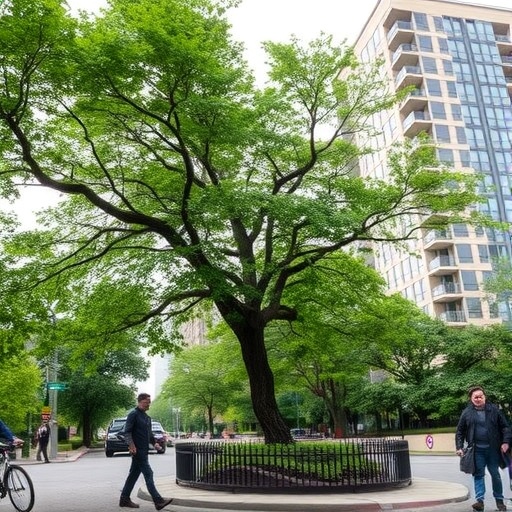
In an era marked by accelerating urbanization and intense environmental challenges, the role of urban greenery in shaping air quality and public health has become a focal point of scientific inquiry. A groundbreaking study published in npj Urban Sustainability by Sun, Ni, Kong, and their colleagues (2026) presents a nuanced portrait of how urban trees influence atmospheric fine particulate matter (PM₂.₅) levels and the subsequent health implications for city dwellers worldwide. This investigation delves deep into the dualistic nature of urban trees, unveiling a complex interplay between their capacity to reduce pollution and, paradoxically, under certain conditions, exacerbate health risks—a dual effect that demands urgent attention from urban planners and policymakers.
Fine particulate matter, PM₂.₅, representing airborne particles with diameters less than 2.5 micrometers, has long been recognized as a pernicious pollutant with profound consequences for respiratory and cardiovascular health. These microscopic particles penetrate deep into the lungs and can cross into the bloodstream, contributing significantly to morbidity and mortality associated with chronic diseases and acute health episodes. Urban environments, replete with vehicular emissions, industrial outputs, and densely populated settings, are hotspots for PM₂.₅ accumulation, triggering sustained public health crises globally. Thus, understanding mechanisms to mitigate PM₂.₅ exposure remains a priority in environmental health sciences.
Urban trees are often championed as natural air purifiers, their foliage intercepting particulate pollutants and sequestering carbon dioxide, while simultaneously enhancing urban aesthetics and microclimates. However, the new study from Sun et al. reveals that this green infrastructure harbors a more complex relationship with air pollution than previously appreciated. By integrating atmospheric modeling with extensive epidemiological data, the research uncovers that the influence of urban trees on PM₂.₅ is not uniformly beneficial. In certain urban layouts and atmospheric conditions, trees contribute to levels of PM₂.₅ exceeding health safety thresholds, thereby generating a dual effect—a potent paradox in urban sustainability.
Delving into the technical mechanisms, urban trees reduce PM₂.₅ concentrations primarily through dry deposition, a process wherein particulate matter adheres to leaf surfaces and is subsequently removed from the atmosphere. This interception is driven by several factors including leaf morphology, surface roughness, and stomatal characteristics. Yet, the same vegetation can alter local airflows, creating microenvironments where pollutant dispersion is hindered. In dense street canyons, for instance, trees may trap pollutants at pedestrian levels by reducing ventilation, leading to the unintended consequence of elevated PM₂.₅ exposure for residents.
The study employs advanced computational fluid dynamics simulations coupled with chemical transport models to dissect these phenomena in diverse metropolitan regions globally. By simulating airflow patterns and chemical transformations of pollutants, Sun and colleagues quantify how tree canopies interact with urban topography and vehicular emission plumes. Their models reveal that in cities with narrow streets bordered by tall buildings, dense tree planting can form quasi-enclosures that suppress air circulation, causing pollutant stagnation and accumulation. Conversely, in more open urban spaces, trees effectively filter PM₂.₅ without adverse airflow effects, underscoring the spatial heterogeneity of tree impacts.
Beyond the physical interactions, the researchers integrate population distribution data and health outcome statistics to estimate the net health burden attributable to trees’ influence on PM₂.₅. Strikingly, their findings indicate that while billions benefit from pollution mitigation provided by urban trees, millions face heightened health risks in areas where vegetation-induced pollutant stagnation prevails. This complex balance raises imperative questions about green urban planning methodologies that have traditionally prioritized tree planting without comprehensive assessments of airflow dynamics and pollutant behaviors.
One of the study’s strengths lies in its multi-scale, interdisciplinary approach. Collaborating specialists from atmospheric chemistry, urban ecology, public health, and data science converge to synthesize a comprehensive framework. They acknowledge that tree species selection also plays a pivotal role; traits such as leaf waxiness, density, and phenology influence particulate capture efficiency, potentially allowing for strategic forestry that maximizes air purification while minimizing microclimate perturbations. Such precision forestry could redefine urban greening policies in the coming decades.
Furthermore, the research draws attention to the seasonal variability of the dual effects. During summer months, higher temperatures and photochemical activity generate secondary organic aerosols amplified by biogenic volatile organic compounds (BVOCs) emitted by certain tree species. These BVOCs undergo atmospheric reactions forming additional PM₂.₅ mass, thereby negating or reversing the beneficial particulate filtration capacity. This chemical dimension adds complexity to the temporal dynamics of tree-pollution interactions and further complicates management decisions.
Sun et al. advocate for a paradigm shift in urban environmental management, urging a transition from simplistic tree-planting mandates toward integrative, scientifically grounded strategies that consider urban morphology, species-specific characteristics, local meteorology, and human exposure metrics. They propose predictive tools that can guide tree placement to optimize pollution mitigation without compromising airflow or triggering secondary aerosol formation. Their approach underscores that effective urban air quality interventions must be bespoke, context-aware, and underpinned by robust empirical data.
The policy implications of this research are profound. City governments and planners are challenged to reconcile competing priorities: the undeniable benefits of green infrastructure for heat mitigation, CO₂ sequestration, and mental well-being against the emerging evidence of potential health trade-offs related to PM₂.₅ exposure. Regulatory frameworks will need to incorporate these nuanced insights, balancing ecosystem services with environmental health outcomes to safeguard urban populations.
Importantly, this work also opens avenues for future investigations. Understanding the interplay between urban trees and air pollution necessitates long-term monitoring and high-resolution data collection across diverse climate zones and urban forms. Technological advancements in remote sensing, IoT sensor networks, and urban microscale modeling will be invaluable in refining predictions and guiding effective interventions. Moreover, community engagement and cross-sector partnerships are essential to implement adaptive management practices informed by scientific innovation.
In conclusion, the dual effect of global urban trees on PM₂.₅ and the associated health burden as elucidated by this landmark study compels a re-examination of how we conceptualize and implement urban afforestation. Trees, while universally celebrated as environmental allies, emerge here as complex agents whose interactions with air pollutants require vigilant analysis. Crafting healthier, more sustainable cities demands that we harness these insights, transitioning from well-intentioned greening campaigns to sophisticated, evidence-based urban ecosystems management that truly advances public health and environmental resilience in the Anthropocene epoch.
Cite Scienmag News
Russell Cooper. (June 3, 2026). Global Urban Trees’ Dual Impact on PM2.5. Scienmag. https://scienmag.com/global-urban-trees-dual-impact-on-pm2-5/
Russell Cooper. "Global Urban Trees’ Dual Impact on PM2.5." Scienmag, 3 June 2026, https://scienmag.com/global-urban-trees-dual-impact-on-pm2-5/. Accessed 3 September 2026.
Russell Cooper. "Global Urban Trees’ Dual Impact on PM2.5." Scienmag. June 3, 2026. https://scienmag.com/global-urban-trees-dual-impact-on-pm2-5/


