


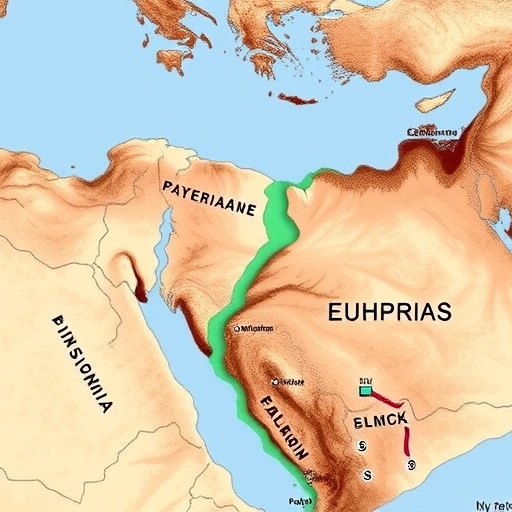
A groundbreaking new study published in Nature Geoscience has unveiled a detailed conceptual model retracing the intricate evolution of the Euphrates River during the Late Miocene epoch. This research provides compelling evidence that the modern Euphrates River emerged from the complex interplay of tectonic reactivations and dramatic environmental shifts, including the transformative Messinian Salinity Crisis (MSC) that partially desiccated the eastern Mediterranean basin.
Scientists have long sought to understand the dynamic processes that shaped the major river systems of the Near East. By integrating high-precision volcanic dating with tectonic fault chronologies and stratigraphic analyses, the research team reconstructs the genesis and subsequent evolution of ancestral river systems—specifically the Palaeo-Murat and Palaeo-Karasu Rivers—that coalesced to form the present-day Euphrates. These findings significantly advance our understanding of fluvial responses to profound base-level fluctuations and tectonic fault reactivations in this geologically active region.
According to the researchers, the Palaeo-Murat River originated on the Anatolian–Eurasian Plates after approximately 16.55 million years ago (Ma), whereas the Palaeo-Karasu River developed later, between around 8.6 and 5.9 Ma. During the Tortonian stage of the Late Miocene, stratigraphic indicators emphasize that both rivers terminated in poorly connected, organic-rich lakes situated south of the North Anatolian Fault (NAF). These lacustrine environments acted as depositional sinks prior to broader Mediterranean base-level shifts.
A dramatic hydrological transformation occurred during the late Messinian, when shoaling events across the Betic and Rifian corridors abruptly constricted the Strait of Gibraltar, triggering what is known as the Messinian Salinity Crisis. This basin-wide evaporitic drawdown lowered the eastern Mediterranean’s base level by an estimated 1.7 to 2.1 kilometers, with minimum necessary base-level lowering of approximately 0.8 kilometers inferred from sediment budget models to reconcile river catchment dynamics. The research highlights how this steep reduction in marine base level profoundly intensified river incision, forcing fluvial networks to rapidly adjust.
The impact of this base-level fall was compounded by ongoing Anatolian tilting and the reactivation of regional faults, especially along the East Anatolian Fault (EAF), which collectively accelerated sediment transport into the eastern Mediterranean basin. The authors hypothesize that perched lakes in the Anatolian uplands catastrophically breached under these conditions, generating mega-floods that sculpted fluvial terraces reminiscent of rapid surface processes observed both on Earth and in ancient Martian landscapes.
Distinct evidence for these transformative episodes emerges from the sedimentary records of the Handere and Nahr Menashe formations, where fluvial systems were active offshore between around 5.45 and 5.33 Ma. Intriguingly, the Palaeo-Karasu River maintained continuous flow across the Anatolian–Eurasian Plates for approximately 120,000 years, while the Palaeo-Murat River experienced a notable drainage avulsion from the Anatolian–Eurasian Plates onto the African Plate around 5.43 Ma. This avulsion coincided with multiple depositional cycles, underscoring the sensitivity of river systems to tectonic and base-level forcings.
By the Pliocene epoch, tectonic reactivations had fundamentally reshaped drainage patterns within the region. Around 3.6 Ma, the East Anatolian Fault’s resurgence diverted the Palaeo-Murat River southeastward onto the Arabian Plate, marking a pivotal event in the nascent evolution of the incipient Euphrates River. Subsequently, decreased fault activity along the Ovacık Fault at approximately 2.8 Ma facilitated the Palaeo-Karasu River’s avulsion and merger with the Palaeo-Murat, effectively establishing a larger, integrated drainage network.
While the tectonic mechanisms driving these avulsions are well constrained, the researchers note ambiguity surrounding the Euphrates River’s ultimate northward avulsion during the Calabrian (~1.6 Ma). This event may have been triggered by localized subsidence or broader landscape readjustments, with the avulsion node situated within a topographic low which likely served as an easily breached divide. Regardless, this transition signifies the definitive establishment of the Euphrates River in its modern configuration on the Arabian Plate.
The study contextualizes these processes within broader Mediterranean geodynamics, drawing analogies to the formation of the Eosahabi fan offshore Libya, one of the largest known Messinian fluvial deposits. Such alluvial megafans lend weight to the interpretation that sudden base-level drops provoked significant river incision and sediment fluxes, which in turn prograded extensive deposits basinward. This interplay underscores how regional tectonics and global paleoenvironmental shifts interwove to sculpt foundational elements of the present-day landscape.
Crucially, this research aligns with broader geological paradigms that hypothesize catastrophic lake-breach floods during periods of extreme base-level fall, similar to scenarios hypothesized on early Mars. The models developed underscore the necessity of integrating fluvial geomorphology with stratigraphy and fault kinematics to unravel these complex evolutionary narratives. Further computational modelling is anticipated to refine these insights, particularly to explain the extended depositional distances observed without exclusively relying on catastrophic flooding mechanisms.
The study also provides a refined temporal framework, constraining crucial phases of fluvial activity and avulsion with unprecedented precision. For instance, sedimentary and volcanogenic data from the Malatya and Kangal basins further corroborate the fault activity timeline, reinforcing the linkages between tectonism, sediment dynamics, and river evolution. These temporal correlations are pivotal for constructing an integrated geodynamic history of the eastern Mediterranean and western Asia.
Moreover, the interplay between tectonics and hydrology during the Miocene to Pliocene transition illustrates the extraordinary sensitivity of large river systems to fault reactivation. The gradual but significant changes along faults like the East Anatolian Fault and the Ovacık Fault not only redirected major drainage networks but reshaped sediment dispersal patterns, influencing basin infill and landscape evolution at multiple scales.
This comprehensive reevaluation of the Euphrates’ evolution also sheds light on the critical role of the Messinian Salinity Crisis in governing Mediterranean basin sedimentation and paleoenvironmental dynamics. The authors argue that the initial partial desiccation instigated a cascade of geomorphic responses, starting with lacustrine isolation of fluvial termini followed by rapid river incisions responding to the shifted base level. Such transient but profound events left indelible signatures in basin stratigraphy and tectonic frameworks.
In summary, this conceptual model not only revises the evolutionary trajectory of one of the world’s great rivers but also offers invaluable insights into how tectonics and climate-induced base-level changes can orchestrate large-scale fluvial system reorganization. The implications of these findings extend beyond the Euphrates basin, providing a lens through which to interpret analogous geological records elsewhere on Earth and potentially other planetary bodies.
As ongoing research continues to refine the picture of Late Miocene fluvial tectonics, this work stands as a cornerstone, illustrating the power of multidisciplinary approaches to resolve deep-time landscapes. It illuminates the deeply interconnected forces sculpting Earth’s surface, from fault mechanics to the transient yet immense effects of evaporitic drawdown, reshaping conventional views of river genesis and evolution in tectonically active regions.
Cite Scienmag News
Violet Maxwell. (June 2, 2026). Late Miocene Euphrates Drained Into Dry Mediterranean. Scienmag. https://scienmag.com/late-miocene-euphrates-drained-into-dry-mediterranean/
Violet Maxwell. "Late Miocene Euphrates Drained Into Dry Mediterranean." Scienmag, 2 June 2026, https://scienmag.com/late-miocene-euphrates-drained-into-dry-mediterranean/. Accessed 4 September 2026.
Violet Maxwell. "Late Miocene Euphrates Drained Into Dry Mediterranean." Scienmag. June 2, 2026. https://scienmag.com/late-miocene-euphrates-drained-into-dry-mediterranean/


