


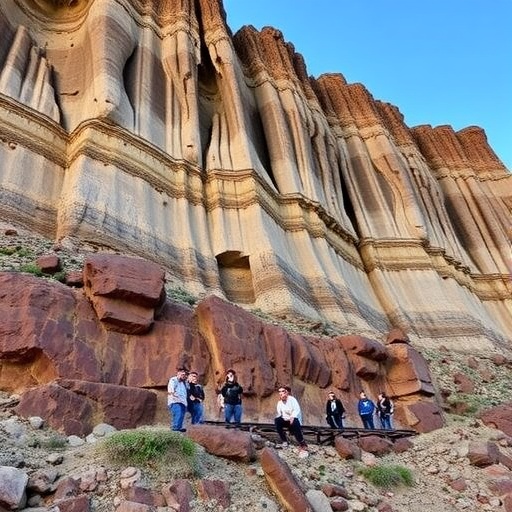
In a groundbreaking new study set to transform our understanding of Earth’s deep history, researchers have unveiled compelling evidence linking continental weathering processes to one of the most enigmatic geological events of the Ediacaran Period: the Shuram Excursion. This research, published in Communications Earth & Environment in 2026 by Gan, Gilleaudeau, Pedersen, and colleagues, provides a detailed geochemical and sedimentological analysis that rewrites prevailing theories about the drivers behind this massive isotopic anomaly, shedding light on the intricate connections between Earth’s surface processes and ancient ocean chemistry.
The Shuram Excursion, a globally recognized negative carbon isotope anomaly approximately 550 million years ago, has intrigued geoscientists for decades due to its magnitude and rapidity. This event represents one of the largest fluctuations in carbonate carbon isotope compositions in Earth’s history. The nature and cause of this excursion have sparked numerous hypotheses, including large-scale oxidation of organic carbon, diagenetic alteration, or shifts in carbon cycling within the ocean-atmosphere system. However, the exact mechanism triggering the Shuram Excursion remained elusive until now.
Gan and colleagues have combined field observations, isotopic geochemistry, and geochemical modeling to argue decisively for an external driver rooted in continental weathering dynamics. Their interdisciplinary approach integrates detailed analysis of sedimentary records with proxies that trace weathering intensity and sediment provenance, ultimately linking enhanced continental silicate weathering to the pronounced carbon isotope shift recorded in marine carbonate successions.
Crucially, the study highlights a strong temporal correlation between U-Pb dating of weathered continental material and the onset of the Shuram Excursion. Enhanced weathering, driven potentially by tectonic uplift and climatic shifts, would have increased nutrient and alkalinity fluxes into the Ediacaran oceans. This influx of weathering-derived ions altered the marine carbon reservoir, particularly by inputs of bicarbonate and alkalinity, which could dilute or reset carbon isotope compositions, thus producing the observed large negative anomaly.
Additionally, the paper explores how continental weathering intensified the oxidative breakdown of large pools of organic carbon sequestered in marine sediments and soils. As oxygen levels rose during the Ediacaran, enhanced erosion exposed previously buried organic-rich strata to oxidative weathering, releasing isotopically light carbon into the ocean-atmosphere system. This mechanism provides a plausible link between lithospheric processes and ocean chemistry changes during the critical transition toward complex multicellular life.
Another significant contribution from this research is disentangling the effects of diagenesis and primary environmental signals within the Shuram Excursion carbon isotope records. By meticulously correlating isotopic variations with sedimentological context and trace element geochemistry, the authors demonstrate that the anomaly reflects a genuine global oceanographic phenomenon rather than localized post-depositional alteration. This finding refutes debates that dismissed the Shuram Excursion as a diagenetic artifact and reinstates its importance as a key marker of Ediacaran environmental evolution.
The implications of continental weathering as a driver extend beyond the Shuram Excursion itself, offering critical insights into feedbacks between tectonics, climate, and the biosphere during a period pivotal for the emergence of early animals. Enhanced weathering would have not only modulated ocean chemistry but also influenced global carbon cycles, climate regulation, and nutrient availability, thereby shaping conditions for early biotic diversification.
By reconstructing paleoweathering intensity through isotopic proxies such as strontium and neodymium isotopes alongside carbon isotopes, the team provides a robust framework linking surface erosion processes with marine geochemical shifts. This integrated approach illustrates how Earth’s lithosphere and hydrosphere dynamically interacted in ways that profoundly impacted oceanic carbon reservoirs during the late Precambrian.
Moreover, the study posits that the magnitude of the Shuram Excursion may serve as an analogue for understanding future Earth system responses to rapid changes in weathering flux driven by climate perturbations. Although occurring in a vastly different geological era, the feedback mechanisms unraveled here underscore the sensitivity of ocean chemistry to continental erosion processes and may elucidate possible trajectories for carbon cycling under anthropogenic influence.
The research also examines the role of microbial mediation in weathering and carbonate precipitation during this interval. Shifts in microbial ecosystem composition influenced sediment diagenesis and carbonate chemistry, further linking biological activity with the geochemical signatures observed. This relationship exemplifies the complexity of Earth system processes where biology and geology co-evolve to shape planetary habitability.
In terms of methodology, the study stands out for its high-precision isotopic measurements obtained through cutting-edge mass spectrometry techniques, enabling unprecedented resolution of temporal changes in weathering and isotope systematics. Coupled with detailed stratigraphic correlation across multiple sedimentary basins worldwide, this comprehensive dataset substantially strengthens the hypotheses proposed.
Fundamentally, this research emphasizes the power of multidisciplinary investigations combining geochemistry, sedimentology, geochronology, and climatology to unravel Earth’s most cryptic events. The Shuram Excursion, once shrouded in uncertainty, now emerges as a window into the profound coupling between tectonic uplift, continental weathering, and evolving ocean chemistry that set the stage for the rise of complex life.
Future studies building on these findings could further refine the timing and extent of weathering-driven geochemical fluxes, incorporate modeling of ocean-atmosphere redox dynamics, and explore analogues in other ancient carbon isotope excursions to fully decode Earth’s carbon cycle history. The work by Gan and colleagues thus represents a vital step in tracing the dynamic pathways from geology to biology that have shaped our planet’s habitability across deep time.
As climate and environmental changes accelerate today, understanding the mechanisms and consequences of past global geochemical perturbations like the Shuram Excursion bears critical lessons for anticipating future Earth system trajectories. This synthesis of continental weathering and isotopic carbon cycling provides an essential framework for interpreting long-term carbon dynamics linked to surface process changes.
Ultimately, this study not only resolves longstanding questions about one of Earth’s largest ancient carbon isotope anomalies but also reinvigorates research into how continental processes control ocean chemistry and atmospheric composition over geological scales. By illuminating the role of weathering during the Ediacaran, Gan et al. open new avenues to explore the interconnectedness of planetary systems during key episodes in Earth’s evolutionary saga.
The Shuram Excursion now stands as a testament to the dynamic feedback loops between lithosphere, hydrosphere, atmosphere, and biosphere, highlighting the rich complexity of Earth’s environmental history and offering fresh perspectives on how planetary habitability is maintained through deep time.
Gan, T., Gilleaudeau, G.J., Pedersen, M.G. et al. Continental weathering as a driver of the Ediacaran Shuram Excursion.
Commun Earth Environ (2026). https://doi.org/10.1038/s43247-026-03625-6
Cite Scienmag News
Violet Maxwell. (June 2, 2026). Continental Weathering Fuels Ediacaran Shuram Excursion. Scienmag. https://scienmag.com/continental-weathering-fuels-ediacaran-shuram-excursion/
Violet Maxwell. "Continental Weathering Fuels Ediacaran Shuram Excursion." Scienmag, 2 June 2026, https://scienmag.com/continental-weathering-fuels-ediacaran-shuram-excursion/. Accessed 4 September 2026.
Violet Maxwell. "Continental Weathering Fuels Ediacaran Shuram Excursion." Scienmag. June 2, 2026. https://scienmag.com/continental-weathering-fuels-ediacaran-shuram-excursion/


