


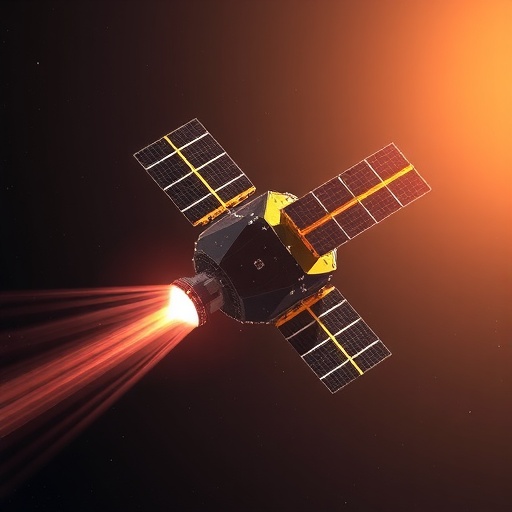
In a groundbreaking development poised to redefine small satellite technology, researchers at the Massachusetts Institute of Technology have unveiled a novel propulsion system that seamlessly integrates the rapid thrust capabilities of traditional chemical thrusters with the precision and fuel efficiency of electric electrospray thrusters. This innovative design promises to endow small satellites with unprecedented maneuverability, enabling swift, powerful maneuvers and subtle, precise adjustments tailored to dynamic mission requirements.
At the heart of this advancement lies a unique “green monopropellant,” originally engineered by the U.S. Air Force, which fuels both chemical and electrospray thrusters from a single, compact propellant tank. This breakthrough eliminates the cumbersome need for separate fuel systems, thereby reducing mass and volume constraints that have historically limited the versatility and operational endurance of microsatellite platforms.
According to Amelia Bruno, the lead author of an illuminating new study published in the Journal of Propulsion and Power, leveraging a unified propellant system represents a paradigm shift for small satellite science missions. “By combining chemical and electrical propulsion in one compact package, we unlock capabilities that allow these miniature spacecraft to conduct more comprehensive scientific observations and complex maneuvers, all within a smaller, cost-effective framework,” Bruno explained.
Electrospray thrusters, considered a marvel of micropropulsion, function by charging ionic liquid particles electrically and emitting them as a focused spray to generate thrust. Although these thrusters excel at slow, highly efficient maneuvers—ideal for gradual course corrections during extended interplanetary trajectories—they lack the immediate, high-thrust bursts characteristic of chemical propulsion systems. Conversely, chemical thrusters deliver rapid, high-thrust impulses but at the expense of heavier, bulkier fuel storage and lower fuel efficiency.
The MIT team’s research demonstrates that their green monopropellant, known as ASCENT (Advanced SpaceCraft Energetic Non-Toxic), excels in powering both propulsion types without compromising performance. This ionic liquid mixture, notable for its stability and non-toxic nature, stands as a safer alternative to the notoriously hazardous hydrazine, which has dominated chemical propulsion for decades. Perhaps even more remarkably, ASCENT’s chemical composition allows it to maintain liquid phase integrity in the harsh vacuum of space, an essential attribute for reliable electrospray operation.
Their experimental setup involved advanced laboratory techniques, including using a magnetic levitation testbed housed inside a vacuum chamber mimicking the conditions of outer space. By applying variable voltage stimuli, the team activated electrospray thrusters attached to diminutive propellant reservoirs, successfully generating measurable thrust and inducing controlled spin on a simulated CubeSat model. Over prolonged testing intervals exceeding 100 hours, the thrusters sustained performance levels on par with conventional ionic liquid fuels.
The dual-mode propulsion system’s integration into a compact CubeSat format signifies a crucial milestone for space exploration technology. This system, slated for demonstration during NASA’s upcoming Green Propulsion Dual Mode (GPDM) mission scheduled for November, will be the first flight to operate a single fuel tank feeding both chemical and electrical thrusters in space. If successful, this mission will open pathways for small satellites to undertake ambitious exploratory sorties beyond Earth’s orbit, including journeys to Mars and the asteroid belt.
Paulo Lozano, the Miguel Alemán Velasco Professor of Aeronautics and Astronautics at MIT and co-author of the study, emphasized the transformative potential of this propulsion approach: “Dual-mode propulsion grants CubeSats the flexibility to optimize thrust based on mission phases—electrospray thrusters for slow, efficient interplanetary transit, and chemical thrusters for rapid repositioning on demand. This versatility could revolutionize small satellite mission design and deployment strategies.”
Moreover, the prospect of deploying such adaptable propulsion systems extends beyond deep space missions. Small satellites equipped with dual-mode thrusters could dramatically improve Earth observation capabilities, enabling timely and coordinated responses to dynamic weather systems or environmental phenomena. For instance, satellite constellations could be rapidly redeployed or gently adjusted to focus surveillance over developing storms or climate events, delivering critical data with unprecedented responsiveness.
The foundational work leading to this technology also underscores decades of expertise in ionic liquid research and electrospray thruster design cultivated in MIT’s Space Propulsion Laboratory. The collaboration with the U.S. Air Force and NASA reflects a growing recognition of the need for safer, greener propellants that do not compromise mission safety or effectiveness. ASCENT exemplifies this shift by mitigating toxicity concerns without sacrificing thrust output or efficiency.
Engineering challenges remain to optimize the physical integration of dual-mode propulsion systems within the tight confines of CubeSats, but current testing validates the feasibility of coupling these diverse engines with a singular, standardized propellant. Such modularity could streamline satellite manufacturing and mission logistics, reducing costs while expanding functional capabilities.
As nanosatellite missions continue to proliferate worldwide, the requirement for adaptable, high-performance propulsion grows ever more critical. The MIT team’s dual-mode propulsion system addresses this demand head-on, combining the strengths of chemical and electric propulsion in a single, scalable platform suited for the unique mass and volume constraints of small spacecraft.
This pioneering research represents a landmark in aerospace engineering, signaling a future where small satellites no longer face propulsion trade-offs but instead enjoy flexible, efficient, and powerful tools for exploration, observation, and scientific discovery across the solar system.
Web References: Journal DOI
Keywords
small satellites, CubeSat, dual-mode propulsion, electrospray thrusters, chemical thrusters, ionic liquid propellant, ASCENT monopropellant, green propulsion, space technology, interplanetary missions, micropropulsion, spacecraft maneuverability
Cite Scienmag News
Denise Maddox. (June 2, 2026). Tiny satellites set to become faster and more fuel-efficient with innovative propulsion system. Scienmag. https://scienmag.com/tiny-satellites-set-to-become-faster-and-more-fuel-efficient-with-innovative-propulsion-system/
Denise Maddox. "Tiny satellites set to become faster and more fuel-efficient with innovative propulsion system." Scienmag, 2 June 2026, https://scienmag.com/tiny-satellites-set-to-become-faster-and-more-fuel-efficient-with-innovative-propulsion-system/. Accessed 3 September 2026.
Denise Maddox. "Tiny satellites set to become faster and more fuel-efficient with innovative propulsion system." Scienmag. June 2, 2026. https://scienmag.com/tiny-satellites-set-to-become-faster-and-more-fuel-efficient-with-innovative-propulsion-system/


