


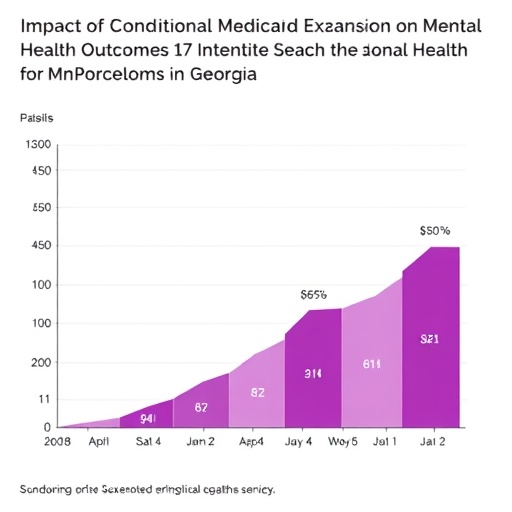
A recent rigorous difference-in-differences analysis leveraging national surveillance data has uncovered troubling mental health consequences linked to Georgia’s Pathways to Coverage program, a policy initiative conditioning Medicaid eligibility on work or community engagement requirements. This pioneering study reveals that the program, originally designed to promote workforce participation and community involvement among low-income adults, paradoxically correlates with a decline in mental health outcomes for this vulnerable population. The findings underscore the potentially onerous barriers such policies may impose on access to essential health coverage and mental health care services, raising profound implications for public health equity and the broader health systems landscape.
Medicaid, the cornerstone of health insurance for low-income individuals in the United States, traditionally offers expansive health coverage without stringent eligibility conditions, enabling vulnerable populations to seek healthcare proactively. However, the Pathways to Coverage program introduces a paradigm shift by mandating that beneficiaries engage in certain work or community activities to maintain their Medicaid eligibility. While well-intended as a strategy to incentivize self-sufficiency, the program’s structural demands may inadvertently engender administrative hurdles that increase stress and reduce the continuity of care, as illuminated by the recent empirical evidence.
The study utilized advanced statistical methodologies characteristic of difference-in-differences (DiD) designs to isolate the mental health impact attributable solely to these Medicaid work requirements. By comparing mental health status trends in Georgia with comparable states lacking such requirements, researchers were able to meticulously control for confounders and temporal factors unrelated to the policy. Such an approach offers robust causal inference, bolstering the validity and generalizability of the conclusions drawn. Specifically, the data indicated a statistically significant increase in mental health deterioration among low-income adults in Georgia following program implementation.
This decline in mental well-being is hypothesized to stem from multifaceted psychosocial stressors induced by the program’s conditionality. The threat of losing essential health coverage places additional psychological burdens on individuals already grappling with economic insecurity and social marginalization. The resultant anxiety and uncertainty can exacerbate existing mental health conditions or contribute to the onset of new disorders, creating a vicious cycle of vulnerability. Consequently, these requirements undermine the intended public health objectives of Medicaid by potentially delaying or deterring important mental health care utilization.
Moreover, the study’s insights signal critical concerns regarding health care equity. The imposition of work requirements disproportionately impacts marginalized groups who face systemic barriers such as limited job opportunities, caregiving responsibilities, and disabilities. For these populations, the pathway to maintaining Medicaid coverage becomes fraught with complexities and risks, amplifying health disparities. The erosion of mental health care access for low-income adults thus not only impinges on individual well-being but also exacerbates broader societal inequities.
Beyond its immediate policy implications, the research challenges prevailing assumptions about the efficacy of conditional eligibility policies in social welfare programs. It advocates for a reevaluation of such strategies through the prism of holistic health outcomes rather than narrow economic metrics. The intricate interplay between social policy and health demands nuanced approaches that prioritize seamless care access and address social determinants of health comprehensively.
In-depth data analysis within this study incorporated extensive surveillance systems, aggregating mental health indicators and Medicaid enrollment patterns over multiple years. This rigorous approach facilitates a granular understanding of temporal changes in population health metrics, highlighting causal linkages between policy interventions and health outcomes. By transcending cross-sectional snapshots, the longitudinal perspective employed unearths delayed and cumulative effects often obscured in shorter investigations.
The psychological science underpinning this phenomenon draws upon established clinical psychology principles recognizing stress as a potent modifier of mental health trajectories. Chronic uncertainty regarding health insurance status or complex administrative compliance requirements may induce heightened cortisol levels and impair cognitive function, thereby amplifying susceptibility to mood disorders such as depression and anxiety. This biological embedding of social policy stressors explicates the empirical findings witnessed.
Health economics perspectives further elucidate the consequences of barriers to coverage retention. Foregone or delayed mental health treatment translates into increased downstream costs due to emergency care reliance, hospitalizations, and productivity losses. Thus, conditional Medicaid programs might precipitate counterproductive fiscal outcomes, offsetting any anticipated workforce participation gains. This revelation calls for integrative policy analyses balancing economic sustainability with population health imperatives.
Community stability and ecology frameworks also offer critical vantage points. Stable, predictable access to health care constitutes a vital ecosystem component sustaining community well-being and resilience. Disruptions induced by conditional eligibility reverberate through social networks, diminishing community cohesion and amplifying social inequality. Recognizing these interconnected dynamics can inform more equitable health policy designs embedded within broader social support systems.
This research arrives timely as numerous states grapple with balancing fiscal responsibility against health equity in Medicaid administration. It furnishes empirical evidence cautioning policymakers about unintended mental health consequences arising from seemingly straightforward policy mandates. As states contemplate expansions or contractions of work requirements, these findings advocate for heightened scrutiny and innovative safeguards mitigating adverse impacts on vulnerable populations.
The authors, led by Sezen O. Onal, PhD, present compelling data-driven arguments that challenge conventional welfare reform narratives. Their work galvanizes further multidisciplinary research exploring optimal mechanisms to integrate social participation incentives without compromising access to essential health services. Ultimately, this study compels health systems, policymakers, and society to reckon with the profound human consequences embedded within seemingly administrative program modifications.
In sum, the Georgia Pathways to Coverage program’s association with worsening mental health among low-income adults underscores fundamental tensions between conditional Medicaid eligibility and health care accessibility. By illuminating this critical public health paradox via sophisticated data analytics and theoretical framing, the research advances scholarly discourse and provides actionable insights to guide evidence-based policy reform aimed at promoting health equity and population well-being.
Cite Scienmag News
Glenn Wilkins. (June 2, 2026). Impact of Conditional Medicaid Expansion on Mental Health Outcomes in Georgia. Scienmag. https://scienmag.com/impact-of-conditional-medicaid-expansion-on-mental-health-outcomes-in-georgia/
Glenn Wilkins. "Impact of Conditional Medicaid Expansion on Mental Health Outcomes in Georgia." Scienmag, 2 June 2026, https://scienmag.com/impact-of-conditional-medicaid-expansion-on-mental-health-outcomes-in-georgia/. Accessed 5 September 2026.
Glenn Wilkins. "Impact of Conditional Medicaid Expansion on Mental Health Outcomes in Georgia." Scienmag. June 2, 2026. https://scienmag.com/impact-of-conditional-medicaid-expansion-on-mental-health-outcomes-in-georgia/


