


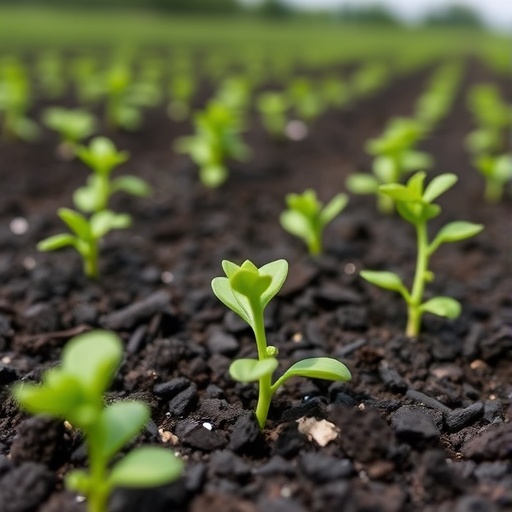
Biochar, celebrated globally as a climate-smart soil amendment, holds exceptional promise for enhancing soil quality while simultaneously sequestering carbon across extensive temporal scales. However, despite its growing application, the dynamic processes governing biochar transformation in various soil environments remain only partially understood, particularly within saline soils, where salt stress poses significant agricultural challenges. A groundbreaking study recently published in the journal Biochar provides unprecedented insights into how increased soil salinization fundamentally slows biochar aging and curtails microbial colonization, shedding light on the complex biochar-soil interactions under salt stress conditions.
When biochar is introduced into the soil matrix, it does not remain chemically or structurally static. Environmental factors such as precipitation, desiccation, the influence of minerals, oxygen exposure, and microbial interactions gradually induce alterations in its surface chemistry and physical morphology, shaping its environmental roles over time. In saline soils—which are becoming increasingly prevalent due to factors such as irrigation mismanagement, sea-level rise, and climatic shifts—these transformation processes are markedly distinct, owing to the unique physicochemical stresses imposed by elevated salt concentrations.
In their investigative effort, researchers targeted the inevitable intersection of biochar aging and soil salinity by selecting agricultural soils from coastal farmlands in Jiangsu Province, China, representing gradients of low, moderate, and high salinity. This design enabled them to simulate long-term environmental aging, approximating nearly eight years of natural biochar-soil interaction through repeated wetting and drying cycles in controlled laboratory conditions. By integrating wheat-straw biochar into these soils, the team meticulously monitored shifts in biochar’s chemical composition, surface topography, mineral associations, and microbial communities, producing a comprehensive temporal portrait of biochar evolution under salinity stress.
Strikingly, their findings revealed that biochar aged in high-salinity soils retained significantly greater total carbon content as compared to counterparts in low-salinity environments. This persistence of carbon was particularly notable in aromatic structures and C-C/C=C surface bonds, which are indicative of stable, condensed carbon matrices resistant to degradation. Concurrently, biochar exposed to elevated salt levels exhibited diminished oxygen content, reduced degrees of oxidation, and fewer C-O bond formations, collectively signaling a deceleration of the aging process.
Quantitatively, the oxidation state, as measured by the oxygen-to-carbon (O/C) ratio, was reduced by approximately 9.82% in biochar from high-salinity soils relative to low-salinity samples by the experiment’s conclusion. Importantly, total carbon underwent a decline of roughly 20% across all salinity treatments, driven predominantly by the attrition of labile carbon forms and progressive mineralization of organic constituents. These nuanced chemical dynamics underscore the protective role of salinity in conserving biochar’s carbon integrity over extended periods.
Microbial colonization, a central agent in biochar transformation, was similarly influenced by salinity gradients. While biochar traditionally serves as a microhabitat supporting diverse bacterial and fungal populations integral to carbon cycling, the study elucidated a marked reduction in microbial abundance and complexity within the biochar matrix under heightened salinity. Fungal communities, in particular, demonstrated heightened sensitivity to salt-induced stress, experiencing substantial declines in colonization levels. Given the pivotal roles fungi play in organic matter decomposition and biochar surface oxidation, their suppression likely contributed to the observed retardation in biochar aging.
Mechanistically, salinity-induced microbial inhibition acts as a double-edged sword. On one hand, diminished microbial activity reduces biochar degradation and surface functionalization, thereby prolonging carbon sequestration. On the other, the attenuated microbial presence may curtail nutrient cycling potential and soil health benefits typically associated with biochar application, a nuanced trade-off warranting further exploration. The researchers propose that the reduced biotic interactions within biochar may be a primary driver behind the slowed aging processes observed.
In addition to microbial factors, abiotic influences were also integral in shaping biochar aging under saline conditions. The study revealed accumulation of soil salts and minerals onto biochar surfaces, effectively forming a mineral coating that likely functioned as a physical barrier. This protective layer could hinder oxidative agents’ access and restrict microbial colonization, thus synergistically contributing to the retardation of biochar’s oxidative aging pathway. The dual mechanism of mineral encrustation and biotic exclusion offers a compelling explanation for salinity’s overarching impact on biochar stability.
These discoveries hold profound implications for agricultural management of saline soils, which are notoriously difficult to cultivate due to osmotic stresses reducing water availability, structural degradation, and suppression of beneficial microbial processes. Biochar has gained traction as a sustainable amendment to ameliorate such constraints, enhancing soil structure, improving moisture retention, and fostering microbial habitats. The ability of saline environments to preserve biochar’s carbon content longer introduces new paradigms for biochar deployment strategies in salt-affected farmlands.
Notably, the slower chemical transformation of biochar in high-salinity soils extends its carbon sequestration lifetime, reinforcing its potential role in climate change mitigation efforts. The retention of aromatic, carbon-rich structures implies more persistent carbon pools, reducing biochar’s mineralization and CO2 release. Nonetheless, the concomitant limitation in microbial colonization necessitates a balanced consideration of both soil fertility gains and carbon storage objectives in saline settings.
The researchers emphasize the need for further investigations encompassing a broader suite of environmental variables including temperature fluctuations, UV radiation exposure, and diverse soil biota compositions under field conditions. Elucidation of carbon transformation pathways at a molecular level and longitudinal tracking of microbial community succession are critical for optimizing biochar formulations and application methods tailored to saline agroecosystems.
Ultimately, this pioneering study not only advances our understanding of biochar-soil-microbe interplays in the context of salinity but also furnishes practical insights for enhancing the efficacy of biochar amendments in global saline agriculture. By integrating chemical, microbial, and mineralogical perspectives, the research charts a pathway toward sustainable management practices that can bolster soil health, crop productivity, and carbon sequestration in increasingly salinized landscapes—a step forward for resilience in the face of mounting environmental challenges.
News Publication Date: March 9, 2026.
Web References:
https://link.springer.com/journal/42773
http://dx.doi.org/10.1007/s42773-026-00589-w
References:
Wang, R., Li, H., Cui, N., Tang, C., Wang, X., Xie, W., & Yao, R. (2026). Increased soil salinization slows biochar aging and limits microbial colonization. Biochar, 8, 72.
Keywords
Biochar aging, soil salinity, microbial colonization, carbon sequestration, soil chemistry, trophic interactions, aromatic carbon, soil microbiome, saline agriculture, mineral coating, soil amendment, environmental remediation.
Cite Scienmag News
Beatrice Stafford. (June 2, 2026). New Study Reveals Saltier Soils Enhance Biochar Longevity. Scienmag. https://scienmag.com/new-study-reveals-saltier-soils-enhance-biochar-longevity/
Beatrice Stafford. "New Study Reveals Saltier Soils Enhance Biochar Longevity." Scienmag, 2 June 2026, https://scienmag.com/new-study-reveals-saltier-soils-enhance-biochar-longevity/. Accessed 5 September 2026.
Beatrice Stafford. "New Study Reveals Saltier Soils Enhance Biochar Longevity." Scienmag. June 2, 2026. https://scienmag.com/new-study-reveals-saltier-soils-enhance-biochar-longevity/


