


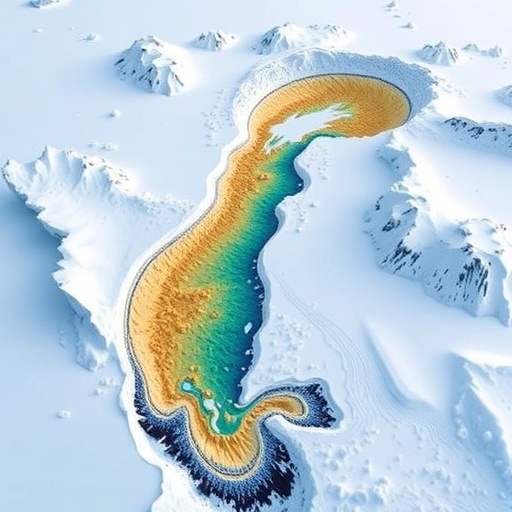
The Arctic’s frozen landscapes have long been recognized as critical reservoirs of carbon, quietly locking away immense quantities of organic material beneath layers of permafrost. Yet, recent scientific advancements reveal that some of the largest stocks of permafrost soil organic carbon and nitrogen reside not in the vast tundras inland but within the dynamic environments of Arctic river deltas. This groundbreaking insight redefines our understanding of carbon storage capacities in polar regions and brings urgent attention to how climate change may unleash previously underestimated sources of greenhouse gases.
Permafrost, soil or sediment that remains frozen for at least two consecutive years, acts as a natural freezer preserving organic matter accumulated over millennia. These frozen grounds store carbon in the form of decayed plant and microbial matter that has not fully decomposed due to the frigid environment. The carbon cycle within permafrost soils thus operates on geological timescales, effectively locking away greenhouse gases. However, with rising temperatures accelerating permafrost thaw, the stability of these carbon stocks is increasingly uncertain.
Arctic river deltas represent an ecological nexus where terrestrial, fluvial, and marine processes converge, shaping complex sedimentary landscapes. These deltas receive enormous volumes of sediment and organic material transported by major Arctic rivers such as the Lena, Mackenzie, and Yukon. Historically, research emphasis has been placed on permafrost located in continuous, inland zones, yet deltas have remained comparatively underexplored despite their potential as significant carbon reservoirs.
In their recent study published in Nature Communications, Fuchs and colleagues illuminate the vast stores of organic carbon and nitrogen embedded within the soils of Arctic river deltas. Utilizing an array of cutting-edge methodologies, including soil core sampling, radiocarbon dating, and advanced geochemical analyses, the researchers were able to quantify not only the sheer magnitude of these stocks but also characterize their composition and vulnerability.
One of the most striking findings is that Arctic river delta soils contain organic carbon stocks rivaling and in some cases exceeding those found in extensive permafrost regions inland. This revelation challenges long-standing assumptions and suggests that deltas are crucial but overlooked components of the pan-Arctic carbon budget. Such high concentrations of nitrogen alongside carbon further underscore the complex biogeochemical cycles underway in these sediments.
The implications for global climate models are profound. As Arctic temperatures climb, permafrost degradation is expected to accelerate, leading to enhanced microbial decomposition of stored organic matter. This process releases carbon dioxide and methane into the atmosphere, potent greenhouse gases that further amplify warming. Since river deltas are highly dynamic and prone to fluvial changes, the disruption of these delicate sediment layers may be a tipping point for large-scale carbon emissions.
The study also revealed nuanced patterns of carbon preservation influenced by sediment deposition rates, freeze-thaw cycles, and the chemical makeup of the organic matter itself. For instance, younger, less decomposed organic material tends to be more labile and thus susceptible to rapid microbial breakdown upon thawing. Conversely, older carbon that has been deeply buried demonstrates resilience but nonetheless may be destabilized over longer timescales.
Nitrogen stocks held within these deltaic soils add another layer of complexity to the Arctic biogeochemical system. Nitrogen plays a vital role in ecosystem productivity and nutrient cycling. Its release during permafrost thaw could influence local food webs and even contribute to enhanced greenhouse gas fluxes through microbial processes such as denitrification, which produces nitrous oxide—a greenhouse gas with significant warming potential.
These findings carry substantial weight for future policymaking and climate mitigation strategies. Accurate accounting of permafrost carbon release is imperative to refine predictions of global temperature trajectories. Arctic river deltas must now be integrated into Earth system models to better anticipate feedback mechanisms that could substantially accelerate climate change beyond current estimates.
Moreover, the dynamic nature of river deltas complicates efforts to monitor permafrost stability. Fluvial processes such as erosion, sediment deposition, and hydrologic connectivity influence not only carbon storage but also the physical integrity of permafrost. This highlights the urgency for expanded field campaigns and long-term monitoring of deltaic regions, which have been historically difficult to access due to remoteness and harsh conditions.
The study by Fuchs et al. also paves the way for interdisciplinary collaboration between geomorphologists, ecologists, atmospheric scientists, and climate modelers. Integrating diverse datasets—from soil chemistry to hydrology and remote sensing—will be essential for capturing the multifaceted interactions shaping carbon and nitrogen dynamics in Arctic deltas under climate stress.
Importantly, the research sheds light on the cascading effects that permafrost degradation could unleash on ecosystem services provided by Arctic landscapes. These services include carbon sequestration, water filtration, and habitat provision for unique flora and fauna. Disruption of these natural functions threatens biodiversity and the livelihoods of indigenous communities relying on these fragile environments.
Technological innovations such as unmanned aerial vehicles (UAVs), drones equipped with hyperspectral sensors, and autonomous sampling devices are increasingly enabling researchers to overcome logistical challenges in Arctic fieldwork. These tools facilitate detailed mapping and analysis of deltaic permafrost soils, ensuring more precise estimates of carbon and nutrient stocks that can inform climate resilience planning.
Looking ahead, the study’s revelations urge the scientific community to pay greater attention to Arctic river deltas as hotspots of biogeochemical vulnerability. As thaw progresses, feedback loops involving carbon and nitrogen release promise to complicate the already precarious path of global climate stabilization efforts.
The emerging picture is one of intricate interplay between geophysical and biological processes in permafrost-affected river deltas—a frontier where the impacts of anthropogenic warming manifest palpably and where mitigation will require nuanced understanding and swift action. As the Arctic continues to awaken from its frozen slumber, unlocking the secrets of these vast organic reservoirs may hold keys to predicting and managing our planet’s future climate trajectory.
In conclusion, Fuchs and colleagues’ work marks a paradigm shift in Arctic carbon science, highlighting the critical but underappreciated role of river delta permafrost soils as carbon and nitrogen vaults. Unraveling the complexities of these frozen landscapes is more than a scientific challenge—it is a necessity for a warming world bracing for unpredictable climatic shifts driven by the very soils once thought inert and frozen in time.
Cite Scienmag News
Violet Maxwell. (May 29, 2026). Massive Permafrost Carbon, Nitrogen Found in Arctic Deltas. Scienmag. https://scienmag.com/massive-permafrost-carbon-nitrogen-found-in-arctic-deltas/
Violet Maxwell. "Massive Permafrost Carbon, Nitrogen Found in Arctic Deltas." Scienmag, 29 May 2026, https://scienmag.com/massive-permafrost-carbon-nitrogen-found-in-arctic-deltas/. Accessed 4 September 2026.
Violet Maxwell. "Massive Permafrost Carbon, Nitrogen Found in Arctic Deltas." Scienmag. May 29, 2026. https://scienmag.com/massive-permafrost-carbon-nitrogen-found-in-arctic-deltas/


