


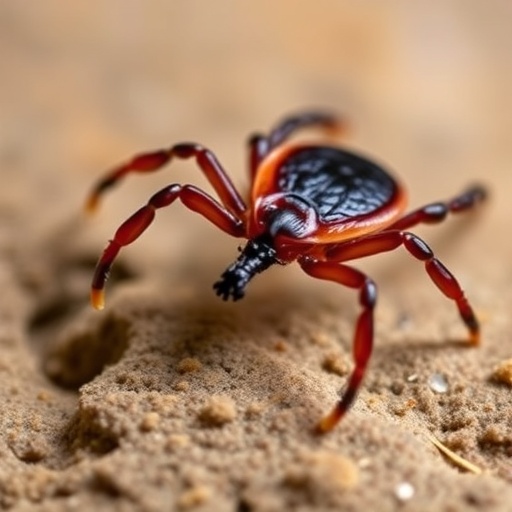
Ticks, despite their minuscule size, represent a monumental threat to global health, serving as vectors for a myriad of diseases that afflict humans, livestock, and wildlife alike. Each year, these arthropods propagate viruses and bacteria that cause debilitating infections across various species, underscoring an urgent demand for innovative strategies to halt their capacity for disease transmission. Researchers at the University of Tennessee College of Veterinary Medicine have made a significant breakthrough in this domain by identifying a tick-derived protein with the potential to impair the transmission of pathogens during feeding, paving a promising path toward next-generation vaccines and prevention tactics.
In a recent publication featured in The EMBO Journal, a distinguished periodical renowned for disseminating cutting-edge molecular biology discoveries, the team led by Professor Hameeda Sultana and alumni postdoctoral fellow Waqas Ahmed has elucidated the critical role of a glycine-rich protein contained within exosomes secreted by ticks. This protein emerges as a central player in the intricate interplay between tick vectors and their vertebrate hosts, mediating not only successful blood-feeding but also efficient transmission of viral agents. Their findings amplify the global understanding of vector biology and provide a molecular foothold to disrupt the infection cycle earlier than ever before.
This discovery emanates from years of meticulous investigation into tick salivary exosomes—nanoscale vesicles that facilitate intercellular communication via protein and nucleic acid cargo delivery. Sultana’s lab was a pioneer in demonstrating that exosomes from tick saliva and salivary glands transport a suite of proteins integral to tick feeding and pathogen transmission. These vesicles operate as stealthy messengers, enabling ticks to circumvent the host’s immune detection by delivering complex molecular cocktails that modulate host responses and assist pathogen mobility between tick and host.
Exosomes, typically ranging from 30 to 150 nanometers in diameter, encapsulate and protect their molecular payloads, making them efficient vectors of biological information. The identified glycine-rich exosomal protein stands out because of its multifunctional nature in tick physiology. Silencing the gene encoding this protein via RNA interference techniques resulted in markedly impaired tick feeding capacity, diminished engorgement weights, and significantly lowered viral loads in the host. These outcomes affirm the protein’s essential function in both nutritional acquisition by ticks and the propagation of pathogens they harbor.
Beyond its biological indispensability, this glycine-rich protein represents a promising candidate antigen for the development of a transmission-blocking vaccine. Unlike traditional vaccines aiming to elicit immunity against the pathogen itself, transmission-blocking vaccines target molecules critical to the vector’s ability to support pathogen survival or transmission, effectively severing the disease chain prior to host infection. This paradigm shift in vaccine design could revolutionize vector-borne disease control, offering broad-spectrum protection against diverse pathogens vectored by ticks.
Girish Neelakanta, a faculty collaborator on the study, emphasizes the transformative implications of these findings. He articulates how dissecting tick molecular biology unveils hitherto unexplored intervention points, thereby expanding the arsenal available for disease prevention. The study’s insights resonate with a growing scientific consensus that vector-derived molecules intricately influence pathogen acquisition and dissemination, inviting exploration into arthropod biology as a reservoir of therapeutic targets.
The ramifications extend further as exosomes are increasingly recognized as pivotal agents in host-pathogen-vector triads. Emerging research corroborates that extracellular vesicles can modulate immune responses, facilitate pathogen survival, and even alter host cellular environments to favor infection. The UT College of Veterinary Medicine’s groundbreaking work elucidates how arthropod exosomes are not mere cellular debris but sophisticated vehicles fostering pathogen-host interactions and vector competence.
In an era where tick-borne illnesses such as Lyme disease, ehrlichiosis, and Powassan virus infections are escalating in incidence and geographic range, comprehension of these microscopic molecular interactions is imperative. Current prevention primarily hinges upon acaricides, environmental management, and personal protective behaviors, which have inherent limitations in efficacy and sustainability. The molecular approach pioneered by Sultana and colleagues heralds a more precise intervention, targeting the biological underpinnings of tick feeding and pathogen transmission mechanisms.
The intricate nature of tick-host engagement is underscored by the capacity of tick saliva to immunomodulate and suppress host defenses, thereby facilitating prolonged blood meals without provoking a strong immune reaction. The exosomal glycine-rich protein elucidated in this research exemplifies a factor that enhances this stealth feeding strategy and concurrently supports viral survival and replication. Hence, neutralizing this protein could simultaneously impair tick feeding and diminish pathogen load, effectively achieving a dual blockade.
While still nascent, the notion of an arthropod exosome-based vaccine strategy is gathering momentum within the vector biology and infectious disease communities. By intercepting critical molecular exchanges at the nanoscale, researchers envision circumventing pathogen transmission with unprecedented specificity and minimal off-target impacts. This approach aligns with broader trends in precision medicine and vaccinology, where understanding host-pathogen-vector dynamics at the molecular level paves the way for tailor-made interventions.
The UT Institute of Agriculture, encompassing UT College of Veterinary Medicine and allied research arms, continues to spearhead these integrative efforts, leveraging its land-grant mission to translate fundamental molecular discoveries into practical solutions for animal and human health. Supported by the National Institutes of Health, this endeavor cements the crucial role of academic institutions in confronting public health challenges engendered by vector-borne diseases.
In sum, the identification and functional characterization of the tick exosomal glycine-rich protein open an exciting frontier in combating vector-borne illnesses. This microscopic molecule offers a chink in the armor of tick-mediated disease spread and provides hope that in the not-so-distant future, vaccines targeting vector biology may become a reality, significantly lowering the burden of tick-borne infections worldwide. As research continues to unravel the molecular dialogue between vectors and hosts, a future less burdened by these parasitic arachnids’ devastating impacts may be within reach.
Web References: https://utia.tennessee.edu, https://dx.doi.org/10.1038/s44318-026-00709-z
Cite Scienmag News
Kristina Jarvis. (May 29, 2026). Halting Ticks in Their Tracks: Breakthroughs in Tick Control. Scienmag. https://scienmag.com/halting-ticks-in-their-tracks-breakthroughs-in-tick-control/
Kristina Jarvis. "Halting Ticks in Their Tracks: Breakthroughs in Tick Control." Scienmag, 29 May 2026, https://scienmag.com/halting-ticks-in-their-tracks-breakthroughs-in-tick-control/. Accessed 4 September 2026.
Kristina Jarvis. "Halting Ticks in Their Tracks: Breakthroughs in Tick Control." Scienmag. May 29, 2026. https://scienmag.com/halting-ticks-in-their-tracks-breakthroughs-in-tick-control/


