


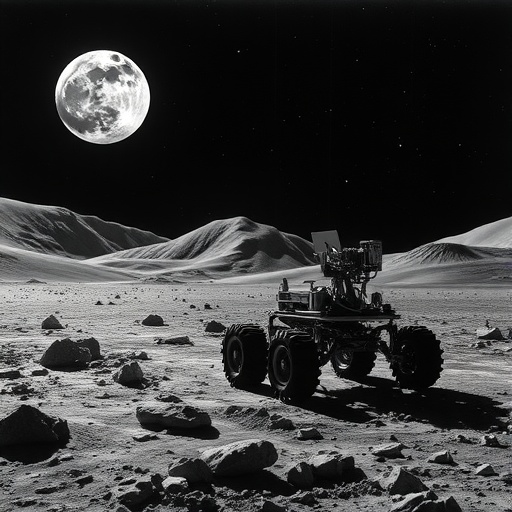
The surface of the Moon is shrouded in what scientists call lunar regolith, a deceptive term that belies its true nature. Unlike terrestrial soil, lunar regolith is a highly abrasive mixture of finely shattered rock and microscopic glass shards, born from billions of years of cosmic bombardment. This fragile dust poses formidable threats to spacecraft seals, astronaut suits, and machinery alike due to its sharp edges and the vacuum environment it inhabits. Moreover, the lunar surface endures extreme temperature variations, unfiltered solar radiation, and a complete absence of atmosphere, all of which conspire to challenge engineering ingenuity in unprecedented ways.
Lunar regolith’s exacting hostility to construction presents a monumental challenge for human colonization ambitions. For researchers at Texas A&M University, however, this unforgiving material is not a deterrent but a resource ripe for exploitation in establishing a permanent human presence beyond Earth. Recent initiatives, such as NASA’s Lunar Innovation Park, aim to pivot from expedition-style “flags and footprints” missions toward enduring settlements built utilising the Moon’s in situ resources. Dr. Patrick Suermann, professor of construction science at Texas A&M and a retired U.S. Air Force lieutenant colonel, champions this paradigm shift by advocating for construction techniques that leverage the Moon’s native materials.
Transporting construction materials from Earth to the Moon poses staggering economic barriers that threaten to cripple future space colonization plans. Estimates suggest that the launch and delivery costs can reach a staggering $1 million to $1.3 million per kilogram on the lunar surface. This cost inefficiency quickly compounds as settlement infrastructure grows. A striking example from a 2018 lunar architecture report indicates that producing rocket propellant on the Moon, rather than ferrying it from Earth, could cut expenses from $10,000 per kilogram down to a mere $500, revealing the critical importance of in situ resource utilization as a linchpin for lunar sustainability.
Texas A&M University’s role in this frontier is multi-faceted and expanding. Central to this is the Texas A&M Space Institute, under the leadership of Dr. Robert Ambrose, which is equipped with two expansive test terrains simulating both the lunar and Martian surfaces. Spanning 240 acres, this facility is uniquely positioned adjacent to NASA’s Johnson Space Center in Houston, fostering strong ties between academia, industry, and government agencies. The institute develops advanced robotics, autonomous systems, and space vehicles designed to endure the Moon’s punishing conditions and optimize construction processes remotely and autonomously.
One of the critical technological focuses lies in the intersection of robotics and human collaboration, spearheaded by the Construction Automation, Safety and Education (CASE) Lab at Texas A&M’s College of Architecture. Led by Dr. Gilles Albeaino, the lab explores how humans and robots can seamlessly function as co-workers rather than simple operators of remote machinery. In such a vacuum environment, where radiation exposure, fluctuating temperatures, and abrasive dust complicate human presence, semi-autonomous robotic systems become essential “foremen” on lunar construction sites, orchestrating the real-time manipulation of regolith and the additive manufacturing of structures via advanced 3D printing technologies.
Building infrastructure on the Moon evokes visions of robotic rovers transporting regolith across craters, robotic arms meticulously layering habitat walls with precision, and engineers on Earth managing operations through virtual reality environments. This futuristic approach requires sophisticated control algorithms, machine learning to adapt to unpredictable variables, and robust communication networks capable of compensating for time delays inherent in Earth-Moon transmissions. The CASE Lab’s research delves deep into these challenges, aiming to devise workflows where human oversight merges with robotic efficiency, overcoming the extreme constraints and hazards of lunar construction environments.
The methodologies and lessons Dr. Suermann and his team employ in lunar construction find roots in terrestrial military deployments where infrastructure was erected in similarly hostile and remote environments. Suermann’s two decades as a U.S. Air Force construction officer in austere locations such as Guam, Greenland, and Afghanistan honed his expertise in rapid, resourceful base building under extreme conditions. The fine, talcum-powder-like sand overlaying massive boulders in desert deployments, for instance, paralleled the layered challenges posed by lunar regolith. These Earth-based expeditions have informed strategies to engineer resilient structures in unforgiving scenarios and serve as a crucible for pioneering extraterrestrial construction techniques.
Utility and sustainability underpin all lunar construction efforts. Every piece of equipment and kilogram of material shipped from Earth translates directly to astronomical costs and logistical complexity. Hence, there is a pronounced drive to harness the Moon’s natural resources—not only regolith but potentially its ice deposits and mineral wealth—to fuel life support systems, generate building materials, and produce propellants on-site. This transformative approach could revolutionize the economics of living off-world, making lunar settlements economically viable and operationally autonomous.
In addition to mechanical challenges, lunar construction must grapple with unique physical phenomena absent on Earth. For example, steel and other metals risk warping under the Moon’s intense thermal flux, oscillating between searing daytime heat and bone-chilling nights in the absence of atmospheric moderation. Radiation, unfiltered by atmospheric protection, permeates all surfaces, requiring innovative shielding solutions integrated into habitat design. Lunar dust’s electrostatic charge causes it to cling tenaciously to surfaces and infiltrate mechanical components, necessitating novel dust mitigation technologies to ensure operational longevity.
Texas A&M’s interdisciplinary approach emphasizes that excellence in lunar construction hinges on bridging multiple fields—mechanical engineering, robotics, materials science, architecture, and computer science. By blending simulations with hands-on experimentation in controlled environments, researchers seek to translate theoretical models into practical applications. The synergy between energy-efficient robotics, regenerative life support, and advanced materials science will ultimately define humanity’s capacity to build sustained presence on the Moon.
Looking toward the future, NASA’s goal to establish a lunar base by 2040 aligns with Texas A&M’s mission to mold a generation of engineers and scientists prepared for off-world challenges. The university’s comprehensive program integrates foundational construction principles with cutting-edge space technology, inspiring a new cadre of “settler-builders” dedicated to transcending traditional exploration. As Dr. Suermann succinctly puts it, the Moon will no longer be a place to visit briefly but an environment where humanity builds enduring homes—layer by layer, particle by particle, starting with lunar regolith.
Houston, Texas – Positioned as a beacon of space innovation, Texas A&M University stands at the forefront of humanity’s quest to transform the lunar surface from an inhospitable expanse into a thriving settlement. By pioneering construction approaches that meld human creativity with robotic precision, and by leveraging the Moon’s own resources, their work charts a path not merely to visit but to inhabit—ushering a new era in extraterrestrial civilization. Each advancement in understanding and technology builds toward a monumental milestone: a self-sustaining presence in the cosmos, grounded on lunar soil, redefined as regolith.
News Publication Date: 2026 (coinciding with Earth & Space 2026 conference)
Web References:
– NASA’s Lunar Surface Innovation Initiative: https://www.nasa.gov/space-technology-mission-directorate/lunar-surface-innovation-initiative/
– Texas A&M Space Institute: https://stories.tamu.edu/stories/launching-the-future-texas-ams-space-institute-will-be-a-hub-for-innovation-and-exploration/
– Dr. Patrick Suermann’s profile: https://engineering.tamu.edu/mtde/profiles/suermann-patrick.html
– 2018 BBC Report on Lunar Architecture: https://www.bbc.com/news/science-environment-58608295
Cite Scienmag News
Denise Maddox. (May 29, 2026). Rovers, Regolith, and Robots: Crafting the Blueprint for Lunar Exploration. Scienmag. https://scienmag.com/rovers-regolith-and-robots-crafting-the-blueprint-for-lunar-exploration/
Denise Maddox. "Rovers, Regolith, and Robots: Crafting the Blueprint for Lunar Exploration." Scienmag, 29 May 2026, https://scienmag.com/rovers-regolith-and-robots-crafting-the-blueprint-for-lunar-exploration/. Accessed 4 September 2026.
Denise Maddox. "Rovers, Regolith, and Robots: Crafting the Blueprint for Lunar Exploration." Scienmag. May 29, 2026. https://scienmag.com/rovers-regolith-and-robots-crafting-the-blueprint-for-lunar-exploration/


