


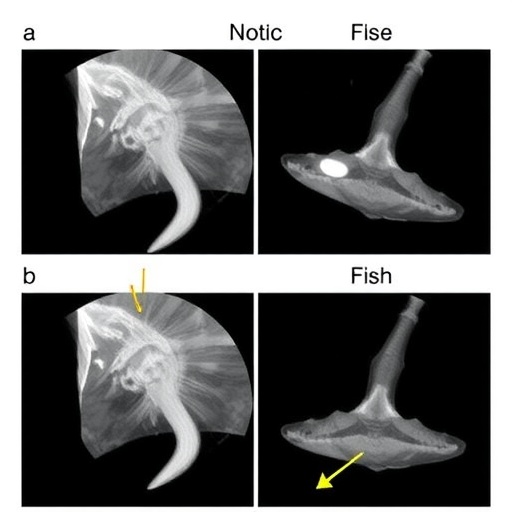
The clinical management of deeply embedded cervical fish bone foreign bodies remains a formidable challenge within otorhinolaryngology. These foreign bodies often evade early detection due to their invisibility under conventional endoscopic examination and limited resolution of standard imaging modalities. This diagnostic obscurity frequently leads to missed diagnoses and necessitates invasive surgical exploration, which carries significant risks of complications, including persistent symptoms, chronic fistula formation, and recurrent infections. The inability to precisely localize these foreign bodies in real-time further complicates their safe and effective removal.
In a groundbreaking development, a multidisciplinary team led by Zhangfeng Wang introduced a revolutionary, minimally invasive rescue technique that leverages ultrasound guidance combined with endoscopic retrieval to manage refractory cases of deeply embedded cervical fish bones. This innovative approach was detailed in a recent publication in ENT Discovery, where the authors meticulously documented a clinical case involving a 27-mm cervical fish bone foreign body that resisted removal despite prior failed open surgical exploration. The precision of ultrasound imaging provided unparalleled real-time visualization of the foreign body’s exact anatomical position, facilitating targeted endoscopic retrieval with minimal tissue disruption.
Ultrasound, long esteemed for its dynamic imaging capabilities and absence of ionizing radiation, served as the cornerstone of this method, enabling continuous navigation and soft-tissue localization during the retrieval process. This real-time visualization supersedes the constraints of traditional radiography, CT, or MRI, which either lack sufficient resolution for small foreign bodies or pose logistical and radiation exposure concerns. By situating ultrasound at the forefront of surgical navigation, the technique mitigates risks associated with blind exploration and excessive tissue trauma, standard in open surgical attempts.
The procedural synergy between ultrasound and endoscopy underscores a new paradigm: combining high-resolution imaging with minimally invasive instrumentation to maximize precision and patient safety. The ultrasound probe delineates the foreign body’s locus within cervical tissues, providing a live map that endoscopic instruments follow through the pharyngeal passage. This minimizes collateral damage to surrounding nerves, vasculature, and musculature, significantly reducing operative morbidity. The case report highlighted complete symptom resolution and fistula healing post-procedure, attesting to its therapeutic efficacy and safety profile.
Traditional open surgical techniques for deeply embedded fish bones frequently culminate in incomplete removal due to the complex anatomy and limited visibility within the cervical fascial planes. Such incomplete extraction exacerbates inflammation, fosters persistent infections, and prolongs patient morbidity. The ultrasound-guided endoscopic technique, by contrast, addresses these deficiencies by affording a minimally invasive corridor directly to the embedded foreign body with enhanced spatial accuracy. This innovative approach helps circumvent the perils of open neck exploration, ushering in a less traumatic and more reliable management avenue.
Importantly, the real-time feedback loop offered by ultrasound imaging empowers surgeons to dynamically adjust their approach during retrieval, contrasting with static preoperative imaging that does not account for intraoperative shifts or patient movements. This adaptability enhances operative confidence and outcomes, particularly in anatomically complex or scarred tissue planes where traditional techniques falter. Moreover, the absence of ionizing radiation aligns with the principles of ALARA (As Low As Reasonably Achievable), promoting patient safety, especially in repeated or prolonged procedures.
The implications of this work extend beyond fish bone retrieval. The fusion of ultrasound guidance with endoscopic interventions portends a broader clinical utility in managing a variety of deeply embedded cervical foreign bodies and lesions. This technology-driven shift advocates for increased integration of ultrasonographic navigation in head and neck surgery, potentially transforming standard protocols toward more precise, less invasive interventions with reduced complication rates.
From a technical standpoint, the execution of such ultrasound-guided endoscopic retrieval demands proficiency in both ultrasonography and endoscopic operative techniques. Surgeons must attain expertise in interpreting cervical ultrasound images—including distinguishing foreign bodies from anatomical landmarks—and seamlessly translating this knowledge into endoscopic navigation. This multidisciplinary skill set, while challenging, is pivotal to harnessing the full potential of this innovative approach.
The study by Hang Li, Lin Chen, Wenbin Lei, and Zhangfeng Wang marks a seminal contribution to otorhinolaryngology, illustrating how modern imaging modalities can redefine complex foreign body management. Their publication in ENT Discovery (Vol. 2, Issue 1, Pages 52-56, 2026) serves as a practical reference guiding clinicians toward more refined, patient-centric approaches. By reducing the reliance on invasive exploratory surgeries, this technique not only improves clinical outcomes but also enhances patient comfort and recovery trajectories.
Encouragingly, the successful application of this surgical salvage method invites further research into optimizing ultrasound parameters, refining endoscopic instruments, and expanding procedural indications. Investigations into integration with three-dimensional ultrasonography or contrast-enhanced imaging may further augment localization precision. Similarly, randomized controlled trials comparing this novel method against conventional interventions would provide robust evidence to inform clinical guidelines.
In conclusion, ultrasound-guided endoscopic retrieval offers a pioneering, minimally invasive solution for the complex clinical problem of deeply embedded cervical fish bones, especially following failed open explorations. This innovation harmonizes advanced imaging technology with surgical finesse, delivering enhanced safety, accuracy, and therapeutic success. As otorhinolaryngology evolves, strategies such as this represent the future of precision surgery – less invasive, highly targeted, and attuned to the nuances of individual patient anatomy and pathology.
News Publication Date: 30-Mar-2026
Web References: https://doi.org/10.15302/ENTD.2026.030004
References: Hang Li, Lin Chen, Wenbin Lei, Zhangfeng Wang. Ultrasound-Guided Endoscopic Retrieval of a Deeply Embedded Cervical Fish Bone After Failed Open Exploration: A Minimally Invasive Salvage Technique. ENT Discovery, 2026, 2(1): 52-56.
Cite Scienmag News
Ophelia Keating. (May 29, 2026). Minimally Invasive Ultrasound-Guided Endoscopic Retrieval of Deeply Embedded Cervical Fish Bone Following Unsuccessful Open Surgery. Scienmag. https://scienmag.com/minimally-invasive-ultrasound-guided-endoscopic-retrieval-of-deeply-embedded-cervical-fish-bone-following-unsuccessful-open-surgery/
Ophelia Keating. "Minimally Invasive Ultrasound-Guided Endoscopic Retrieval of Deeply Embedded Cervical Fish Bone Following Unsuccessful Open Surgery." Scienmag, 29 May 2026, https://scienmag.com/minimally-invasive-ultrasound-guided-endoscopic-retrieval-of-deeply-embedded-cervical-fish-bone-following-unsuccessful-open-surgery/. Accessed 3 September 2026.
Ophelia Keating. "Minimally Invasive Ultrasound-Guided Endoscopic Retrieval of Deeply Embedded Cervical Fish Bone Following Unsuccessful Open Surgery." Scienmag. May 29, 2026. https://scienmag.com/minimally-invasive-ultrasound-guided-endoscopic-retrieval-of-deeply-embedded-cervical-fish-bone-following-unsuccessful-open-surgery/


