


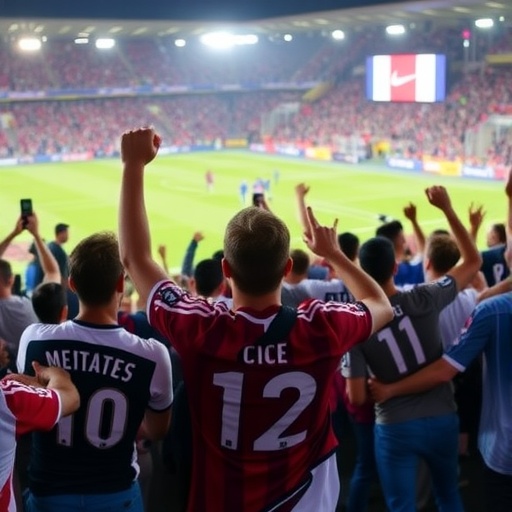
In the dynamic landscape of European football, social scientists are unveiling a nuanced layer of collective identity that transcends local club allegiances. Recent research illuminates how fans craft multilayered social bonds not only within their hometown teams but also at national and supranational European levels. This emerging European fan identity challenges traditional assumptions that football fandom is narrowly rooted in discrete, localized communities, offering new perspectives on social cohesion and cultural integration within Europe’s most beloved sport.
At the heart of this inquiry lies the observation that football fans frequently report significant identification with not just their club but also with the larger national and European fan communities. Of these, allegiance to the local club remains predominant, reflecting deep-seated cultural and historical ties that anchor fandom in place and tradition. However, the fact that notable levels of identification are reported with European fan communities signals that football supporters conceive of their social identities well beyond county or national borders. This reveals the existence of a superordinate fan identity layer that is psychologically distinct from local or national affiliations, suggesting fans possess a “dual identity” that overlaps multiple spatial and social scales.
The theoretical underpinning of this phenomenon finds resonance in the Common In-Group Identity Model (CIIM), which posits that collective identification can evolve beyond immediate in-groups toward broader, more inclusive communities. Football fandom, a cultural institution deeply woven into Europe’s social fabric, emerges here as a potent site for constructing such identities. Fans’ simultaneous connection to club, country, and Europe illustrates how supranational fan identity can coexist with, rather than replace, more proximate allegiances, weaving a “marble cake” of overlapping affiliations.
Delving deeper, regression analysis uncovers the demographic, political, and sport-related factors associated with European fan identification, painting a complex portrait of who these fans are. Notably, female fans showed marginally stronger European identification compared to males, contradicting prior studies that often link stronger European political affinity with men. This gender differential may reflect unique cultural socializations within football fandom distinct from broader political trends.
Age also emerges as a defining characteristic: younger fans, socialized in a more interconnected and cosmopolitan Europe, displayed heightened European fan identification. This aligns with existing research documenting greater European Union support among younger cohorts who navigate diverse cultural and physical spaces with fewer national barriers. Educational attainment further correlates positively with supranational fan identification, highlighting the role of cultural capital in facilitating openness to broader, more inclusive social identities that extend beyond parochial limits.
Political and affective dimensions play an equally vital role. Emotional attachment to Europe and the European Union strongly predicts belonging to the European fan community, emphasizing that affective bonds underpinning identity are crucial in transcending nation-state boundaries. This is paralleled in other European subcultural groups, such as LGBTQI+ communities, where pan-European cultural events have catalyzed distinct supranational identity formations through shared experience and representation.
Moreover, interpersonal and group-specific trust emerges as a significant predictor. Trust in European fans themselves—not merely generalized social trust—intensifies identification, signaling how specific affective-relational ties within a sports community underpin superordinate identity construction. This particularized trust stresses that European fans recognize fellow supporters as in-group members, fostering a sense of belonging that transcends anonymity.
Interestingly, cosmopolitan values, typically associated with universal tolerance, exhibited a small but statistically significant negative correlation with European fan identification. This counterintuitive finding hints at a more grounded form of community belonging rooted in concrete cultural practices—such as football fandom—rather than abstract globalist ideals. It suggests that the emotional and symbolic glue binding fans is more intimately tied to shared cultural experience than universalist principles.
Political orientation contributes further nuance: right-leaning respondents reported stronger European fan community identification despite broader socially documented Euroscepticism within right-wing political camps. This paradox may reflect football fans’ affinity for clearly defined group identities and collective belonging, facets prized in certain conservative value systems, enhancing the appeal of a pan-European fan identity within this subpopulation.
Football-specific behaviors also provide meaningful insight. Fans who exhibit greater general interest in football, regularly follow European competitions beyond club loyalty, and engage with foreign leagues show stronger ties to the European fan community. These consumption patterns enhance exposure to diverse clubs, players, and fan cultures, thereby facilitating community formation that crosses national borders. The internationalization of football media and fandom thus serves as a vehicle for constructing shared European identities.
Critically, trust in fellow European fans dominates as one of the most robust factors associated with this supranational identitarian layer. This reinforces the view that collective identity formation is deeply relational and affect-driven. Additionally, the normative dimension—fans’ advocacy for common representation—underlines the linkage between identity and political agency within supranational fandom, echoing the theoretical assertion that shared goals and cooperative norms underpin superordinate group cohesion.
Conversely, negative perceptions of fans and critiques of European football governance showed no significant impact on European fan identification. This dissociation suggests fans can maintain robust collective identities while holding critical views of constituent groups or institutional authorities, underlining a conceptual boundary between fan community and organizational governance structures within football.
Country-specific contexts influence the strength of European fan identification. In Norway, weaker identification aligns with the nation’s more distanced relationship to EU integration and a peripheral domestic football scene, highlighting how both political integration and sporting ecosystems shape fan identity. Germany’s comparatively reduced identification may stem from entrenched national fan cultures, which potentially diminish the appeal of supra-national community formations.
Some interpretations could posit that football fans might be oriented toward global rather than European identities, given football’s worldwide popularity. However, the present data counter this by demonstrating stronger ties to Europe specifically, as evidenced by positive attachments to Europe and the EU and the negative correlation with generic cosmopolitan values. Moreover, UEFA’s governing role and integrated European football media markets lend institutional boundedness that nurtures uniquely European identity contours absent in a mere global fan perspective.
The observed national variation in European fan identity should not discredit the existence of a shared identity but reflect its multifaceted and contextually modulated reality. European identity here is nested within national identities—an interwoven fabric rather than a monolithic whole—manifesting with different intensities according to local institutional, cultural, and demographic factors.
Acknowledging that European fan identity partly reflects socioeconomic privilege is vital. Higher education and practices like attending away matches relate to greater identification, underscoring how participation in this supranational community likely requires resources enabling cross-border mobility and cultural engagement. This echoes broader patterns in European integration research where identity dimensions often vary alongside socioeconomic inequalities.
Methodologically, the study refrains from asserting causal claims due to its cross-sectional design but suggests likely bidirectional dynamics, especially between football-related engagement and European fan identification. These interrelations underscore a complex interplay where stronger supranational identification might promote increased football interest and vice versa, highlighting the recursive nature of identity formation and cultural consumption.
Ultimately, this research enriches our understanding of layered collective identities within Europe’s social sphere. It demonstrates that European fan identity exists not as a marginal curiosity but as a substantial, multidimensional phenomenon extending across demographics and national borders. Deeply embedded in shared cultural practices, affective bonds, and collective political agency, this supranational identity represents a critical expansion of fans’ social imaginaries.
The European fan community emerges as a powerful example of social cohesion forged from everyday leisure activities rather than formal political institutions. Encompassing a large segment of European citizens—over half of the surveyed population identified as football fans, with many expressing significant European fan identity—this collective offers a “thinly” but meaningful connection that supports broader notions of a European social fabric.
Compared to more elite or narrowly targeted European integration initiatives like Erasmus or the European Capital of Culture, football’s reach is broader and more populist. Its capacity to foster superordinate identifications bottom-up places it uniquely as a cultural engine of European social cohesion, illustrating processes of identity transformation amidst ongoing Europeanisation.
The findings contribute rich empirical validation to theoretical models of superordinate identity formation, revealing how cultural domains such as sport enable complex identity layering and overlapping affiliations. They highlight football fandom as a vibrant locus for studying European integration beyond formal political arenas—where affective belonging, social trust, and collective agency dynamically intertwine in shaping continental identities.
As Europe continues to grapple with questions of unity, diversity, and belonging, the lenses of football fandom offer a compelling window into grassroots processes of social cohesion. This research underscores the transformative potential of cultural engagement in advancing supranational identities, emphasizing the importance of nurturing inclusive, emotion-rich communal spaces that transcend national divides. Through football, millions of Europeans find a shared community—a palpable manifestation of collective belonging that illuminates pathways toward a more cohesive European society.
Cite Scienmag News
Courtney Benton. (May 29, 2026). European Fans Forge Common Identity Through Football. Scienmag. https://scienmag.com/european-fans-forge-common-identity-through-football/
Courtney Benton. "European Fans Forge Common Identity Through Football." Scienmag, 29 May 2026, https://scienmag.com/european-fans-forge-common-identity-through-football/. Accessed 3 September 2026.
Courtney Benton. "European Fans Forge Common Identity Through Football." Scienmag. May 29, 2026. https://scienmag.com/european-fans-forge-common-identity-through-football/


